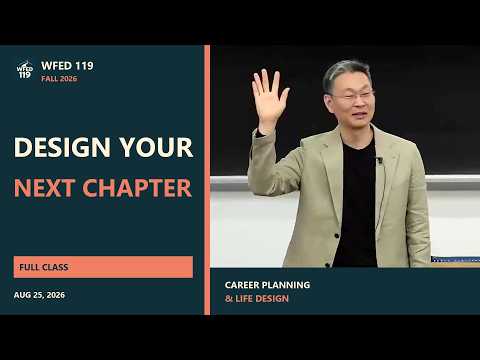
Design Your Next Chapter: Career Planning & Life Design | WFED 119 | Aug 25, 2026
Overview
Dr. Yoon introduces WFED 119 as a hands-on process for designing a personal life plan and completing a meaningful community project. Students use career bingo, a dream-tree framework, reflection, and the My Life as a Book assignment to connect values, strengths, purpose, goals, and practical strategies; they can use LiveCraft AI or a workbook, with a cited study of about 60 volunteers finding higher future-oriented forethought among AI users but little difference otherwise.
Key takeaways
- Students can build career readiness through varied experiences such as internships, mentoring, study abroad, and informational interviews; Dr. Yoon recommends at least 10 informational interviews before graduation.
- The dream-tree framework connects terminal values and life purpose with instrumental values, strengths, goals, strategies, and desired outcomes.
- My Life as a Book turns long-term life design into a practical assignment: students create a slide-based memoir with a title, chapters, and preface, then revise and present it.
- LiveCraft AI is the default course option, but a workbook alternative is available; a prior study of about 60 student volunteers found higher forethought among AI users and mostly no other group differences.
- WFED 119 combines individual planning with collective action: teams pursue a meaningful community mission, share responsibilities, report real progress, and receive peer evaluations twice.
- Penn State students can use Career Services for resume and LinkedIn feedback, including 15-minute drop-in counseling, and use LionLink or LinkedIn to connect with potential mentors.
Chapters
- The session opens with repeated microphone checks before the sound begins working.
- Dr. Yoon starts the course welcome at about 2:10.
- Dr. Yoon says students will develop a purpose statement based on values, strengths, personality, and energy flow during the first four weeks.
- LiveCraft AI is the default course tool, but students can opt out and use a workbook instead.
- In a previous study of about 100 students, around 60 volunteered; AI and non-AI groups showed mostly similar outcomes, while AI users reported higher forethought.
- Top Hat will track attendance and participation through course activities.
- Students spend 12 minutes meeting classmates and recording names for people with experiences matching career-bingo prompts.
- The activity encourages students to make horizontal, vertical, or diagonal lines while learning about peers' career development.
- Technical audio problems interrupt parts of the activity, but students continue talking and filling in their sheets.
- Students discuss experiences they hope to have, including camp counseling, factory work, landscaping, and living abroad.
- One student describes work at a Florida plastic-injection-molding company that produced medical devices, including Botox syringes.
- Other examples include earning more than $1,000 in a month through landscaping, studying in Croatia, considering study abroad, and completing an internship.
- A student interested in teaching describes learning from a kindergarten-teacher mentor through thesis work and a school visit.
- Students circle experiences they want to pursue during college and consider building a personal list of career-development opportunities.
- Dr. Yoon argues that varied experiences help students understand the world of work and develop a clearer sense of themselves.
- Penn State Career Services offers resume and LinkedIn feedback, including 15-minute drop-in counseling.
- LionLink and LinkedIn can help students find industry mentors; Dr. Yoon recommends completing at least 10 informational interviews before graduation.
- The dream-tree analogy links foundational values and purpose to plans and the desired outcomes students hope to achieve.
- Dr. Yoon distinguishes terminal values, the ends people ultimately pursue, from instrumental values, the means they use to pursue them.
- The course emphasizes attendance, peer conversations, and teamwork as students explore their life plans.
- The community project asks teams with varied backgrounds to choose a meaningful mission, develop ideas, and present results.
- The course develops students' foundations through stories about strengths and recurring life themes, alongside some standardized assessments.
- Dr. Yoon contrasts familiar tools such as the Big Five and Myers-Briggs with the Enneagram, which uses nine types.
- The dream-tree roots and trunk represent foundations such as values, purpose, strengths, and preferred ways of working.
- Students use those foundations to envision a future and identify strategies for reaching it.
- Dr. Yoon introduces Rick Snyder's hope theory and identifies goals as a central component of hope.
- Students envision their lives 10, 20, or 30 years ahead, including possibilities beyond age 60.
- My Life as a Book asks students to create a condensed autobiography or memoir in slide format, with a title, chapters, and preface.
- The book is a major midterm submission and later becomes a recorded presentation; Dr. Yoon cautions students to keep personal stories genuinely their own rather than outsourcing them to AI.
- Students develop a dream list, goals, plans, options, and strategies that they can revisit after the semester.
- Dr. Yoon connects life planning to his professional work in talent and organization development, including goal setting and performance management.
- The course is designed as a hands-on studio centered on discovery, reflection, and candid conversations about personal goals.
- Teams will assign specific responsibilities such as leader, HR contact, strategist, and timekeeper.
- Top Hat will be used for attendance, an opening check-in question, and an end-of-class reflection.
- Dr. Yoon says the course is not designed for last-minute cramming and emphasizes consistent attendance and participation.
- The final exam is an online reflection about students' experiences and learning, scheduled for the Tuesday class time, with an accommodation for conflicting exams.
- The My Life as a Book midterm is submitted through Canvas during a week without a class meeting.
- The course is classified under general health and wellness and considers financial, occupational, intellectual, spiritual, and relational dimensions.
- Early work explores hopes, values, purpose, and mission before moving to life roles, strengths, and future stories.
- Students apply the course's planning process across multiple areas of life rather than focusing only on career choice.
- Students use SWOT analysis to identify strengths, weaknesses, opportunities, and threats, then combine them to form strategies.
- A life-design routine exercise asks what to eliminate, reinforce, reduce, or create in daily habits.
- Grades include the My Life as a Book midterm, roughly nine to ten weekly assignments, Top Hat participation, peer evaluation, a reflective final, and a recorded final book presentation.
- Peer evaluations count for 15% and occur twice, giving teammates feedback on contribution and opportunities to improve.
- The team project may take 30% to 40% of students' effort and applies human agency at the collective level.
- Teams report actual progress on a community-focused project and present their action-learning results near the end of the semester.
- Project scope should be sized realistically around students' other courses and commitments.
- Students who complete three AI-study assessments, at the start, around midterm, and near the end of the semester, can earn 5% bonus points.
- Students may volunteer for filmed front-of-class conversations to earn participation bonus points.
- Dr. Yoon asks students to read the Top Hat instructions and be ready to use the system in the next session.
Transcript excerpt
1:27 Hello everyone. Can you hear me? Okay. Or is it working? Hello. Hello. Uh, it doesn't seem to work, right? >> Yeah. So let me Oh hello. This is better right. Okay. >> Okay. Welcome to uh work proet 119. Um this is about career planning and life
2:16 design as the course title indicates. Um how many of you have um your life plan already set? Oh wow, that's cool. All right. So what do you want to be or what? Yeah, I'm >> finance major. Mhm. [clears throat] I >> already have uh applied for some companies work as a to be trained at work. Okay. And somehow Okay. Back home at Saudi. >> Okay. Oh, cool. Great. Thank you. And how many of you have um mission statement uh or life purpose statement? Okay, that's good because uh you will develop one uh through this course um based on your innate uh personality type
3:06 and energy flow and also uh your values and also strength. So that will come within the first maybe four weeks or so. Um let's see and we will do some activity today um at the very beginning. My name is uh Hungjun Yun, Dr. Jun Yun. Um, also I go by Jun. So you can call me Jun or Dr. Yun, whichever you prefer. And this course is being uh broadcasted. So how many of you have seen um some social media channels uh related to this course? Oh very very few. Okay. Cool. Cool. So uh there will be uh media release form uh to be distributed. So um some of you
3:56 may be filmed uh later on. So if you feel if you don't feel comfortable uh you don't have to sign but there will be uh occasions where some of you will come
This is the start of the transcript. Save this video free for the whole transcript, searchable and time-coded.
In this course
Related notes
Summary, takeaways, and chapters were generated by AI from the video's transcript and may contain errors. The video belongs to its creator, Career Planning and Life Design.