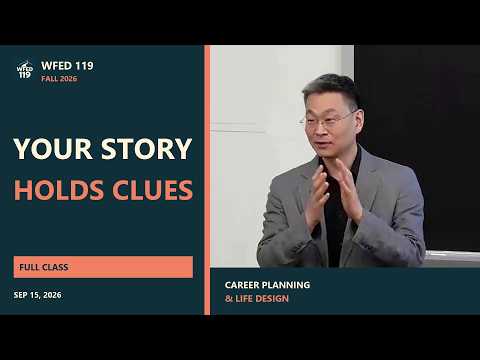
What Do Your Stories Reveal? Finding Your Life Themes | WFED 119 | Sep 15, 2026
Overview
WFED 119 uses the Career Construction Interview to help students identify life themes by comparing stories, preferences, role models, and early memories. In a live demonstration, sophomore Hussein connects Muhammad Ali, Vinland Saga, My Hero Academia, sports, creative work, and family memories to themes including problem solving, overcoming obstacles, peace, and natural beauty; students then conduct partner interviews and compare human analysis with an AI platform.
Key takeaways
- A Career Construction Interview can uncover life themes by comparing several kinds of evidence, including admired people, favorite media, hobbies, remembered sayings, school subjects, and early memories.
- Theme analysis works by identifying commonalities across different stories; Hussein's sports, coding, and role-model examples all supported problem solving or overcoming obstacles.
- A useful distinction in Hussein's demonstration was between a process, overcoming obstacles, and an outcome, choosing peace.
- Hussein's creative interests were specific: ceramics and coding involved making or solving something from scratch, while photography centered on finding natural beauty.
- The class treats AI as a second opinion for identifying recurring themes, while requiring students to make their own judgments and write their own reflections.
- Students' partner notes support the assignment, but each student remains responsible for submitting their own stories and themes by Sunday.
Chapters
- The instructor polls students by Enneagram type, including types one through nine, to guide future team assignments.
- About 43 students prefer to remain with the same Enneagram type, although that preference may not fit the class's goal of creating diverse teams.
- The instructor aims to form four teams with all different Enneagram types, alongside 12 additional teams of six or seven students.
- Students can choose project topics but not teams; if a topic is oversubscribed, a student's second or third choice may determine placement.
- Team composition may account for major, grade level, gender, ethnicity, Enneagram type, and other factors.
- Interns, guests, and AI help strengthen initial project proposals before students narrow roughly 30 ideas to 12.
- The instructor expects to announce teams the following Tuesday, after the class prioritizes topics on Thursday.
- Students who want to stay together can coordinate by choosing the same project topic, though team size may require splitting groups.
- The class shifts to finding life themes through a Career Construction Interview worksheet rather than a conventional PowerPoint lecture.
- Students will listen for the essence of a partner's stories and later identify recurring ideas across different answers.
- The instructor invites a volunteer for a recorded demonstration and cautions that sharing candid personal stories requires comfort with being recorded.
- Hussein, a sophomore studying AI engineering and identifying as Enneagram type 7, names Muhammad Ali and Thorfinn from Vinland Saga as role models.
- He admires Ali for standing up for his beliefs and Thorfinn for learning to choose peace over violence.
- Hussein says both figures' struggles taught him about overcoming obstacles and becoming a better person.
- Hussein describes My Hero Academia as a story about gaining power, helping people, and being willing to give up power for the greater good.
- He describes Vinland Saga as a story of a boy shaped by war who learns that a true warrior chooses peace.
- The class distinguishes the process, overcoming obstacles, from the desired outcome, choosing peace.
- Hussein spends free time playing tennis and pickleball, rock climbing, running, and watching anime.
- Tennis appeals to him because it creates a clear one-on-one challenge; climbing tests his own abilities, and running with others adds a competitive element.
- The instructor links these activities to the recurring idea of overcoming challenges.
- Hussein recalls a Quran verse about remembering a higher power, noting that some things are beyond personal control.
- He enjoyed ceramics, coding, and photography: ceramics and coding let him make something from scratch or solve a problem, while photography offered a calm way to find natural beauty.
- He disliked math, biology, and chemistry because he did not see the same kinds of problems to solve; he prioritizes problem solving over a broader creativity label.
- Hussein recalls a trick-shot video in which a basketball rebounds off a lawn mower and hits his younger brother, a moment he still finds hilarious.
- He also remembers his sister running over his brother in a non-serious incident and describes the memory humorously.
- His first remembered visit with grandparents from the Middle East involved his first plane trip and a strong feeling of mutual love.
- The instructor describes theme-finding as qualitative content analysis: look for commonalities across stories and group related examples.
- The class identifies overcoming obstacles, peace, problem solving, creativity, and natural beauty, then asks Hussein to rank the ideas.
- Hussein places problem solving first, creativity second, and natural beauty third; peace and overcoming obstacles also recur in his examples.
- The instructor introduces the idea that people may actively master patterns connected to what they passively suffered, while noting that Hussein's recollections are mostly humorous or positive.
- After the demonstration, students pair up and spend about 15 minutes interviewing each person using the worksheet.
- Partners are asked to capture recurring ideas and share their notes so each student can complete their own story and theme submission.
- The instructor frames the peer notes as useful evidence for students' individual assignment work.
- At 43:18, the instructor clarifies that students submit their own themes and stories, while partners provide notes to support that work.
- Students must use the course AI platform to compare themes found by a human partner with patterns detected by AI.
- At 54:36, the class switches to round two, with students changing roles and managing the remaining interview time.
- Students are asked to finish the worksheet and submit their themes and stories by Sunday, using the course AI platform to double-check the analysis.
- The instructor says AI may detect a theme a human partner missed; students can capture the results page and paste a screenshot into their submission.
- Reflection questions must be answered personally, not generated by AI, because the reflection is intended to come from the student.
- Examples of themes from the class include overcoming obstacles, creativity, problem solving, and peace.
Transcript excerpt
0:12 [snorts] I'm not sure. >> [laughter] >> Okay. Okay, let's um move on to the
1:30 next. [clears throat] There are four options. Wow, it's very interesting. So, 43 of
2:44 you want to stay with the same anagram type. Wow. Are you done? Can you raise your hand if you are type one? Okay. Type one. You're okay. Type two. All right. Type three.
3:34 Okay. Four. Okay. Five. Okay. Six. Okay. Seven. All right. Nine. No. Eight. I'm sorry. [laughter] Eight. Again. Five of you. Okay. And at 9. Okay. Cool. Um and and I will end what happened. So let's see. Okay. My my uh goal is to have at least four teams um with all different enog types. So I
4:25 will try to honor your preference but looking at the results about half of the class wants to stay want to stay with the same type. So that may not happen to you. Some of to some of you for some of you it will happen but some of for some of you it will not happen. So that's something I can share and um observing the team the four teams of nine different personality types will be interesting and on the other hand I will also try to help you to stay together but one way that you can do it uh if you want to stay together is that we'll prioritize um those uh project ideas on f uh on Thursday this week. So if you want to stick together, you can choose the same project. So that's how you can you can
5:14 do so. But for each team other than the nine uh nine typed uh teams, each team will have six to seven members only. So um you you may need to split. So we'll
This is the start of the transcript. Save this video free for the whole transcript, searchable and time-coded.
In this course
Related notes
Summary, takeaways, and chapters were generated by AI from the video's transcript and may contain errors. The video belongs to its creator, Career Planning and Life Design.