Personal SWOT: Turn Your Vision Into Strategies | WFED 119 | Oct 20, 2026
 Watch on YouTube →
Overview
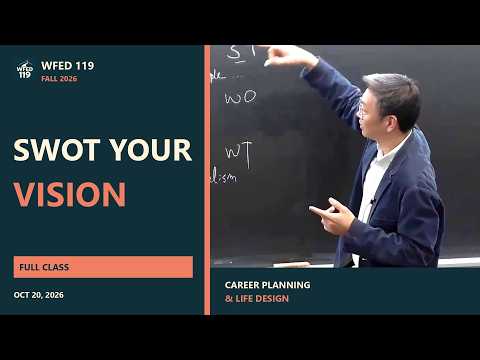
The class turns students’ personal visions into actionable plans using SWOT analysis: identify internal strengths and weaknesses, external opportunities and threats, then combine them into SO, ST, WO, and WT strategies. The instructor models the process with a goal of helping 10 million people achieve their dreams, recommends researching factors and using AI to brainstorm, and asks students to prioritize three strategies; the session also covers team-project action planning and peer feedback.
Key takeaways
- A personal SWOT is useful only when tied to a specific destination: choose one meaningful vision milestone before listing strengths, weaknesses, opportunities, and threats.
- The SWOT categories distinguish personal factors from environmental ones: strengths and weaknesses are internal, while opportunities and threats include trends, institutions, regulations, and networks.
- The four SWOT combinations generate different action questions: use strengths to exploit opportunities, use strengths to reduce threats, address weaknesses through opportunities, and limit weaknesses while managing threats.
- A large vision can motivate sustained effort and attract help, but it may require collective action through collaborators, a company, an organization, or government.
- Strategy development should include research and environmental scanning, not intuition alone; AI can help investigate societal, technological, and political changes relevant to a chosen goal.
- Students should brainstorm broadly, select their top three strategies, and translate those priorities into goals while also acting on team projects and using peer feedback to improve collaboration.
Chapters
0:00
Class Check-In Before Moving Beyond the Midterm
- Students are asked whether they need more time to finish their current work.
- The instructor closes the work period before introducing the next stage of the course.
5:00
From Midterm Future Stories to a Plan for Getting There
- Students have submitted midterm future stories, and the instructor congratulates them on completing the assignment.
- The next challenge is turning those stories into action by breaking large ambitions into smaller steps and choosing priorities.
8:00
Select One Vision Milestone Before Starting SWOT
- The instructor revisits the mission statement, values, and vision statement from students’ earlier work.
- Students are asked to choose one attractive, important milestone as the destination for their SWOT analysis.
- The instructor recommends using a professional milestone when it connects meaningfully to school and career plans.
12:00
Yashi Connects an Astronaut Goal to a Pink Airline Vision
- Yashi describes a vision of making education and physical fitness accessible to everyone, alongside becoming an astronaut and starting a company.
- The instructor suggests that Yashi’s symbolic image of a pink airplane airline could serve as a focused vision statement.
- Yashi identifies excellent grades, relevant training and experience, and physical fitness as requirements for becoming an astronaut.
15:00
The 10 Million Dreams Vision as a Long-Term North Star
- The instructor’s vision is to help 10 million people identify their dreams and make them come true, an aim formed around 2005 or 2006 before doctoral study in the United States.
- The 10 million figure was inspired by the then-estimated 40 million population of South Korea.
- A compelling vision can sustain personal effort and attract collaborators; large goals may require teams, organizations, or government action.
18:00
Personal SWOT: Internal Factors, External Conditions, and Four Strategy Types
- SWOT is applied to a person’s own life and career rather than to a business or product.
- Strengths and weaknesses are internal factors; opportunities and threats come from the surrounding environment.
- The four combinations are SO, ST, WO, and WT strategies, which are used to generate possible actions toward a chosen vision.
21:00
Assess Strengths and Weaknesses Against the 10 Million Goal
- Students identify possible strengths for the instructor’s goal, including academic background, logical thinking, a platform, and determination.
- Potential weaknesses include being one person with limited time, budget, resources, and exposure to other countries.
- The instructor notes that unfamiliarity with international regulations and norms can also hinder a worldwide goal.
25:00
Scan Opportunities and Threats, Including AI and Regulations
- Students consider external opportunities such as modern media, networking, research support, and international professional connections.
- AI could help expand access to dream-planning support, but it could also become a competitor.
- Potential threats include restrictive regulations, rising nationalism, and cybersecurity concerns.
30:00
Use Penn State and International Networks as Environmental Opportunities
- The instructor treats Penn State’s research support and mechanisms for commercializing intellectual property as opportunities in a local environment.
- Penn State policies can also create obstacles because projects may need to meet institutional requirements.
- Academic careers and professional organizations can provide international networks for reaching people in other countries.
36:00
Build SO, ST, WO, and WT Actions from SWOT Combinations
- An SO strategy pairs academic credibility with media access, for example by building a social-media presence as an expert.
- Commercializing the LiveCraft platform could help scale the 10 million dreams effort, provided its bugs are fixed and the product is made more attractive.
- An ST response could include strong cybersecurity for LiveCraft, while a WT response could involve working with people who understand cybersecurity or regulations.
42:00
Prioritize Three Strategies and Use AI for Research
- The instructor recommends brainstorming 20 to 30 possible strategies and selecting the top three to pursue.
- Creating a company and commercializing LiveCraft are described as connected priorities for the instructor’s next one to three years.
- Students are encouraged to research weaknesses in relation to their chosen vision and use AI to scan societal, technological, and political trends.
48:00
Turn Personal Plans and Team Projects into Concrete Action
- Students should add SWOT decisions to their goal-setting document and develop plans after prioritizing strategies.
- Teams have three to four weeks left to take action, make progress, and demonstrate impact rather than stopping at a plan.
- The instructor asks teams to record project actions and learn how to make progress collectively.
54:00
Review Peer Feedback and Find Team Documents in Microsoft Teams
- Students are asked to review peer evaluations as another source of self-knowledge, comparing how they see themselves with how teammates see them.
- The instructor describes multi-rater or 360-degree feedback from leaders, peers, and subordinates as common in large companies.
- Teams are directed to the even-team or odd-team feedback document in the Microsoft Teams shared folder and asked to record both feedback and their response.
1:05:00
Resolve Feedback Delivery Issues and Check the Updated Evaluation
- During the team session, the instructor checks whether students received peer evaluations and recognizes that the initial feedback delivery did not work for everyone.
- At 68:37, students are told that team peer-evaluation feedback is available in their inbox and can be accompanied by comments for the instructor to review.
- The remaining class time is largely team work and troubleshooting, with no further clearly intelligible instructional content in the transcript.
Summary, takeaways, and chapters were generated by AI from the video's transcript and may contain errors. The video belongs to its creator, Career Planning and Life Design.