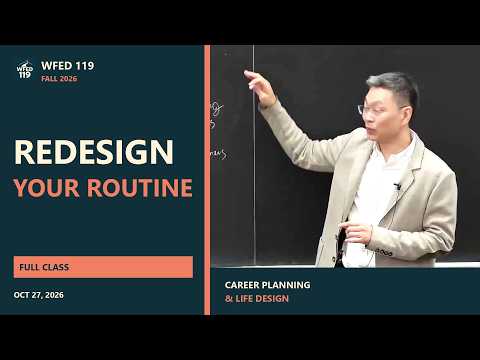
ERRC: Redesign Your Routine With Blue Ocean Thinking | WFED 119 | Oct 27, 2026
Overview
The class applies Blue Ocean Strategy’s ERRC framework, eliminate, reduce, raise or reinforce, and create, to redesign personal routines and improve teamwork. Examples range from a coffee shop strategy canvas and changes to exercise and career plans to team practices for student projects, including an app matching students with clubs and a kindness trail.
Key takeaways
- A strategy canvas makes differentiation visible by comparing a business across customer-value factors; the coffee shop concept distinguishes itself through books, karaoke, and activities rather than trying to outperform McDonald’s on every dimension.
- The ERRC framework can translate a desired future into specific routine changes, such as eliminating tobacco use and adding a second weekly basketball session to sustain fitness.
- Career choices can be tested against both financial constraints and lifestyle demands: Destiny shifted from teaching toward law after weighing out-of-state tuition, student loans, experience requirements, and possible work hours.
- Health routines should adapt to individual constraints: a student recovering from cervical injuries returned to the gym three to four days weekly with medical guidance and avoided heavy lifting.
- Teams can convert ERRC into concrete operating agreements, including reducing procrastination and unequal workloads, reinforcing deadlines, and creating individual task lists.
- Project teams are expected to move from planning to measurable action, with progress updates, completed major actions, and preliminary impact data available for final presentations.
Chapters
- The class introduces Blue Ocean Strategy as a way to differentiate a business and adapt its ideas to daily routines and habits.
- The ERRC framework asks what to eliminate, reduce, raise or reinforce, and create.
- The opening restaurant example sets up a strategy canvas comparing customer value across competing businesses.
- The class maps McDonald’s on factors including cleanliness, speed of service, price, atmosphere, food quality, and accessibility.
- Students place each factor on a low-to-high scale to visualize the restaurant’s customer value profile.
- Drive-through service is cited as one reason McDonald’s scores highly on accessibility.
- A student proposes a niche coffee shop with books, seating for reading, and a small karaoke and music area.
- The concept aims for a stronger atmosphere and food quality than McDonald’s, with competitive service and midrange pricing.
- The shop’s distinctive value is an inclusive, activity-rich experience for a broader audience than a children-focused play area.
- The four ERRC moves are eliminate, reduce, raise or reinforce, and create.
- Students suggest eliminating the franchise model to establish an independent brand, while reducing price could attract customers.
- Marketing and cleanliness are proposed for reinforcement, and customer loyalty is suggested as something to create.
- The instructor describes stopping tobacco use after a difficult breakup in college, following a reflective conversation with God.
- At Penn State, the instructor chose not to adopt the heavy drinking culture, limiting alcohol to occasional sips at social events.
- After tenure and years away from regular exercise, the instructor created a Saturday basketball routine with a Korean basketball club.
- Adding a second weekly basketball session on Wednesday or Thursday helped maintain energy and muscle recovery between Saturday games.
- Students are asked to complete the ERRC module on LiveCraft alongside a goal-setting assignment and share examples of routine changes.
- Destiny, a third-year political science major, reconsidered teaching because out-of-state tuition and student loans made the path financially difficult.
- She increased law-related experience through research, networking, and internships, including a criminal defense internship, while exploring criminal and family law.
- Destiny recommends using an ERRC exercise to compare legal career demands, such as work hours, with personal lifestyle goals.
- A student describes breaking cervical vertebrae while playing rugby and being bedridden for much of the previous year.
- Following guidance from a surgeon, the student returned to the gym three to four days a week and avoids heavy lifting.
- The student prioritizes earlier sleep, morning gym sessions when possible, and home-cooked meals with protein, rice, vegetables, and fruit.
- The instructor recommends walking for 10 to 15 minutes after meals, or practicing basketball dribbling indoors when at home.
- Another student reports lifting weights at about 8:30 p.m. on weekdays and stopping eating out in favor of cooking.
- The class raises sleep, phone scrolling before bed, healthy eating, and money habits such as Roth IRA contributions as possible routine topics.
- Teams use the Week 10 collective ERRC exercise to improve teamwork and make better use of members’ natural strengths.
- Students draw on earlier strengths-finding work, personal stories, and Enneagram types to identify useful team practices.
- Each team records what to eliminate, reduce, reinforce, and create, then adds its group chant.
- Teams are instructed to post progress updates in the Canvas team project area before Thursday presentations.
- The required update structure covers project overview, objective, progress, next actions, and team reflection.
- Teams should review written feedback on their submissions and comment on what they addressed, disputed, or need clarified.
- Team Four’s chant is “Find your club, find your crew,” and its app matches students with clubs by major and time commitment.
- Team Four targets a product by the following Tuesday and identifies procrastination, vague communication, and weak time management as issues to address.
- Team Six’s planner aims to help students manage time; its ERRC list includes reducing absences and unequal work and creating task lists for each member.
- Team Six reports that most coordination happens in class because its group chat is mostly inactive and one member has been absent.
- Team 13 is developing a kindness trail using QR codes and Instagram, and plans to reduce hesitation, reinforce positive dialogue, and set a posting schedule.
- Teams have about three weeks to complete their projects, with a progress presentation scheduled for the coming Thursday.
- Major project actions should be completed by the final presentation, and teams are expected to provide preliminary impact data.
- The instructor allows an ongoing installation, such as a sticky-note wall, to remain available during the final presentation while results are collected.
Transcript excerpt
0:04 [clears throat] [cough and clears throat] >> Is there anyone uh who wants to run a restaurant later on? Like start a business, a restaurant, food service. Oh, okay. Anyone else?
0:53 And how many of you have worked uh in a restaurant maybe as a server? Okay. Okay. Cool. Cool. Can I have maybe a volunteer um who will have a conversation with me about a maybe a case of running a restaurant as a business? We'll have We'll have It'll be maybe 5 to 10 minute uh conversation. Cuz it might be helpful if uh the person student can come to the front. If you don't mind. Or Mary Mary needs to come. I don't know. If you No? Okay. Or it can be open open question. Uh today um let's see. Uh today's main topic uh is um ERC.
1:50 Uh it's from blue ocean strategies. Uh or blue blue ocean strategy is to create your own blue ocean um and to come up with strategies to get there, but it's not um the strategies that we created last time like swap-based strategies is to for your own personal life, it is to manage your day-to-day lives, routine, and habits. Okay, so to um help you understand the concept I'd like to share [clears throat] where this came from and how it can be applied to your personal life. So, blue ocean strategy um is from a business strategy book. So, how to make businesses successful how to
2:40 differentiate your business from others. So, there's a concept of strategy canvas. So, something like this. Uh let's suppose that you want to create a business. It can be restaurant, food service, or restaurant business. And maybe your competitor might be McDonald's, for example. But, you can choose that it may not be it
This is the start of the transcript. Save this video free for the whole transcript, searchable and time-coded.
In this course
Related notes
Summary, takeaways, and chapters were generated by AI from the video's transcript and may contain errors. The video belongs to its creator, Career Planning and Life Design.