Discover Your Strengths Through Stories & Listening | WFED 119 | Aug 27, 2026
Overview
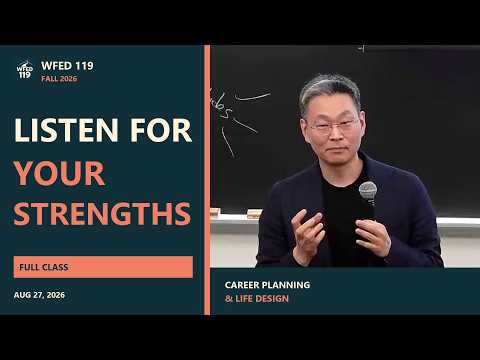
Dr. Yoon teaches students to identify strengths through personal stories: listeners map specific evidence into values, attitudes, and skills, then share their observations with a partner. He models the method with a story from his Korean military service, where an assignment supporting soldiers at risk of suicide led him to develop a counseling and education program; the session also covers course logistics and an Enneagram assignment.
Key takeaways
- A personal story can reveal strengths more clearly when a listener tracks concrete actions and groups evidence into values, attitudes, and skills.
- Dr. Yoon's military story shows how a career direction can emerge from experience: assessing soldiers at risk of suicide and observing a successful group intervention strengthened his interest in counseling and education.
- Effective strengths feedback should be specific: Dr. Yoon encouraged students to name capabilities such as assessment administration and program development rather than saying only that someone is competent.
- The peer exercise uses reciprocal listening, about 10 minutes per storyteller, and a written map of strengths that the listener can share with their partner.
- Dr. Yoon developed a soldier support program by combining group counseling methods with activities involving a local rehabilitation facility; after three successful deliveries, it spread to other battalions.
- The class emphasizes nonjudgmental listening: values, strengths, and Enneagram types should be understood as different, not ranked as better or worse.
Chapters
- Students can earn 5% bonus credit by completing a 15 to 20 minute research survey three times: near the start, middle, and end of the semester.
- Two students have volunteered for internships in social media and teamwork management; students seeking one credit through Workforce Education 195 must contact Dr. Yoon during the add and drop period.
- Students are asked to test access to the course AI platform through the student lounge link using their Penn State credentials.
- The media release covers photos and video clips used mainly for promotional purposes, with an opt-out option.
- Dr. Yoon says opted-out students can have captured images blurred or mosaicked, though live recording makes front-of-room participation harder to protect.
- Students should complete the Top Hat checkout reflection near the end of class.
- Dr. Yoon introduces a peer activity in which students listen to personal stories and identify the strengths they reveal.
- He uses a dream-tree image to describe his identity and role as someone who helps dreams grow.
- The exercise combines story sharing, attentive listening, follow-up questions, and a closing debrief.
- Dr. Yoon is an associate professor and professor in charge of Workforce Education and Development programs, and a master trainer for the National Career Development Association.
- His career includes management training and organizational change work at LG Display, following military service in Korea.
- A mission statement he wrote in 1999 focused on helping young people develop hopes and dreams; his current mission is to inspire individuals and organizations to develop and realize their dreams.
- His work connects individual career development with organizational development, where people build an organization's identity and direction together.
- Students are asked to recall an experience that brought joy or fulfillment after substantial effort, rather than using admission to Penn State as their example.
- Stories can come from school, work, family, sports, or another part of life; even a small achievement can be useful.
- The aim is to connect a concrete experience to strengths rather than rely only on a test or assessment.
- Dr. Yoon asks listeners to stay open and nonjudgmental because values, strengths, and personality types are not ranked as superior or inferior.
- Listeners should notice what a person actually did in the story, rather than offer only broad compliments.
- Follow-up questions can clarify details or invite the storyteller to explain what mattered in the experience.
- Students draw a central circle labeled with Dr. Yoon's name and three branches for skills, values, and attitudes.
- They record as many strengths as possible, with a target of more than 10 observations from Dr. Yoon's story.
- Examples include humanistic values and organizing skills; the same three-branch map will be used with a partner.
- As a Korean artillery officer, Dr. Yoon expected to move from a company assignment toward a battalion-level role.
- He wanted an information and education officer position because it included character education for soldiers and matched his interest in helping people develop.
- After studying counseling as an undergraduate, he volunteered to administer an assessment intended to identify soldiers with suicidal symptoms.
- A two-day group counseling program led by a division chaplain helped participating soldiers change their outlook, prompting Dr. Yoon to learn more about counseling.
- The battalion commander asked Dr. Yoon to become an HR officer, but Dr. Yoon had prepared to pursue the information and education role.
- He wrote a letter explaining his preparation and plans; after it reached the commander during a staff vacation, his actions were interpreted as disobedience.
- Dr. Yoon apologized and agreed to the HR role, but the commander instead assigned him to information and education and asked him to help prevent suicides.
- Dr. Yoon learned group counseling methods from the division chaplain and developed a program combining those techniques with other activities.
- He contacted a local rehabilitation facility so soldiers could learn through experiences involving people with disabilities.
- After three successful deliveries, the program spread to other battalions in the brigade.
- Before Dr. Yoon left military service, a soldier told him that his life had changed because of Dr. Yoon's work.
- Students identify values including service, honesty, helping people, and determination.
- Attitudes named include being proactive, curious, adaptable, open-minded, and strong-willed.
- Dr. Yoon prompts students to make skills more specific, suggesting active listening, assessment administration, and program development.
- Students form pairs and take turns sharing a fulfilling experience that required effort.
- The listener uses the values, attitudes, and skills framework to capture strengths evidenced by the story.
- Dr. Yoon gives roughly 10 minutes for each partner's turn and encourages curious follow-up questions.
- Students wrap up the first exchange and switch roles for another roughly 10-minute round.
- Listeners continue to record specific strengths their partner's story reveals.
- At the end, students may give their partner the written strengths map as a personal reflection or gift.
- Before the next Tuesday session, students should use the course AI platform to complete the first module's Enneagram assessment and record their type in an ungraded quiz.
- The assignment is due Monday at 11:59 p.m. and should take about 15 to 20 minutes.
- Students who opted out of the AI platform can use the suggested website and supplemental resources to check their type.
- The following week will focus on Enneagram types, including a group activity that puts students of the same type together.
Transcript excerpt
0:23 and turn on. [laughter] Okay. Okay. Who needs more time for attendance? Okay. >> [snorts] >> Absolutely.
2:09 Yeah, we'll send um a announcement an announcement with some housekeeping items. after uh this class. But um some of you asked me about bonus point credit opportunity which is to participate in the research. So what it takes is for you to take u a survey three times uh this um this week or next week uh sometime in the middle of semester and at the end of semester. And taking the survey will take 15 to 20 minutes. 20 20 20 minutes maximum and that will give you 5% bonus credit. So if you are interested in participating in the study then you can just click on the link uh
2:56 that link is under week one. Click on the link and go through the uh survey but don't do it right now because it will take time. Another one that I uh wanted to share was that um yeah there if uh there are there were two uh students who volunteered to uh do internship with us. One student will work on uh social media for this class. Another student will work on uh teamwork uh management and things like that. But um I want you to take a look at and take a look at this form and see whether there's any um activities or work that interests you. All right? So depending on your major and what you want to do in the future, uh this type of experience
3:45 can help you to move forward. So think about that. But if you want to do it uh with credit uh typically one credit of workforce ed 195 um then you need to do it uh you need to talk to me uh today or tomorrow because
This is the start of the transcript. Save this video free for the whole transcript, searchable and time-coded.
In this course
Related notes
Summary, takeaways, and chapters were generated by AI from the video's transcript and may contain errors. The video belongs to its creator, Career Planning and Life Design.