fnb100f261005b
Overview
Jeff Hunk distinguishes the income statement, which tracks the process from revenue to profit or loss, from the balance sheet, which describes capital structure. He develops revenue as price times quantity sold, explains direct and indirect costs and the progression from operating profit (EBIT) to earnings after taxes, then connects investment income to savings and investment portfolios.
Key takeaways
- The income statement explains how sales and other income become profit or loss after expenses, interest, and taxes; the balance sheet instead describes capital structure.
- Sales revenue is calculated as price times quantity sold, and for multiple products total revenue is Σ(pi × qi); revenue alone does not establish profit.
- Direct costs include inputs tied to production, such as a retailer's $400 laptop purchase or a manufacturer's labor, equipment, and components, while indirect costs must also be deducted.
- Operating profit is also called EBIT, earnings before interest and taxes; after interest the result is EBT, and after taxes it is earnings after taxes or net profit.
- Investment income comes from returns on a portfolio of other firms' securities, with the portfolio funded from accumulated profits or, for an individual, savings.
- The household-budget analogy distinguishes relatively fixed expenses from quantity-dependent variable spending: reducing variable costs can increase savings available for investment.
Chapters
- Jeff Hunk opens the Monday class and checks which students have joined the online session.
- He asks students to enable cameras when possible and explains that camera or device problems can be communicated.
- At 5:08, Jeff Hunk introduces financial statements from a firm's microeconomic perspective.
- The introductory material connects financial-statement analysis to evaluating earnings per share, return on equity, and return on assets.
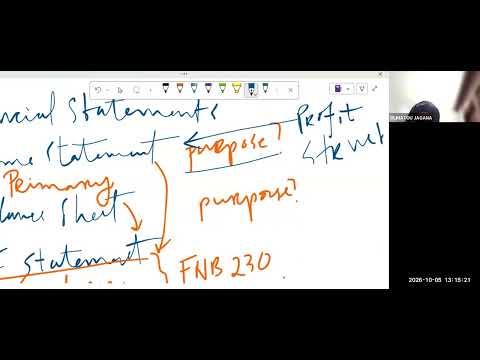
- The four statements listed are the income statement, balance sheet, cash flow statement, and retained earnings statement.
- Finance 100 focuses on the income statement and balance sheet; cash flow and retained earnings statements are reserved for Finance 230.
- Cash flow and retained earnings statements draw on data from the income statement and balance sheet.
- The income statement describes the operating process that leads from business activity to profit or loss.
- Operating activity includes making or acquiring products, selling them, receiving revenue, and paying expenses.
- Jeff Hunk uses π for profit in microeconomics, distinguishing it from P, which denotes price.
- Jeff Hunk contrasts the income statement's focus on profit with the balance sheet's focus on capital structure.
- He argues that knowing each statement's purpose helps distinguish which line items belong on each statement.
- The income statement is also structurally described as an income and expenses statement; profit or loss is its result.
- Sales revenue is identified as a business's primary income source, while investment income is secondary.
- Expenses are grouped into direct costs and indirect costs.
- Jeff Hunk defines sales revenue mathematically as price multiplied by quantity sold, or P × Q.
- He recommends the formula over a verbal definition because it captures the calculation directly and consistently.
- In the example, Best Buy pays Dell $400 for a Model X laptop and sells it for $500.
- Selling 1, 10, 100, 1,000, or 10,000 laptops at $500 yields revenue of $500, $5,000, $50,000, $500,000, or $5 million.
- The $100 difference between the sale price and purchase cost is not yet profit because indirect costs also need to be covered.
- For a business selling n products, total revenue is the sum of each product's price multiplied by its quantity sold: Σ(pi × qi).
- The multi-product formula extends the same P × Q logic used for a single Best Buy laptop.
- Investment income is described as passive income from holdings such as other companies' stocks and bonds.
- Jeff Hunk distinguishes company management from company ownership, using Apple and Steve Jobs as an example.
- A CEO manages a company, while shareholders provide ownership capital; the two roles can be held by different people.
- A sole proprietorship has one owner, while a restaurant requiring $5 million could be funded by five partners contributing $1 million each.
- Jeff Hunk contrasts small businesses with large corporations such as Nvidia, Apple, and Amazon, which have many shareholders.
- He describes early-stage companies as seeking private funding, including venture capital, before becoming publicly listed.
- For a retailer such as Best Buy, the $400 paid to Dell for each laptop is a direct cost.
- For Dell, direct production inputs include physical capital, labor, and raw materials.
- Laptop components such as CPUs, GPUs, RAM, storage, screens, keyboards, and speakers illustrate material inputs.
- Subtracting direct and indirect costs from sales revenue produces operating profit, also called operating income or EBIT.
- EBIT means earnings before interest and taxes, reflecting profit from operations before financing costs and taxes.
- The class takes a 10-minute break after laying out this operating-activity sequence.
- After the break, Jeff Hunk restates sales revenue as P × Q and operating profit as the ultimate result of operating activity.
- He confirms that EBIT stands for earnings before interest and taxes, distinguishing earnings from the earlier revenue stage.
- Jeff Hunk notes that students meeting the 80% attendance threshold can receive attendance credit.
- The lecture explains that financing a business can create interest expense, which is deducted after EBIT.
- After interest is paid, earnings before taxes are called EBT; the taxable-income label is also discussed.
- Jeff Hunk describes private startup funding and later access to public bond markets, while noting that lenders may require collateral.
- The class compares EBT with the plain-language label profit before taxes and treats them as equivalent descriptions.
- Jeff Hunk points out that accounting uses the word income for several stages, including operating income and taxable income.
- He cautions that using income indiscriminately can blur the difference between gross revenue and profit after expenses.
- Subtracting taxes from EBT yields net profit, also called earnings after taxes.
- The lecture's sequence is operating profit or EBIT, then EBT after interest, then earnings after taxes after tax payments.
- Jeff Hunk uses a fish-cleaning analogy to distinguish gross revenue from the final amount remaining after costs, interest, and taxes.
- A company's investment portfolio is described as holdings in other companies' stocks and bonds, not its own securities.
- Jeff Hunk traces investment funds from profits into a portfolio, with market returns then generating investment income.
- He also suggests that students consider investing small amounts, such as $100 in an S&P 500 or Nasdaq ETF.
- A personal investment portfolio can begin with savings, such as $500 set aside from earned income.
- A paycheck is generally received after payroll tax withholding, making the remaining amount disposable income.
- Jeff Hunk uses household budgeting to illustrate how income left after expenses can be saved and invested.
- The lecture compares household fixed costs such as rent, basic food, transportation, and phone service with business indirect costs.
- Variable spending, such as restaurant dates or movies, changes with quantity and can fall to zero.
- Reducing variable expenses increases savings, which can fund investments such as an ETF portfolio.
- Jeff Hunk connects business investment income to profits invested in a market portfolio and closes the session after questions.
- The class is scheduled to meet again on Wednesday.
Transcript excerpt
5:08 All right. All right. Good afternoon, everyone. Good afternoon. Happy Monday. Happy Monday to everyone. Happy Monday. All right. So, let's see who's here today. Let's see. Um, let's see. Seven people. We have Arman, we have uh Brandon, uh Olim Matu, Valentina, Valentina, and we have uh Yasir. We have Tyandre and Anna Karen. Okay, Anna Karen is our uh supplemental instructor. Uh Yasir, if you uh can you turn on your camera if possible? Turning on your camera is always preferred.
5:57 >> Um, camera >> I'm trying to click the uh the start video, but it won't turn on. >> Okay. But uh let's see. Um I don't know uh how else you can do that. Maybe you need to uh log out and log in again or don't do that. You don't need to do that. Just to uh just to turn on the camera. You want me to You want me to leave and join back? >> Oh, no, no, no, no. Stay there. Stay there. Uh, now that I know you're there, you just, you know, I'll stay there. Okay. >> All right. Thank you. >> And still there are two more people. There is Leo and uh who else? Uh, Leo, Aaron, and Leo, please turn on your camera. Just turn on your cameras.
6:47 >> Hi, professor. Yeah, my camera just isn't working right now. I still have to get it fixed. Uh, okay. Okay. At least you're responsive, right? You're responsive. >> Hi, professor. Um, I don't have a camera on my desktop. >> Ah, at least you know. Uh, can you uh use your um Is there a can you put up your profile picture? >> Oh, okay. I I'll change that. >> Yeah. Yeah, sure. All righty. So uh uh so we have you know uh like uh
This is the start of the transcript. Save this video free for the whole transcript, searchable and time-coded.
In this course
Related notes
Summary, takeaways, and chapters were generated by AI from the video's transcript and may contain errors. The video belongs to its creator, Jeff Hunk.