fnb100f260902a
Overview
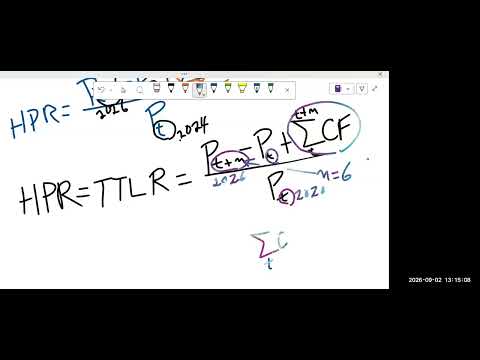
Jeff Hong explains holding period return as the asset’s price change plus cash flows received during ownership, divided by the initial price, then applies the formula to Nvidia stock and a house investment. He uses a 2020 to 2026 Nvidia example, with a price increase from $100 to $300 producing a 200% six-year holding period return, and an Excel house-value exercise from 2005 to 2016 to distinguish capital gains, rental income, annual returns, and the limits of simple averaging.
Key takeaways
- Holding period return is calculated as the ending price minus the initial price, plus cash flows received during ownership, all divided by the initial price.
- An Nvidia purchase at $100 in 2020 and sale at $300 in 2026 produces a 200% six-year holding period return, but dividing 200% by six ignores compounding.
- Stock dividends, bond interest, and house rent are cash flows that belong in total return alongside capital gains or losses.
- A zero-coupon bond can pay no interest during ownership and still provide a return because it is sold below its maturity value.
- In the 2005 to 2016 house-value spreadsheet, locking the initial-price cell with Excel F4 keeps copied formulas anchored to the correct purchase price.
- The correct compounded annual growth rate depends on geometric averaging of year-over-year returns, not simply dividing total holding period return by the number of years.
Chapters
- The recording begins with a brief interruption before Jeff Hong starts class at about 5:28.
- Jeff says the in-person class has moved online because he felt nauseous during his bus commute.
- Students without reliable laptops or Wi-Fi can use a computer in the scheduled classroom computer lab.
- Jeff expects students to have watched the assigned material through ROI Part 6 before class.
- He introduces holding period return, also called total return, as the price change plus cash flows received during ownership, divided by the initial price.
- The subscripts t and t+n mark the start and end of the holding period, rather than specific numerical values.
- For an Nvidia investment bought at the end of 2020 and sold at the end of 2026, t marks 2020 and n equals six years.
- Using year-end purchase and sale prices makes the example consistent on an annual basis, although real transactions can happen at any time.
- The summation symbol adds all cash flows received from time t through time t+n, such as stock dividends.
- Jeff distinguishes management, which runs a company, from the board of directors, which represents shareholders and oversees management.
- Dividends are optional for stocks, while a stock’s price increase is a capital gain and a decrease is a capital loss.
- Fast-growing companies may reinvest profits instead of paying dividends, so shareholders can receive returns primarily through capital appreciation.
- Companies raise borrowed funds by issuing bonds, which generally pay interest; a zero-coupon bond instead sells below face value and pays its maturity value later.
- A homeowner living in a house receives no rental cash flow, while renting it out creates income comparable to stock dividends or bond interest.
- House prices can also rise or fall, so a rental property’s return can combine capital appreciation with rental income.
- Jeff assumes Nvidia costs $100 at the end of 2020 and is worth $300 at the end of 2026, with no dividends in the example.
- The $200 capital gain divided by the $100 purchase price gives a 200% holding period return over six years.
- Dividing 200% by six does not produce the correct annual growth rate because investment returns compound over time.
- Students are directed to Brightspace Module 1 to download the Excel file named “house value and geometric average.”
- The exercise uses year-end house values from 2005 through 2016, an 11-year holding period.
- Jeff frames the spreadsheet as a way to apply the return logic, rather than requiring advanced Excel knowledge.
- The house’s total capital gain is the 2016 sale value minus the 2005 purchase value, and annual capital gains are calculated from year-to-year price changes.
- Adding the annual capital gains should equal the final house value minus the initial value.
- Jeff uses Excel’s F4 key to lock the initial-price cell, preventing the reference from shifting when a formula is dragged across columns.
- In the rental scenario, the spreadsheet includes rent received during the holding period, with the example assuming no rent during the first three years.
- The total cash-flow term is added to capital gain in the holding period return numerator, while the initial house price remains the denominator.
- Jeff explains that zero-income years can remain in the cash-flow range, preserving a consistent formula that also works when income is received.
- Jeff distinguishes a holding period return from annual year-over-year growth rates, which must be calculated from each year’s value relative to the previous year.
- The 2005 to 2016 interval contains 11 years, and Excel can count observations or subtract calendar years to identify the period length.
- An arithmetic average of annual rates is not the true compounded annual growth rate; Jeff introduces geometric averaging as the appropriate next topic but leaves the calculation for the following class.
- Jeff ends the lesson by asking students to confirm they downloaded and completed the Excel exercise, with matching results more important than appearing in the screenshot.
- The class will not meet on Labor Day Monday and is scheduled to meet the following Wednesday.
- Jeff clarifies that Wednesday is normally in person in a hybrid format, while online changes may occur for health or other reasons and will be announced.
Transcript excerpt
0:30 Oops. All right. All right. Good afternoon,
5:30 everyone. Good afternoon. >> All right. How's everybody? Okay. Let me >> All right. So, um let's see who's here. I see uh nine people. Okay. And if your camera is not on, please turn on your camera. Please turn on your camera. All right. So, good. We have um we have uh Witmore. Wait more. Is that right? Uh Andy. Hi. We have Brandon. We have Susanna. We have Tyandre.
6:19 Uh, Anisha, right? We have Ian, Yenni, Aaron, and those those people that haven't turned on the camera, please. I would appreciate it. Um, so, uh, I hope you have watched all the, uh, assigned videos. I mean, you may not have come to a a macro uh ROI and macro yet, but at least you need to have come to a um ROI part six. Okay, but you know um because we cannot go through all of these videos during the class, I you know, having watched them in advance is a must. And uh so uh let me get to the part that
7:09 most of you would be uh uh like you know very some some people not most of you but some people panic when whenever they see the math the math is nothing but the logic. So if you if you get the logic then it's not a difficult thing to follow. Now uh but before we move on uh of course I need to uh apologize for not being there in person but you know I was on the way uh that was like uh you know because I have 11:00 class I was on the way and I felt very sick I mean it's like motion sickness um I was I couldn't just stay on the on the bus
This is the start of the transcript. Save this video free for the whole transcript, searchable and time-coded.
In this course
Related notes
Summary, takeaways, and chapters were generated by AI from the video's transcript and may contain errors. The video belongs to its creator, Jeff Hunk.