fnb100f260831b
Overview
Dr. Jeff Hong introduces BMCC’s hybrid FNB 100 course, explaining its Brightspace workflow, Zoom attendance rules, calendar, Connect assignments, and the importance of completing timed course materials before their access windows close. He frames the finance curriculum around maximizing return on investment while managing risk, then connects the 2008 financial crisis and today’s AI investment boom to market concentration, chipmakers, and portfolio performance.
Key takeaways
- For this course, Zoom attendance is measured through login records: students need at least 80 minutes of a 100-minute class to be counted present, and cameras are preferred as additional evidence.
- Brightspace checkmarks track engagement and can determine whether a quiz or test becomes visible, so students must complete required videos and materials before timed access windows close.
- FNB 100’s first finance unit distinguishes holding period return from annualized return and uses weighted and geometric averages, calculated in Excel, to compare performance across time.
- The 2007 subprime mortgage crisis contributed to the 2008 financial crash because mass defaults and foreclosures increased housing supply, lowered home prices, and weakened banks’ loan recoveries.
- Hong characterizes AI-sector risk as a potentially unsustainable investment race rather than a repeat of the housing crisis, emphasizing circular links between Nvidia investment, hyperscaler financing, and GPU purchases.
- Large technology firms and chipmakers make up a substantial share of the S&P 500; Hong estimates chipmakers alone represent at least about 20%, making market performance sensitive to the AI trade.
Chapters
- Dr. Jeff Hong greets students joining the first online session and checks who is present.
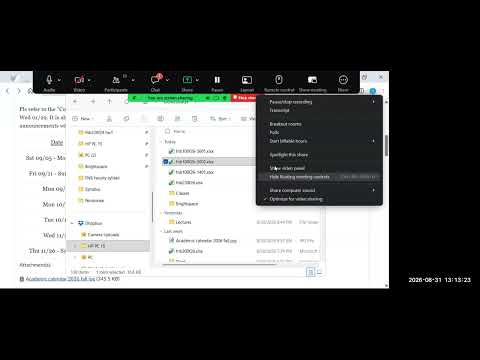
- He opens the Brightspace landing page and explains that pinned announcements remain at the top.
- Students should select “Show all announcements” because the landing page truncates older posts.
- Hong asks students not to email his BMCC account because of a junk-mail glitch, and to reply within their original email thread so messages stay organized.
- Students should sign into Zoom with first and last names matching the BMCC roster; middle names can be omitted.
- Zoom login records supply attendance data, and students must stay logged in for at least 80 minutes of the 100-minute class to count as present.
- Cameras are preferred as evidence of participation, especially for students without profile pictures.
- Class recordings and automatically generated Zoom transcripts will be posted in the Brightspace course materials.
- The course meets online Mondays and in person Wednesdays, with holiday-related Monday cancellations requiring schedule adjustments.
- BMCC’s enrollment verification deadline is listed as September 17, and students need evidence of attendance or course engagement during the opening weeks.
- Zoom login records and completed Connect chapter problems can document participation.
- A student marked as never attending may receive a WN, which can affect financial aid; Hong says students with engagement evidence may appeal.
- Students should identify their section as FNB 100-5200 when contacting Hong, since he manages multiple course rosters.
- The syllabus tile includes course objectives, learning outcomes, topics, policies, and grading information.
- Hong warns that one linked syllabus document is outdated and points to 2022 materials.
- The course covers seven topics, with risk analysis split into two units despite the syllabus listing six.
- Quizzes follow topics, a midterm follows the fourth topic, and a final follows the last topic.
- Hong says the schedule is a rough guide because holidays and instructional pacing may shift exact quiz and exam dates.
- Students need the Connect ebook access code for end-of-chapter problems; Hong estimates a six-month subscription costs about $50.
- Assignments appear in Connect with padlock icons until their scheduled release dates.
- A mistakenly displayed August 30, 2025 Chapter 3 assignment will not be issued.
- Module One is scheduled to run from the August 28 semester start through a September 17 due date, subject to later adjustments.
- Timed videos become active on their start dates and can deactivate after their access windows close.
- Brightspace may truncate module lists; clicking “Load more” reveals additional items that are already available in the course.
- Opening course links changes their status indicators from black dots to checkmarks, which record engagement with materials.
- Quizzes and tests can require specific videos, PDFs, or Excel exercises as release conditions.
- Students must complete required items while their timed access windows are open or the assessment may remain invisible.
- Hong’s course introduction says sound investment judgment draws on financial mathematics, accounting, macroeconomics, and market momentum.
- He reviews the S&P 500 reaching roughly 4,700 in December 2021, followed by inflation, Federal Reserve quantitative tightening, and regional bank concerns.
- The course aims to build the analytical skills needed to evaluate financial assets amid volatile economic and geopolitical events.
- The first topic distinguishes holding period return, or HPR, from annualized return.
- Students will compare weighted and geometric averages as methods for annualizing returns.
- Hong says students will calculate HPR and annualized averages using Excel.
- Hong describes investing as seeking higher ROI while minimizing risk, using a hypothetical $10,000 that a cautious saver might leave in a bank.
- He contrasts savings-account yields around 0.1% in the low-rate period after 2008 with recent high-yield accounts around 3%.
- A certificate of deposit is described as a fixed-term loan to a bank; early withdrawal can trigger a penalty, while recent rates may reach about 4%.
- Hong explains that borrowers defaulting on subprime mortgages left banks with homes to repossess and sell.
- Large-scale foreclosures increased housing supply, pushed prices down, and reduced the amount banks could recover on loans.
- He links the 2007 subprime mortgage crisis to the 2008 financial crisis and cites Lehman Brothers’ bankruptcy.
- Hong distinguishes current AI-sector risks from the 2008 housing crisis, pointing instead to intense competition among AI data-center companies.
- He describes Nvidia investing in AI hyperscalers that then use financing, including special-purpose vehicles, to buy Nvidia GPUs.
- He warns that not every company can win a winner-take-all contest, and notes that OpenAI had not shown a profit while Anthropic was described as profitable.
- Using a market heat map, Hong compares one-day, one-week, and one-month performance across S&P 500 sectors.
- He identifies Nvidia, Microsoft, Amazon, Google, and Meta as large companies with significant AI or data-center exposure.
- He estimates chipmakers account for at least about 20% of the S&P 500, highlighting how concentrated market performance can become.
- Hong shows a personal portfolio of roughly 50 to 60 stocks, with about 32 positions positive and 18 negative at the time shown.
- He says many losses were under $100, while the largest displayed loss was about $2,000 and a leading gain was around $24,000.
- The portfolio is heavily weighted toward technology and Nasdaq-related holdings; Hong notes that TQQQ is a triple-leveraged ETF with high volatility.
- Hong concludes that AI has not completely changed finance but is currently a major growth engine, benefiting publicly traded chipmakers such as Nvidia, Broadcom, and Samsung Electronics.
- Students are expected to watch Module One videos through Part Six before the next class; Hong plans to begin with Part Two rather than replay Part One.
- The next meeting is in person at Ferman 509, and students should also log into Zoom to document attendance.
Transcript excerpt
1:29 All right. Good afternoon everyone. Good afternoon. Good afternoon. >> Good afternoon, professor. >> Good afternoon. >> Good afternoon. >> Good afternoon. >> Good afternoon. >> All right. >> Good afternoon. Good afternoon. All right. So, let's see. Uh, let's see who's here. Okay, let's see who's here. So, I see uh Tyander. Tyander. I see uh >> Hi, Andre. >> Tyandre. Okay. >> Yeah. Or just Tai. >> Okay. >> Thank you. >> All right. All right. Uh so I and Malik Aaron and Hello.
2:19 >> Hello. Hello. And who's uh who's this? Uh Maverick. There's me. >> Hello. Um Valentina. >> Hi. There's Valentina. And there's Andy. And there's Sleon. Okay. Uh Blendy and uh Sahira. And uh yeah, there's Ty Ty Andre. Ty Andrew. Uh who didn't I who I who did I miss? There's uh Veronica. >> Yes, I'm right here. >> So, uh let's do this fir first. Um camera is preferred. Okay. Uh since I'm
3:08 sharing my screen uh there's only Mark two also. Um this is the landing page right the uh homepage of our bright space. Uh of course this message is you know pinned on top so it will always be uh this class was activated on August 25th. So since then you should have been able to access uh this page and uh you must have checked out everything. Now the point is uh this is not everything right because the landing page has uh limitations in
4:00 other words that's not everything there I mean everything that has been every posting that that there has been ever since since the the August 25th To see all of them, you got to link uh click this link, show all announcements. And obviously uh a single page cannot show everything because you know the earlier ones the
This is the start of the transcript. Save this video free for the whole transcript, searchable and time-coded.
In this course
Related notes
Summary, takeaways, and chapters were generated by AI from the video's transcript and may contain errors. The video belongs to its creator, Jeff Hunk.