fnb100f260831a
Overview
Jeff Holmes introduces BMCC’s Finance 100, Principles of Finance, section 5100, and explains how to navigate Brightspace, meet attendance and course deadlines, and prepare for quizzes and exams. The first lesson frames return on investment (ROI) through holding-period returns, annualization, and comparisons among savings accounts, CDs, bonds, and stocks, while emphasizing the need to account for risk and changing market conditions.
Key takeaways
- Brightspace completion check marks are not just progress indicators: required videos and other course materials can be release conditions that determine whether a quiz or test is visible.
- Finance 100 attendance combines Zoom login records with evidence of active presence; Holmes states that students should attend at least 80% of class and that a login under five minutes is counted absent.
- Annualizing holding-period returns is necessary to compare investments held for different lengths of time, such as a five-year position and a two-year position.
- A CD is a maturity-based contract in which a depositor lends funds to a bank; early withdrawal may trigger a penalty because the bank can have already lent those funds onward.
- The seven-topic course plan fits into roughly 14 usable teaching weeks, with quizzes after topics, a midterm after topic four, and a final after topics six and seven; exact assessment dates can shift.
- Holmes uses Tesla and Nikola to show why spectacular short-term stock gains should not be mistaken for stable value: rapid appreciation can reverse, and speculative growth may lack a proven business.
Chapters
- Jeff Holmes welcomes students to the first Finance 100 class and notes that the Brightspace course opened before the semester began.
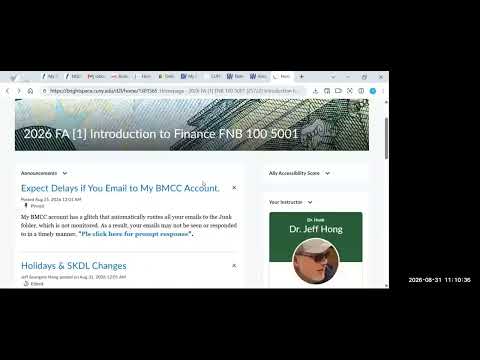
- The landing page shows only some announcements because posts are listed in reverse chronological order.
- Students should select “Show all” to review the full announcement history; Holmes counts 11 posted messages.
- Holmes warns students not to use his BMCC email because messages can be diverted to a junk folder.
- Students should use the direct contact link in Brightspace and catch up on course posts rather than relying on the landing page preview.
- When following up by email, students should reply in the existing thread instead of composing a new message each time.
- Holmes prefers students to turn on cameras, but says a camera is not mandatory if a student has a technical problem; a profile picture is the alternative.
- Zoom login records provide the attendance baseline, while camera presence or responses help confirm students are actively attending.
- Holmes says attendance requires at least 80% of class time, that shorter attendance may be marked late, and that a login under five minutes counts as absent.
- The hybrid section meets online on Mondays and in person on Wednesdays in Fiterman Hall room 803, unless Holmes announces a change.
- Labor Day and another Monday holiday disrupt the normal schedule; the class must check the college calendar for the correct meeting dates.
- Holmes identifies October 13 as a Tuesday that follows the Monday class schedule to make up for a missed Monday.
- Holmes’s course introduction presents Finance 100 as preparation for making informed decisions about stocks, bonds, and other financial assets.
- He traces market conditions from the S&P 500 reaching about 4,700 in December 2021 through inflation, Federal Reserve tightening, the Silicon Valley Bank crisis, and recession concerns.
- The course connects financial judgment to accounting, financial mathematics, macroeconomics, and market conditions.
- Fundamental analysis uses financial-statement measures such as return on equity, return on assets, and earnings per share.
- Holmes distinguishes valuation work from market-momentum indicators such as moving averages, RSI, and MACD.
- Students will encounter macroeconomic variables including inflation, interest rates, GDP growth, and money supply measures M1 and M2.
- The class is Finance 100, section 5100, a hybrid section; Holmes teaches multiple Finance 100 sections as well as Finance 230 and Finance 300.
- Students should identify their section in messages so Holmes does not need to search several course rosters.
- Holmes flags an outdated textbook link in the syllabus and directs students to the current course link instead.
- The semester offers about 45 contact hours before holidays reduce the usable teaching time to roughly 14 weeks.
- The course outline covers seven topics or modules, so Holmes estimates that each takes about two weeks.
- Quizzes follow topic coverage, with a midterm after topic four and a final after topics six and seven; exact dates may shift by about a week.
- Module 1 is available through the end of the semester, but its material is intended to be completed on the class schedule.
- Early ROI videos open August 28, have an initial September 3 deadline, and remain available for an additional week before deactivation.
- Brightspace check marks track completion, and required content may act as a release condition that keeps a quiz or test hidden until finished.
- Holmes recommends using the course tiles and announcements, and selecting “Load more” when additional content is not initially displayed.
- The assignments, tests, and quizzes tile is the primary assessment location, even if Brightspace navigation links do not always match it exactly.
- Students need the current McGraw Hill Connect access code for chapter problems and specified assessments; the code is purchased through the Connect setup process.
- The opening topic defines return on investment (ROI) and holding-period return (HPR), then compares HPR with annualized return.
- Students are expected to calculate weighted and geometric averages for annualized returns using Excel.
- The course goal is to maximize investment return while keeping risk in view.
- Holmes uses a hypothetical $10,000 balance to explain why savers compare bank deposits with financial assets.
- A certificate of deposit (CD) has a maturity date and functions as a contract in which the depositor lends money to the bank.
- Early withdrawal can incur a penalty because banks may have lent deposited funds into mortgages, car loans, or other obligations.
- Holmes contextualizes the course’s older interest-rate examples by noting that the video materials were created around 2020, when rates were near zero.
- He contrasts the roughly 6% long-run historical benchmark rate he cites with much lower rates during the pandemic and the higher rates later available on some deposits.
- Bank deposits and high-grade bonds can offer more predictable returns, while stocks have greater uncertainty but potentially higher returns.
- Bank interest rates are commonly quoted as APR, or annual percentage rate; APY, or annual percentage yield, accounts for compounding and is usually higher.
- An investment’s holding period can be as short as days or months or as long as multiple years, but its return can still be expressed as an annual rate.
- Annualizing returns makes investments with different holding periods more comparable than simply comparing their total gains.
- A five-year total return cannot be compared directly with a two-year return because the investments were held for different lengths of time.
- Holmes uses Tesla’s large historical price swings to illustrate how a short-term gain can be followed by a sharp sell-off.
- He also describes Nikola as a speculative hydrogen-truck company whose early surge did not establish a durable business, cautioning against treating rapid growth as proof of value.
- The holding period is the time an investor owns an asset; buying Nvidia near the end of August and selling at the end of December would be about four months.
- In the HPR notation, P at time t is the starting price and P at time t plus n is the ending price; t labels the starting point and n represents the period length.
- Subtracting the initial price from the ending price gives the asset’s capital gain before other return components are considered.
- Holmes assigns ROI videos two through five before the Wednesday class meeting and asks students to finish the remaining material from video one.
- Even for the in-person Wednesday meeting in Fiterman Hall, students must log into Zoom so the login record provides a digital attendance footprint.
- In response to Whitney’s textbook question, Holmes clarifies that Connect requires a purchased access code, not a QR code.
Transcript excerpt
1:37 All right, good morning everyone. Good morning. Good morning. Happy first day of class. >> Happy first day of class to everyone. And as uh people are joining us as people are joining you know uh peacemail by peacemail um I'm getting distracted because you know that small window pops up every once in a while that you know someone is in the waiting room but you know um uh let's see who's there. I uh according to according to this uh what is this called? Uh the
2:26 control bar or zoom control bar there are 12 people or you know I mean I I'm double counted so there are actually 10 people. All righty. So uh and some people Um uh I don't know why but you know this class the bright space course has been active since uh last week you know uh even before the 28th I believe I turned it on I activated on uh August 25th uh let's see when it was actually when everything was turned phone. No, I I cannot, you know, since I'm in
3:17 uh student mode, I cannot check that. But let me just quickly uh but it will be the same thing. I mean uh you see this was posted, right? Um the first message was posted on uh August 25th. So you should have uh I mean everyone here has obviously checked out uh this landing page and uh everything else. So that's why you are here. First of all, this is the landing page, right? This is the landing page. Oh, come on. Two people are in the I believe it's just one person
4:13 two people. So in the landing page look um the first message I posted uh was not that I mean that's one of the first two
This is the start of the transcript. Save this video free for the whole transcript, searchable and time-coded.
In this course
Related notes
Summary, takeaways, and chapters were generated by AI from the video's transcript and may contain errors. The video belongs to its creator, Jeff Hunk.