EVEG 4156: PoU Water Treatment: Sedimentation
 Watch on YouTube →
Overview
Samuel Snow explains point-of-use water treatment as a practical option where centralized infrastructure is unavailable, emphasizing that community acceptance, ease of use, cost, and durability matter alongside treatment performance. He derives the Stokes settling relationship, applies it to a 10-micrometer particle settling through a 1-meter water column, and explains why sedimentation mainly removes larger particles rather than pathogens. A two- or three-pot method can improve water clarity and provide storage time, but careful transfers are essential and sedimentation alone is not reliable disinfection.
Key takeaways
- For spherical particles in the lecture's settling model, terminal velocity follows Vs = g·dp²·(ρp − ρw)/(18μ), so particle diameter has a squared effect on settling speed.
- A 10-micrometer silt particle settling through 1 meter of water at about 7.4 × 10⁻⁵ m/s takes approximately 225 minutes, showing that even visible improvement can require hours.
- Reducing particle diameter tenfold makes settling about 100 times slower, which is why ordinary sedimentation cannot reliably remove bacteria and viruses directly.
- Sedimentation is useful as pretreatment because it removes larger particles that can clog membranes, interfere with UV treatment, or shield attached pathogens.
- Coagulation and flocculation improve settling by aggregating small particles and can help capture attached microbes, but they do not replace disinfection.
- The two- or three-pot method relies on staged settling, clean-container transfers, and undisturbed sediment; user acceptance and careful handling determine whether it works in practice.
Chapters
- Point-of-use treatment treats water where it will be consumed, such as an individual home or a small community.
- Samuel Snow frames it as a short-term option where reliable water infrastructure is unavailable, including remote settings such as backpacking.
- Large centralized systems can be more cost-efficient per person, but require substantial infrastructure investment.
- New technologies typically gain early adopters first, then mainstream users, while skeptics may wait until cost and uncertainty decline.
- Snow uses a student survey on AI at LSU to illustrate how communities can contain enthusiastic users, opponents, and people in between.
- Early adopters can make expensive technologies commercially viable until production scales and prices fall.
- Water treatment adoption depends on community belief in the technology, understanding of pathogens, and perceived value, not only technical performance.
- Visible results, such as sediment collecting or clearer water, can make treatment benefits easier to recognize.
- Field equipment should be intuitive, robust, and practical to power; UV LEDs are becoming more suitable for point-of-use use as costs decline and battery operation becomes easier.
- Sedimentation separates particles when gravity overcomes buoyancy and the surrounding water's drag.
- Removing particles can reduce turbidity, protect membranes from clogging or damage, and prevent particles from blocking or scattering UV light.
- Bacteria and viruses may attach to larger particles, so settling those particles can remove some associated pathogens without disinfecting the water.
- The basic model assumes particles are spherical and approximately uniform in size and density.
- The force balance includes particle weight downward, buoyancy upward, and drag opposing the settling direction.
- Particle volume and density provide a practical substitute for directly measuring the mass of microscopic particles.
- At terminal settling velocity, gravity's net force after buoyancy balances the drag force on the particle.
- For the spherical-particle model, the settling velocity is Vs = g·dp²·(ρp − ρw)/(18μ), where dp is particle diameter and μ is dynamic viscosity.
- The equation shows that settling speed increases with the square of particle diameter and depends on particle-water density difference and water viscosity.
- A sedimentation basin must give the hardest-to-remove particle enough time to fall from the water surface to the bottom before water exits.
- Rectangular basins and circular basins can be analyzed using a representative cross-section of the flowing water.
- For a batch point-of-use container, the same principle becomes the time needed to settle through the water's depth.
- The example uses a 1-meter water depth, water at 25°C, and silt density of 2.2 g/cm³.
- A 10-micrometer particle has a settling velocity of about 7.4 × 10⁻⁵ m/s under the example conditions.
- At that speed, settling through 1 meter takes about 13,500 seconds, or 225 minutes, approximately 3.75 hours.
- The calculation requires consistent SI units, including converting particle diameter and density before using the settling equation.
- In a flowing system, particles must settle to the bottom before being carried out with the water.
- Basin dimensions and flow rate determine water velocity and hydraulic residence time; a larger flow cross-section generally slows the water.
- Snow focuses point-of-use design on batch settling, while noting that flow-through systems require relating settling velocity to residence time.
- Viruses are roughly 10 to 100 nanometers, while many bacteria are about 1 to 5 micrometers, too small for practical gravity settling in ordinary containers.
- Giardia and Cryptosporidium are larger single-cell parasites, with some forms approaching the 10-to-15-micrometer range.
- The lecture's 10-micrometer, 1-meter example takes roughly 225 minutes, illustrating why smaller pathogens would take much longer to settle.
- Because settling velocity scales with diameter squared, reducing particle diameter by a factor of 10 makes settling about 100 times slower.
- Changing water temperature affects viscosity and density, but those changes are modest compared with changing particle size.
- Coagulation and flocculation can bring particles together into larger aggregates, improving settling and potentially capturing attached bacteria and viruses.
- Fine particles at the bottom of a bucket or drum can be resuspended by bumping or stirring the container, carrying contaminants back into clearer water.
- Snow cautions that pathogens attached to settled particles may persist, and some conditions could allow pathogens to grow during storage.
- Container design and handling should keep settled material undisturbed and reduce the risk of recontamination.
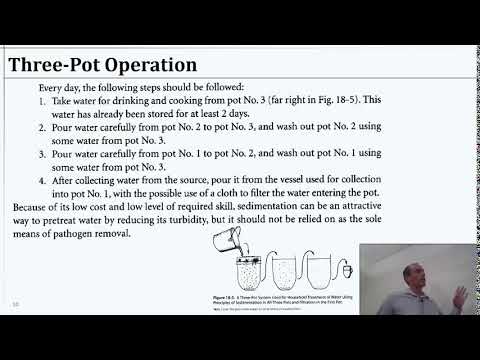
- The two-pot or three-pot method uses successive settling periods, with water carefully poured from the clearer upper layer into the next clean container.
- A cloth screen can remove exceptionally large debris before water enters the first pot.
- The lecture describes at least 48 hours of storage as a measure aimed at reducing a schistosomiasis-related risk, while emphasizing that storage and settling are limited treatments.
- In the described three-pot routine, drinking and cooking water comes from pot three, pot two is transferred into pot three, and pot one is transferred into pot two.
- Rinse each emptied pot with some of the cleaner water before refilling it from the next, dirtier stage; pour carefully to avoid disturbing sediment.
- The method is inexpensive and uses simple containers and cloth, but its value depends on local risks, education, and whether users will follow the multistep routine.
- Sedimentation and storage can make water safer than doing nothing, but they do not provide dependable pathogen disinfection.
Transcript excerpt
0:03 All right, good morning. Today we're going to talk about point of use treatment technology. So going from what kind of contamination are we looking at to um how do we start treating the different contaminants? And we're gonna for now focus on point of use technologies. Meaning it's something that is not designed for centralized treatment or or perhaps how can we take a typical centralized design and apply it to an individual home scale use perhaps a small community. But really point of use is referring to the location where you're going to use this water. that's where you're treating it. So the uh the reason for that if it's
0:54 not already obvious is that in places where we don't have developed infrastructure, we need some sort of infrastructure at for for each person or for each location of use. So that's that's kind of the the short-term solution. Whereas in many cases a a larger system of infrastructure is more costefficient per person and can can be made reliable. All of that many of the things we enjoy in terms of utilities and water treatment and distribution uh are so effective and so reliable because we've been able to scale it uh with significant infrastructure investments. So the question becomes well in the LA in the case where we don't
1:41 have that what can we do? This would also apply to uh the scenarios where perhaps you go backpacking in a remote area and you have no other um you know no infrastructure out in the wild. Okay. How do you use point of use to keep yourself safe when you need to drink some water from who knows what source? Uh so that's kind of the the scenario we're looking at for point of use technologies in general. Um
This is the start of the transcript. Save this video free for the whole transcript, searchable and time-coded.
In this course
Related notes
Summary, takeaways, and chapters were generated by AI from the video's transcript and may contain errors. The video belongs to its creator, Samuel Snow.