Execution Strategies: How to Actually Reach Your Goals | WFED 119 | Oct 29, 2026
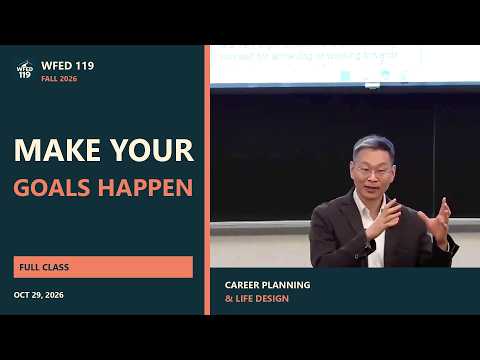 Watch on YouTube →
Overview
Personal goal execution strategies include writing goals and daily tasks down, working backward from deadlines, using accountability and rewards, and making goals visible through notes or vision boards. The class then applies the same focus on measurable goals and feedback to Penn State team projects, including campus resource quizzes, career guidance tools, playlists, a positivity wall, mentorship, and a health website; several teams set targets such as 250 sticky notes, 30 quiz responses, or a November 24 presentation.
Key takeaways
- Writing goals and specific tasks down, then reviewing them regularly, turns an intention into a repeatable daily practice; one example paired quarterly goals with Post-it task lists carried in a pocket.
- Work backward from a real deadline and use commitment devices, such as paying to register for an exam, to create urgency before motivation fades.
- Rewards can reinforce execution: a student received a promised $500 incentive for maxing out a Roth IRA, while milestone rewards and consequences can make progress more tangible.
- Visible reminders and vision boards can keep goals salient, but visualized goals should be chosen carefully because attention can steer people toward outcomes they later regret, as with the instructor’s RV purchase.
- Course projects become easier to evaluate when teams define numeric targets and collect feedback, such as Team 7’s resource-awareness measures and Team 1’s target of 250 positivity-wall notes.
- Stretch goals encourage teams to develop strategies for reaching beyond an easy baseline, while realistic near-term targets help projects produce evidence by the November 24 presentation deadline.
Chapters
- The session has two parts: brainstorm strategies for achieving individual goals, then review team project progress.
- Teams are asked to submit progress documents before sharing their updates.
- A student who became president of a high-school sports commentary club wrote tasks in a notebook, built connections with club members and administrators, and learned leadership skills.
- An SAT preparation example used a baseline practice test of about 1,250, targeted study of missed concepts, and a final score around 1,400 after two weeks.
- Breaking a large goal into written tasks and using practice results to guide study made progress more concrete.
- Registering and paying for an exam before feeling fully prepared can create a commitment that motivates preparation.
- Rewards can reinforce follow-through: one student’s father offered $500 for maxing out a Roth IRA.
- The class also considered self-imposed consequences for missed tasks and treats for reaching milestones.
- Teams use a shared Google Doc to brainstorm ways to execute personal goals and create a supportive environment.
- Students are encouraged to build on one another’s ideas, then identify three strategies they personally want to adopt.
- The instructor clarifies that the exercise concerns individual goals, not the teams’ course projects.
- Sharing a goal with other people can create accountability because they can ask about progress or offer help.
- The instructor describes carrying laminated quarterly goals and daily Post-it tasks in a uniform pocket during Korean military service, and reviewing them each day.
- Visible reminders can go on dorm walls or desks, while a vision board can use printed images or digital collages to keep priorities in view.
- A vision board once included an RV that the instructor later bought and somewhat regretted, illustrating why goals and visualizations should be chosen thoughtfully.
- Students review the brainstormed list, including daily to-do lists, goal visualization, and calendar reminders, and select three ideas to try.
- The class then switches from personal execution strategies to team project progress presentations.
- Team 7 is developing a quiz that identifies campus resources students do not know and provides information about where to access them.
- Its initial targets are for 20% of quiz participants to report learning about a new resource and 5% to report using a recommended resource within three months.
- The team has begun asking PSU students about resource awareness and exploring quiz formats and social media promotion.
- The instructor asks the team to set a concrete audience goal, launch the quiz, and collect feedback to evaluate its impact.
- The Pathfinder team is building an app or website to help students find clubs, organizations, and activities connected to their interests and majors.
- After interviewing 11 students, the team identified gaps in information about meeting times, dues, contacts, and what clubs do.
- Targets include connecting 10% or more of students to career-related clubs within three months and engaging 15% in clubs or internships within a year.
- Next steps include contacting Career Services and Student Affairs, adding club data and introduction videos, testing the prototype, and refining it; members say Enneagram-informed roles suit their strengths.
- Team 14 has published a roughly 10-question quiz that uses students’ skills and preferred work environments to suggest career areas such as sales or engineering.
- The rough draft has received about 15 responses, with 30 as the initial target; the team hopes to broaden participation across class years.
- The instructor recommends seeking a wider audience and collecting evidence of whether quiz results help students.
- Team 12 plans to collect song suggestions through a QR code, build a study playlist, and share it with students.
- The team’s research points to classical instrumental music and ambient music as options that may support focus without distracting lyrics.
- The team set a short-term reach goal of 50 to 100 people and a longer-term goal of 500; the instructor encourages a stretch target above the initial estimate.
- Next steps include distributing Google Forms, building the playlist from student suggestions, and gathering feedback.
- Team 1 is arranging a positivity and gratitude wall for the Thanksgiving season, with Student Health and Promotional Wellness helping identify a location such as the HUB or IM Building.
- The team has assigned tasks among nine members and set measurable targets, including 250 on-theme sticky notes, 11 daily photos, and a final presentation on November 24.
- Visitors will be able to write a positive message or draw on supplied sticky notes; team members plan daily checkups rather than staffing the wall continuously.
- The instructor asks the team to announce the confirmed location and dates so classmates can participate.
- Team 8 proposes matching students in Penn State’s Division of Undergraduate Studies with mentors such as professors, advisers, and graduate students.
- A preliminary survey will assess interests, followed by mentor conversations and pre- and post-meeting assessments of students’ confidence about career plans.
- The team still needs to recruit participants, develop mentor criteria, and promote the program; the instructor suggests contacting DUS advisers and setting a realistic target such as helping 10 students by November 24.
- The team plans to use a small initial sample and potentially grow the program beyond the course deadline.
- Team 2 is building a website about mental health, sleep, and caffeine, linking students to Penn State resources such as CAPS.
- The team has drafted a site outline and selected five main topics; remaining tasks include finishing the website, generating a QR code, posting campus infographics, and maintaining the site.
- The instructor suggests a possible self-tracking feature where students record caffeine intake and how they feel, then revisit the site to support analysis and a report.
- The class ends at about 67 minutes, with teams that did not present scheduled to share their progress the following Tuesday.
Transcript excerpt
0:09 Okay, >> good afternoon everyone. Uh we are going to do two things uh today. One is to um come up with execution strategies. So it's not about your teamwork but about um your own for your own goals. So let's see how it goes. That's uh that's part one and part two is uh for each team to share your progress uh briefly. Um so let's see that is from where is it here? Let's see in progress. I think I made it available.
1:10 Maybe I opened the wrong section. >> I saw last time I saw um one of the teams submitted. Yeah, here. Okay, it's here, right? So, team 10 uh team uh week 10. So, okay, I see all these. So, if you you if your team um hasn't submitted your progress uh document, please do so. Um and yeah, we'll go through this first. Let's see. Okay. So there there are uh two two
1:59 prompts. So let's suppose that you have a very uh important goal to achieve. So, so one question is um how will you make those uh work or make make it achieved and maybe over time you had important goals to achieve and it is to share the strategies or tactics that you've used um it can be uh to make your life uh more efficient or it can be to trick you um to create it can be uh sense of urgency for yourself and that that's first part how you maximize uh the execution so that you can achieve important goals that you have. Second one is uh how how you can
2:49 create environment that's highly supportive of you in making u those goals uh happen or goals to be to be achieved. So um can you give any uh examples?
This is the start of the transcript. Save this video free for the whole transcript, searchable and time-coded.
Related notes
Summary, takeaways, and chapters were generated by AI from the video's transcript and may contain errors. The video belongs to its creator, Career Planning and Life Design.