ENGR 201 Fall 2026 - Lecture 16 - Centroids (problems) & distributed loads
 Watch on YouTube →
Overview
Bruno Guidio reviews composite-area centroids, showing how to divide shapes into standard components and subtract holes as negative areas while tracking each component's signed coordinates. He then applies the centroid of a load diagram to replace distributed loads with equivalent point forces for equilibrium and support-reaction calculations, including rectangular, triangular, and trapezoidal load examples.
Key takeaways
- For a composite area, calculate the centroid coordinates with x̄ = Σ(Ai xi)/ΣAi and ȳ = Σ(Ai yi)/ΣAi; assign holes negative area while retaining their actual centroid coordinates.
- A centroid may lie outside a concave or cutout shape, as with a C-section, because the centroid is a weighted geometric location rather than necessarily a point in the material.
- A distributed load can be replaced by a single resultant for equilibrium calculations when its magnitude equals the load-diagram area and its line of action passes through that diagram's centroid.
- A uniform load of 2 kN/m across 5 m becomes a 10 kN resultant at the 2.5 m midpoint; a triangular load with the same peak and span becomes a 5 kN resultant at L/3 from the peak.
- A trapezoidal load can be handled as a rectangle plus a triangle, allowing each component's resultant and centroid location to be calculated separately.
- For the beam example, replacing 4 kN/m over 0.5 m with a 2 kN force at the diagram's centroid gives reactions By = 1.375 kN and Ay = 0.625 kN.
Chapters
- Bruno Guidio notes that centroid homework is due the following Tuesday and says the lesson should provide the material needed to finish it.
- The second exam is scheduled for November 10, with another topic beginning the next week.
- A centroid is a geometric property of an area, located by combining the centroids of simpler component shapes.
- For each component, record its area and its x and y centroid coordinates measured from the chosen axes.
- Triangle centroid formulas depend on orientation, so coordinates must be measured from the right reference point rather than copied without adjustment.
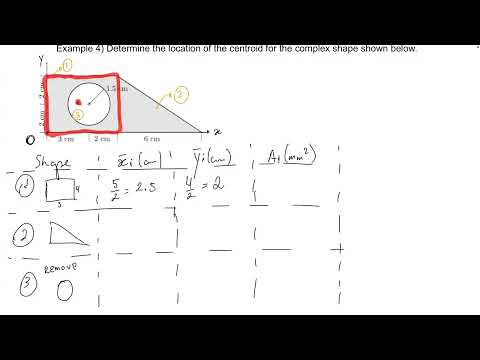
- Model a shape with a circular hole as a complete outer shape plus a circle whose area is negative.
- The same subtraction method works for missing quarter circles and other familiar cutouts.
- A removed shape's centroid coordinates remain ordinary coordinates; its negative area supplies the subtraction in the composite calculation.
- The worked shape is split into a 5-by-4 rectangle, a triangle, and a circular hole with radius 1.5.
- The rectangle contributes area 20 at coordinates (2.5, 2); the triangle contributes area 12 at approximately (7, 4/3).
- The hole contributes approximately negative 7.07 at coordinates (3, 2), producing a net area of about 24.93.
- The resulting composite centroid is approximately x = 4.5 and y = 1.7.
- The centroid of a cutout or concave shape can lie outside the material without indicating a calculation error.
- For a symmetric C-shaped section, removing material shifts the centroid toward the opening, potentially placing it in empty space.
- The centroid is especially useful as a reference for later calculations, such as locating axes and dividing a section into regions.
- Students break a more complex section into four familiar shapes, including a rectangle, a triangle, a semicircle, and a circular cutout.
- The example includes outer and inner radii of 60 and 40, so each circle-related area must use the correct radius.
- Guidio emphasizes that changing the coordinate axes changes the reported centroid coordinates, but not the centroid's physical location.
- The rectangular component measures 120 by 80, has area 9,600, and has centroid coordinates (60, 40).
- The triangle has base 120 and height 60, area 3,600, and centroid coordinates (40, -20) relative to the chosen axes.
- The semicircle uses radius 60; its horizontal centroid coordinate is 60 and its vertical coordinate is built from the 4r/(3π) offset plus the 80-unit baseline.
- The full circular cutout is assigned negative area and centroid coordinates based on the given dimensions.
- Guidio recommends summing component areas once before calculating either centroid coordinate, then using that same denominator for both.
- The four-component example yields a combined area of approximately 13,828 and a centroid near (54.8, 36.6).
- Distributed loads act over a length, area, or volume; examples include building weight, wind, water pressure, earth pressure, and snow on a roof.
- For equilibrium and reaction calculations, a distributed load can be replaced by an equivalent concentrated force.
- The replacement preserves the total force and moment for equilibrium calculations, but it does not reproduce the same structural bending or stress effects.
- The magnitude of the equivalent point force equals the area under the load-intensity diagram.
- Its line of action passes through the centroid of that diagram, connecting the composite-area methods to distributed-load analysis.
- Use the equivalent force and its centroid location to calculate support reactions with force and moment equations.
- For a uniform rectangular load, the resultant is W times L and acts at the midpoint; 2 kN/m over 5 m gives 10 kN at 2.5 m.
- For a triangular load, the resultant is one-half W times L; a 2 kN/m peak over 5 m gives 5 kN.
- The triangular resultant acts at the triangle centroid: L/3 from the high-intensity end, or 2L/3 from the zero-intensity end.
- A trapezoidal load can be represented as a rectangle of intensity W1 plus a triangle of peak intensity W2 minus W1.
- The rectangular component has resultant W1L at L/2; the triangular component has resultant (W2 - W1)L/2.
- Place the triangular component at its centroid, 2L/3 from its zero-intensity end, and use both forces in equilibrium calculations.
- The final beam example has a pin at A, which provides Ax and Ay reactions, and a roller at B, which provides By.
- Before writing equilibrium equations, replace the 4 kN/m rectangular load over 0.5 m with a 2 kN downward resultant.
- The resultant is placed at the midpoint of the loaded segment, shown 0.55 m from A and 0.8 m from B.
- Horizontal force equilibrium gives Ax = 0 because the example has no other horizontal force.
- Vertical force equilibrium gives Ay + By - 2 = 0, with forces in kilonewtons.
- Taking moments about A gives By(0.8) = 2(0.55), so By = 1.375 kN and Ay = 0.625 kN.
Transcript excerpt
0:01 All right guys, lecture 16 engine 2011. In the name of the father, son, holy spirit. Amen. Direct the lord, we beseech you our actions by holy inspirations and carry them all by grace's assistance that every prayer and work of ours may begin ours and through you come to completion through Christ our Lord. Amen. Father, son, holy spirit. Amen. Okay. So, just a few things. Don't forget we have the homework due next week, next Tuesday. If you have any questions about it, let me know. So, after today, you should be able to to finish the homework uh about St. Droids.
0:50 See if my iPad is going to work here. If you submit the extra point uh activity, I will grade it probably in the next few days and let you know by email uh the the upgraded um the grade. So you should be able to to get it iPad or okay. Oh yeah, the last thing is no wrong. Let me take a look here again. November 10th is our second exam. So next week we have a new topic and then
1:42 the beginning of the other week as well. Then November 10th, okay, is our next exam. So if you need to put in the calendar or just make sure you are here, November 10th is our second exam. I think that's it. Any other questions? All good or Okay. So we start discussing last class uh about centroidids. Centroids are properties of the shape of the shape of the structure. Okay. Of the area of the structure. So pretty much we just went a little bit off of what we
2:31 are studying but we're going to come back in a moment. Okay, by the end of this class we're going to come back
This is the start of the transcript. Save this video free for the whole transcript, searchable and time-coded.
Related notes
Summary, takeaways, and chapters were generated by AI from the video's transcript and may contain errors. The video belongs to its creator, Bruno Guidio, PhD.