ENGR 201 Fall 2026 - Lecture 15: Centroids
 Watch on YouTube →
Overview
Bruno Guidio introduces centroids as geometric properties of shapes, distinct from centers of mass and gravity, and shows how to locate them using area-weighted coordinates. He develops the composite-area method, explains centroid locations for common shapes, and works through examples involving an L shape, a symmetric composite section, and regions with negative coordinates.
Key takeaways
- A centroid is a property of shape rather than material: changing an object's density or weight does not change its centroid if its geometry stays the same.
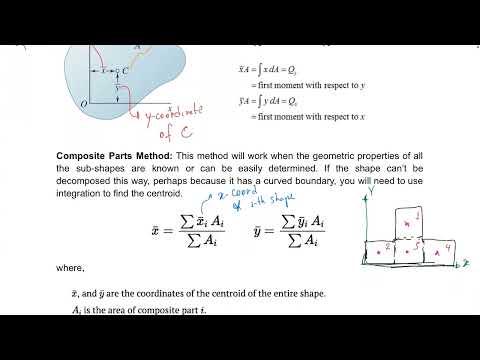
- For a composite area, calculate x̄ = Σ(xᵢAᵢ)/ΣAᵢ and ȳ = Σ(yᵢAᵢ)/ΣAᵢ, measuring every component centroid from the same selected axes.
- Triangle centroid distances depend on orientation and reference corner: a triangle's centroid is b/3 from one end of its base and 2b/3 from the other.
- A rough estimate based on removed or added area is a useful error check; the 7-by-8 L-shape example should have x̄ < 3.5 and ȳ < 4.
- Symmetry can determine a centroid coordinate without calculation: the three-component example has x̄ = 6 in, and the final symmetric section has x̄ = 0.
- When a component lies below an axis, keep its area positive but use a negative centroid coordinate in the weighted sum; this produces ȳ ≈ 4.62 in for the final section.
Chapters
0:00
Lecture 15 Roadmap: Centroids and Future Applications
- Bruno Guidio introduces centroids as a new topic in ENGR 201 mechanics, distinct from the force and moment calculations covered previously.
- Centroid concepts will support distributed-load analysis later in the week and applications such as bending stress in future engineering courses.
- Guidio previews a return to forces and moments next week, followed by preparation for exam number two.
2:26
Centroid Versus Center of Mass and Center of Gravity
- A center of gravity represents the point where an object's total weight can be treated as acting, while a center of mass represents its mass distribution.
- With uniform gravity, center of mass and center of gravity usually coincide, but neither is defined in the same way as a centroid.
- The centroid depends on shape alone, not on an object's material, mass, or weight.
8:45
Area Moments and the Composite-Area Centroid Equations
- A centroid balances the geometric first moments of area on opposite sides of the point, analogous to balancing a rectangular tabletop on a finger.
- For a continuous shape, the coordinates follow x̄ = ∫x dA / A and ȳ = ∫y dA / A.
- For component shapes, use x̄ = Σ(xᵢAᵢ)/ΣAᵢ and ȳ = Σ(yᵢAᵢ)/ΣAᵢ, with each component's centroid coordinates measured from the chosen axes.
13:16
Reference Centroids for Rectangles, Circular Sections, and Triangles
- A rectangle's centroid lies at its midpoint, so its coordinates from a corner are b/2 and h/2.
- The reference table includes circular-section formulas, including a semicircular centroid distance of 4r/(3π) from its diameter.
- A triangle's centroid lies one-third of the base and height from the right-angle corner; reversing its orientation can make the measured base-direction distance 2b/3 instead.
- Guidio recommends splitting a trapezoid into a rectangle and triangle when that makes centroid calculations easier.
17:35
Estimate the L-Shaped Section's Centroid Before Calculating
- The first example is an L shape decomposed into two rectangles, though alternative decompositions should produce the same result.
- A 7-by-8 bounding rectangle would have its centroid at (3.5, 4), providing a reference for checking the L-shape result.
- Removing area from the upper-right side shifts the centroid left and downward, so the expected coordinates should be less than 3.5 and 4.
21:40
Calculate the L Shape with Area-Weighted Coordinates
- The 7-by-2 rectangle has area 14 and centroid coordinates (3.5, 1) from the axes at the bottom-left.
- The 3-by-6 rectangle has area 18 and centroid coordinates (1.5, 5); its vertical coordinate includes the 2-unit offset below it.
- Combining the two rectangles gives x̄ = (1.5×18 + 3.5×14)/32 = 2.375 in and ȳ = (5×18 + 1×14)/32 = 3.25 in.
- The result is consistent with the initial estimate that the centroid shifts left and downward from the 7-by-8 rectangle's center.
29:12
Practice Decomposing a Composite Shape into Familiar Parts
- Students work individually or with a colleague to choose a decomposition for a second composite section.
- The shape may be split into multiple rectangles and triangles, or handled with a trapezoid if its centroid formula is known.
- Guidio emphasizes locating each component centroid relative to the diagram's orange origin and accounting for triangle orientation.
36:41
Solve the Symmetric Composite Section Using Three Components
- Guidio decomposes the shape into a 12-by-2 rectangle and two identical right triangles, each with base 3 and height 4.
- The rectangle has area 24 and centroid coordinates (6, 1); each triangle has area 6 and vertical coordinate 10/3.
- The two triangles' horizontal centroid coordinates are 1 and 11, measured from the left origin, so symmetry keeps the combined x-coordinate at 6 in.
- Area weighting gives ȳ = (24×1 + 6×10/3 + 6×10/3)/36 ≈ 1.78 in.
46:14
Use Symmetry to Simplify a Section with Shifted Axes
- In the final example, the axes are moved, placing portions of the composite shape in regions with negative coordinates.
- The shape is symmetric about the vertical axis, so its centroid's horizontal coordinate is known to be x̄ = 0 without calculation.
- Guidio splits the shape into three regions to calculate only ȳ and to make the below-axis contribution explicit.
50:20
Assign Component Centroids and Areas Around the New Origin
- The upper rectangle is 8 by 10, with area 80 and centroid y-coordinate 4 from the shifted horizontal axis.
- The pair of symmetric triangles is treated together: combined area 30 and centroid y-coordinate 10, using h/3 plus the 8-unit offset.
- The lower rectangle is 2 by 10, with positive area 20 but centroid y-coordinate −1 because it lies below the horizontal axis.
53:35
Apply Signed Coordinates and Interpret the Final Centroid
- The final vertical coordinate is ȳ = (4×80 + 10×30 + (−1)×20)/(80 + 30 + 20) ≈ 4.62 in.
- Only the coordinate is negative for the lower rectangle; its area remains positive because the region still exists.
- The negative-coordinate contribution lowers the centroid, while changing the origin changes the reported coordinates but not the physical centroid location.
Summary, takeaways, and chapters were generated by AI from the video's transcript and may contain errors. The video belongs to its creator, Bruno Guidio, PhD.