ENGR 201 Fall 2026 - Lecture 05: 3D System (Vectors)
 Watch on YouTube →
Overview
Bruno Guidio teaches how to represent 3D forces in Cartesian vector form, first using direction cosines and then using two points on a force’s line of action. The core method is to subtract endpoint coordinates, normalize the resulting displacement, and multiply by the force magnitude; worked examples apply it to 2500 N, 420 N, and 840 N cable forces.
Key takeaways
- For endpoints M and N on a 3D force’s line of action, calculate N − M first; reversing the order reverses every component sign.
- Normalize a displacement (Δx, Δy, Δz) by √(Δx² + Δy² + Δz²) to obtain a unit direction vector with magnitude 1.
- A force vector requires both magnitude and direction: multiply the unit vector by the given force magnitude rather than reporting λ alone.
- For the 2500 N example, B − A = (−40, 80, 30) m and the resulting force is approximately (−1060, 2120, 795) N.
- For the 420 N AC example, the displacement (3, −6, 2) has length 7, producing components (180, −360, 120) N.
- For the 840 N AB example, the displacement (−2, −6, 3) also has length 7, producing components (−240, −720, 360) N.
Chapters
0:00
Course Context and Preview of 3D Particle Equilibrium
- Bruno Guidio transitions from 2D particle equilibrium to representing vectors in three dimensions.
- He notes that the next class will extend particle-equilibrium calculations to 3D.
- Late homework submissions are still accepted during the week, with a stated penalty of about 30%.
2:00
Adding the Z Axis to Cartesian Vector Notation
- A 3D Cartesian vector uses the basis directions i, j, and k for x, y, and z.
- Unlike a 2D vector, a 3D force generally has x-, y-, and z-components.
- The direction of a vector cannot be described by a single planar reference angle.
4:00
Direction Cosines for 3D Vector Components
- The angles θx, θy, and θz are measured between the vector and the positive x, y, and z axes.
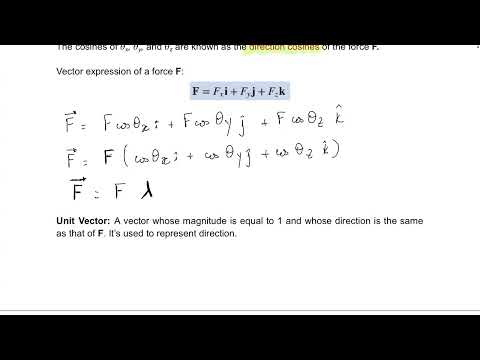
- Each component is the force magnitude multiplied by the cosine of its corresponding direction angle: Fx = F cos θx, with analogous expressions for y and z.
- All three direction cosines are used to describe the vector’s orientation in 3D.
8:00
Writing a Force as Magnitude Times Unit Vector
- Guidio writes a force as F = Fλ, where F is the scalar magnitude and λ is a unit vector pointing in the force’s direction.
- A unit vector has magnitude 1; i, j, and k are coordinate-axis examples.
- The direction unit vector can be written as λ = cos θx i + cos θy j + cos θz k.
12:00
Using Two Line-of-Action Points Instead of Three Angles
- Two known points on a force’s line of action are sufficient to determine its direction without directly finding three angles.
- For endpoints M(x1,y1,z1) and N(x2,y2,z2), the displacement from M to N is N − M.
- The chosen point order matters because reversing endpoints reverses the vector’s signs and direction.
17:00
Normalize the Endpoint Displacement to Find λ
- The displacement components are Δx = x2 − x1, Δy = y2 − y1, and Δz = z2 − z1.
- Its length is dMN = √(Δx² + Δy² + Δz²), the 3D extension of the Pythagorean theorem.
- The unit vector is λ = (Δx i + Δy j + Δz k)/dMN; dividing by the length preserves direction while making the magnitude 1.
22:00
Convert the Unit Direction into Cartesian Force Components
- Substituting λ into F = Fλ gives force components proportional to Δx, Δy, and Δz.
- The force magnitude must still multiply the unit vector; omitting it yields direction only, not the full force.
- The direction cosines can also be recovered as Δx/dMN, Δy/dMN, and Δz/dMN, with inverse cosine used to obtain the angles.
28:00
Set Up the 2500 N Cable Force from Points A and B
- The first cable example asks for Cartesian components of a 2500 N force acting on a bolt.
- Using the diagram’s axes, Guidio identifies A = (40, 0, −30) m and B = (0, 80, 0) m.
- The force direction is taken from A to B, so the displacement is B − A rather than A − B.
34:00
Calculate the First Cable’s Direction and Force Components
- The displacement B − A is (−40, 80, 30) m, with signs determined by the selected axis directions.
- Its length is √(40² + 80² + 30²) = √8900 ≈ 94.34 m.
- Multiplying the normalized displacement by 2500 N gives approximately F = (−1060 i + 2120 j + 795 k) N.
46:00
Practice Applying the Two-Point Method to Cable AC
- Guidio assigns a second diagram-based problem: find the Cartesian form of the 420 N force along cable AC.
- Students work through endpoint coordinates, displacement, length, unit vector, and force components, with time to compare calculations with classmates.
- He emphasizes checking where the force starts and where it points, and warns that changing axis conventions can flip component signs.
57:00
Resolve the 420 N Force Along Cable AC
- The stated coordinates are A = (0, 6, 0) and C = (3, 0, 2).
- The displacement AC = C − A = (3, −6, 2), whose length is 7.
- For a 420 N force directed from A to C, the Cartesian vector is (180 i − 360 j + 120 k) N.
1:00:00
Resolve the 840 N Force Along Cable AB and Review
- Guidio uses A = (0, 6, 0) and B = (−2, 0, 3), giving AB = (−2, −6, 3) and length 7.
- For an 840 N force from A to B, the components are (−240 i − 720 j + 360 k) N.
- He closes by reminding students to label multiple unit vectors by their cables, such as λAC and λAB, and to verify signs against the diagram’s axes.
Summary, takeaways, and chapters were generated by AI from the video's transcript and may contain errors. The video belongs to its creator, Bruno Guidio, PhD.