ENGR 201 Fall 2026 - Lecture 13: 2D Equilibrium of a Rigid Body
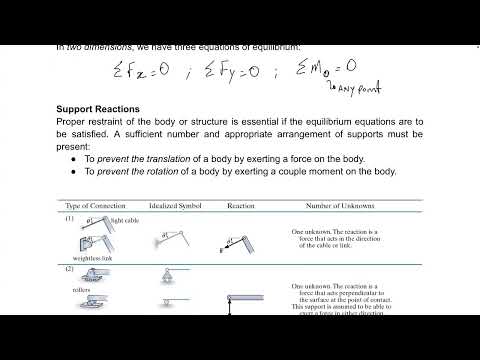 Watch on YouTube →
Overview
Bruno Guidio develops the 2D rigid-body equilibrium method: identify supports and their reactions, draw a free-body diagram, then apply ΣFx = 0, ΣFy = 0, and ΣM = 0. Worked examples find beam reactions under angled and point loads, then crane reactions using the weights of a 1,000 kg crane and a 2,400 kg crate.
Key takeaways
- A 2D rigid body in equilibrium must satisfy three independent conditions: ΣFx = 0, ΣFy = 0, and ΣM = 0.
- Support type determines the unknown reactions: a roller gives one normal force, a pin gives two force components, and a fixed support gives two force components plus a moment.
- For a determinate 2D problem, match three unknown reactions to the three equilibrium equations; choosing a moment center at a support can eliminate its reaction from the equation.
- A negative solved reaction means its actual direction opposes the direction assumed in the free-body diagram, as with the beam's Bx of −424.26 N and crane's Ax of approximately −107,256 N.
- The 0.2 m thickness of the beam matters because a horizontal load applied above its reference line creates a moment through its vertical offset.
- Using g = 9.81 m/s², the crane example's 1,000 kg crane and 2,400 kg crate weigh 9,810 N and 23,544 N, respectively, producing a wall reaction of about 107,256 N.
Chapters
0:00
Exam 1 Grading, Optional Extra Credit, and Exam 2 Scope
- Exam 1 grades are expected to be posted by lunchtime the next day, with time available Thursday to discuss them.
- Students below a class-dependent threshold near 75% or 80% may be offered optional extra-credit problems to raise the Exam 1 score up to that range.
- Exam 2 is planned for three weeks later and begins with material introduced in this lecture; the final exam will be comprehensive.
3:10
Rigid-Body Equilibrium Requires Both Force and Moment Balance
- Particle equilibrium uses ΣFx = 0 and ΣFy = 0, but many engineering structures require accounting for their length, size, and shape.
- A rigid body is in equilibrium when it neither translates nor rotates under the applied loads.
- The 2D conditions are ΣFx = 0, ΣFy = 0, and ΣM = 0; the net moment can be evaluated about any point.
8:20
Support Reactions Counter Loads and Restrict Motion
- Supports provide reaction forces or moments that oppose external loads and prevent unwanted movement.
- A support may restrict horizontal translation, vertical translation, rotation, or some combination of those motions.
- For a table supporting Bruno's weight, the legs provide reactions that keep the table from moving down or rotating.
13:00
Recognize Cable, Roller, Pin, Slider, and Fixed Supports
- A cable supplies one tension reaction along the cable; a roller or rocker supplies one force perpendicular to its contact surface.
- A smooth surface and a smooth pin-in-collar contact also provide one normal reaction, while a pin or hinge supplies separate x- and y-reactions but permits rotation.
- A slider can provide two reactions that prevent motion in two ways while permitting translation along its track; a fixed support supplies x-, y-, and moment reactions.
22:00
Build a Free-Body Diagram and Count Unknown Reactions
- Isolate the structure in a free-body diagram and replace each support with the reaction components implied by its constraints.
- Include a structure's weight at its center of gravity when the problem requires it; use a provided center-of-gravity location for irregular shapes.
- A beam supported by a pin at A and a roller at B has Ax, Ay, and By: three unknowns for the three 2D equilibrium equations.
- Two pin supports would create four reaction unknowns, beyond the three-equation method used for determinate problems in this course.
27:30
Set Up the Beam Problem with Angled and Point Loads
- The first worked example asks for the horizontal and vertical reactions at pin B and the reaction at roller A.
- The beam has a stated thickness of 0.2 m, which matters when locating the moment arm of a horizontal force applied above its centerline.
- The beam's own weight is excluded, and a 600 N angled force is resolved into 600 cos 45° and 600 sin 45° components.
30:00
Draw Beam Reactions from the Pin and Roller Constraints
- Pin B prevents horizontal and vertical translation, so the free-body diagram includes Bx and By.
- Roller A rests on a horizontal surface, so its single reaction Ay acts vertically, perpendicular to the surface.
- The diagram also includes the 200 N and 100 N loads, beam dimensions, and the two components of the 600 N force.
34:00
Use ΣFx and ΣFy to Relate the Beam Reactions
- Taking rightward as positive, ΣFx = 0 gives Bx + 600 cos 45° = 0, so Bx is approximately −424.26 N.
- The negative sign means the actual Bx direction is opposite the arrow initially assumed in the free-body diagram; it does not by itself indicate compression.
- Taking upward as positive, ΣFy = 0 gives Ay + By − 600 sin 45° − 100 − 200 = 0, or Ay + By = 724.26 N.
41:00
Choose a Moment Center That Eliminates Unknown Reactions
- Any point can be used for ΣM = 0, but choosing a support reaction's location eliminates that reaction because its moment arm is zero.
- Taking moments about A leaves By as the only unknown reaction in the moment equation; taking moments about B instead isolates Ay.
- For moments about B, Bx, By, and the 200 N force have zero moment arms because their lines of action pass through B.
48:00
Solve the Beam Moments and Interpret the Reaction Directions
- The moment equation about B accounts for Ay at a 7 m arm, the vertical component of the 600 N load at 5 m, and the 100 N load at 2 m.
- The horizontal 600 cos 45° component has a 0.2 m vertical offset from the beam reference line, so the beam thickness affects its moment.
- The solution gives Ay ≈ 319.49 N and, from vertical force balance, By ≈ 404.77 N; the horizontal reaction is 424.26 N opposite the assumed Bx arrow.
- These support reactions are inputs for later design of connections, columns, and analysis of beam stresses.
53:00
Convert Crane and Crate Masses into Loads and Reactions
- The crane example uses a 1,000 kg crane and a 2,400 kg crate, with the crane's weight applied at its stated center of gravity.
- Using g = 9.81 m/s² gives a crane weight of 9,810 N and a crate weight of 23,544 N.
- The pin at A supplies Ax and Ay, while the roller against a vertical wall at B supplies a horizontal reaction Bx.
58:00
Apply Crane Force Balance Before Taking Moments
- Horizontal equilibrium gives Ax + Bx = 0, so the two horizontal support reactions have equal magnitudes and opposite directions.
- Vertical equilibrium balances Ay against the 9,810 N crane weight and 23,544 N crate load.
- Together, the vertical loads total 33,354 N, so Ay must provide an upward reaction of 33,354 N.
1:01:00
Find Crane Bx from Moments and Check the Physical Response
- Taking moments about A removes Ax and Ay from the moment equation; the crate's 23,544 N load acts at 6 m and the crane's 9,810 N weight at 2 m.
- The wall reaction Bx has a 1.5 m moment arm, yielding Bx ≈ 107,256 N; horizontal force balance gives Ax ≈ −107,256 N.
- A negative Ax indicates the actual direction is opposite the assumed arrow, and a physical visualization helps check how the reactions counter the crane's tendency to rotate.
Summary, takeaways, and chapters were generated by AI from the video's transcript and may contain errors. The video belongs to its creator, Bruno Guidio, PhD.