ENEE 684 Lecture 23
Overview
Ergun Simsek connects ultrafast-laser pulse metrics to practical dispersion control and pulse measurement. The lecture quantifies repetition rate, pulse energy, peak power, intensity, and time-bandwidth product, then compares grating, prism, chirped-mirror, and 4F compensation with chirped-pulse amplification, autocorrelation, and FROG.
Key takeaways
- At 100 MHz, a 100 fs laser has a duty cycle of 10⁻⁵; a 500 mW, 80 MHz source nevertheless carries 6.25 nJ per pulse.
- Peak power depends on pulse shape as well as energy and duration: a 100 pJ, 100 fs rectangular pulse reaches 1 kW, while Gaussian and sech² profiles use shape corrections.
- Transform-limited time-bandwidth products are about 0.441 for Gaussian pulses and 0.315 for sech² pulses; larger measured values indicate dispersion or chirp.
- Fused silica near 800 nm contributes roughly 36 fs²/mm of group-delay dispersion, making component thickness and total glass path important in femtosecond experiments.
- Chirped-pulse amplification protects amplifier optics by stretching a pulse before amplification and recompressing it afterward, supporting millijoule-scale pulses.
- Autocorrelation estimates ultrashort-pulse duration from delayed pulse overlap, while FROG adds spectral information through a delay-scanned nonlinear measurement.
Chapters
- Mode locking combines many cavity modes to generate ultrashort pulses.
- The lecture links pulse intensity, power, and energy to dispersion management and pulse characterization.
- Free-space optics techniques supplement the fiber-dispersion methods discussed in an earlier lecture.
- Repetition period and repetition frequency are reciprocals: a 100 MHz laser emits pulses every 10 ns.
- A Ti:sapphire laser operating at 80 MHz has a 12.5 ns pulse period.
- For 100 fs pulses at 100 MHz, the duty cycle is 10⁻⁵, so light is present for only a tiny fraction of each second.
- Single-pulse energy is average power divided by repetition frequency; 500 mW at 80 MHz gives 6.25 nJ per pulse.
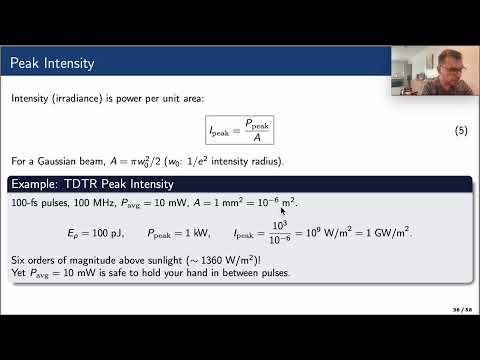
- A 100 pJ pulse lasting 100 fs has a rectangular-pulse peak power of 1 kW; Gaussian and sech² pulse shapes require factors of about 0.94 and 0.88.
- Peak intensity is peak power divided by beam area; 1 kW over 1 mm² is 1 GW/m², despite modest average power.
- A 10 mW average-power laser can therefore produce intense, brief pulses, which is why focusing and laser safety matter.
- The time-bandwidth product multiplies pulse duration by frequency bandwidth and is dimensionless.
- For transform-limited pulses, the lower bounds are approximately 0.441 for Gaussian pulses and 0.315 for sech² pulses.
- A measured product well above the relevant limit indicates excess chirp or dispersion in the optical system.
- Chirp means that instantaneous frequency varies across the pulse, causing different parts of the pulse to accumulate different delays.
- As a chirped pulse propagates through dispersive optics, it can broaden in time and its time-bandwidth product can increase.
- For a 50 fs sech² pulse centered at 800 nm, the lecture estimates a bandwidth near 6.3 THz, or about 13.4 nm.
- Ti:sapphire systems are tunable across a broad near-infrared range and commonly produce pulses from roughly 5 to 100 fs at 80 to 100 MHz.
- Ytterbium- and erbium-doped fiber lasers operate near 1 μm and 1.55 μm, respectively, while Nd:YAG light near 1064 nm can be frequency-doubled to 532 nm.
- Oscillators typically produce nanojoule-scale pulses; chirped-pulse amplification enables much higher pulse energies.
- A material's refractive index varies with frequency, so spectral components travel at different group velocities and can separate in time.
- Group-velocity dispersion is related to the second frequency derivative of propagation constant β; free-space optics often reports it in fs²/mm.
- For fused silica near 800 nm, the lecture uses a GDD value near 36 fs²/mm and estimates a dispersion length near 10 cm for a 100 fs pulse.
- Normal and anomalous dispersion have opposite signs; compensating elements can be selected to offset accumulated dispersion.
- Diffraction-grating pairs create wavelength-dependent paths to compensate pulse dispersion, with the lecture identifying them as suitable for large dispersion.
- Prism pairs use wavelength-dependent refraction and adjustable prism spacing to tune the relative path lengths of spectral components.
- Chirped mirrors use layered dielectric coatings to give different wavelengths different penetration depths and group delays.
- The lecture compares approximate correction ranges of 1000 fs² for gratings, 100 fs² for prisms, and 10 fs² for mirrors, while noting that the appropriate choice depends on the system.
- A 4F pulse shaper uses gratings, lenses, and a spectral modulator arranged at equal focal-length spacings to manipulate wavelength components.
- Chirped-pulse amplification, developed by Donna Strickland and Gérard Mourou, stretches a pulse before amplification and recompresses it afterward.
- Stretching lowers peak intensity inside the amplifier, reducing damage risk while enabling amplification from nanojoule to millijoule pulse energies.
- A mode-locked laser's comb-line frequencies follow fₘ = fCEO + m·fREP, where fCEO is the carrier-envelope offset and fREP is the repetition frequency.
- Frequency combs support atomic clocks, spectroscopy, and dense wavelength-division multiplexing.
- Autocorrelation splits a pulse into two delayed copies and measures their overlap as delay changes, providing a pulse-width estimate even when photodetectors cannot resolve femtosecond pulses.
- Rick Trebino's FROG approach adds spectral measurement to a scanned-delay, second-harmonic-generation setup, recording intensity versus wavelength and delay.
- Using 36 fs²/mm for fused silica, the lecture estimates that 5 mm of glass has little effect on a 100 fs pulse, while 5 cm can broaden it substantially.
- Optical tables accumulate dispersion from components including beam splitters, lenses, and crystals, so total glass thickness and path length should be tracked.
- Thin optics and short propagation paths help limit dispersion before grating pairs, prisms, mirrors, or pulse shapers are added.
- The lecture closes by recapping pulse metrics and previewing photodetector topics including PIN devices, responsivity, quantum efficiency, and dark-current noise.
Transcript excerpt
0:20 Okay guys, um so like last time uh we talked about uh ultrash short pulses, right? ultra fast uh pulses. We saw that uh when you have a cavity with a large gain factor like broadband gain we can create thousands of modes and those thousands of modes then when they are logged in then we can uh generate ultra short ultra fast uh pulses. So today's uh online uh recording uh we'll see a bunch of equations uh we'll go over like bunch of numbers to understand uh the intensity uh the power energy um then we'll talk about um dispersion.
1:12 So remember in the previous previously we we talk about dispersion in fiber optics optical fibers. In this uh chapter we will talk about uh how to deal with dispersion in free space optics. Okay. Um then uh after reviewing you know four different techniques of dispersion management then we will talk about autocorrelation uh and frog and then we will conclude and after the Thanksgiving break uh we can [snorts] uh start our chapter 14 uh 13 I believe which is like photo detectors. Okay. So let's start again. This is uh professor Donna Strickland at UNMBC uh
2:02 in March uh 2025. Um so when we have like a mod lock laser it has a certain repetition frequency right so repetition frequency meaning that the the so that will be a time difference between each pulses uh and it is it will be periodic. So in the time domain we call it um TRAP right repetition period. So one over tap is uh repetition frequency. For example our uh my Thai laser it is repetition frequency is 80 MHz. There are some other different models for former ones or other brands their uh repetition frequency can go up to 100
This is the start of the transcript. Save this video free for the whole transcript, searchable and time-coded.
In this course
Related notes
Summary, takeaways, and chapters were generated by AI from the video's transcript and may contain errors. The video belongs to its creator, Ergun Simsek.