ENEE 684 Lecture 21
Overview
Ergun Simsek explains semiconductor laser operation through optical feedback, resonant modes, threshold gain and current, and the carrier-photon rate equations. He connects those fundamentals to practical design and lab choices, including free spectral range and detector limits, temperature drift, DFB and VCSEL architectures, and how output power affects modulation and linewidth.
Key takeaways
- A semiconductor laser reaches threshold when modal gain balances internal and mirror losses, with Γg_th = α_i + ln[1/(R1R2)]/(2L).
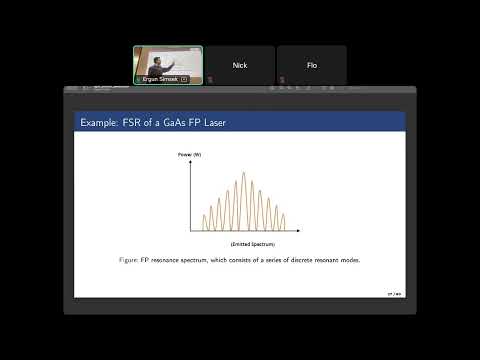
- Cavity length determines both the threshold tradeoff and resonant-mode spacing: a 300 micrometer cavity with group index 3.64 has an FSR near 137 GHz, which can exceed photodetector bandwidth.
- Laser output power is approximately proportional to drive current above threshold, so current doubling does not imply power doubling; two current-power measurements can help estimate the threshold current.
- Temperature control matters for wavelength stability: the cited GaAs shift of 0.3 nm/°C implies about 3 nm of drift across a 10 °C change.
- DFB gratings select a Bragg-resonant wavelength, while VCSELs produce circular beams that are convenient for fiber coupling; the architectures prioritize different output characteristics.
- Higher laser output power can support greater modulation bandwidth, while spontaneous emission and the Henry linewidth-enhancement factor contribute to spectral broadening.
Chapters
- The class sets December 7 for short term-paper presentations, with each student allotted roughly five to six minutes.
- Simsek introduces threshold current: below threshold, a diode emits mainly spontaneous emission like an LED; sufficient carrier injection enables lasing.
- Mode locking and pulse generation are previewed for the next class, with many resonant modes and a long gain medium identified as important.
- LEDs and laser diodes both produce electron-hole pairs, but a laser adds an optical-feedback cavity such as a Fabry-Perot resonator or ring resonator.
- Stimulated emission creates a photon matching the incoming photon in frequency, direction, and momentum, supporting coherent amplification.
- A laser's output spectrum is much narrower than broadband LED emission, though gain-medium design involves tradeoffs between output and spectral characteristics.
- In a Fabry-Perot diode, resonant modes satisfy a round-trip cavity condition; a 1 cm cavity can support mode numbers in the thousands at near-infrared wavelengths.
- The frequency free spectral range is approximately c/(2n_gL); for a 1 cm cavity and group index 2.5, it is about 6 GHz.
- A 300 micrometer cavity with group index 3.64 has an estimated FSR of 137 GHz, beyond the bandwidth of some lab photodetectors.
- An optical spectrum analyzer must resolve the wavelength spacing: Simsek contrasts a roughly 2 nm instrument with a higher-resolution instrument near 0.1 nm.
- The laser threshold condition balances modal gain against internal loss and mirror loss: Γg_th = α_i + α_m.
- Mirror loss is estimated as α_m = ln[1/(R1R2)]/(2L), where R1 and R2 are facet reflectivities and L is cavity length.
- A shorter cavity generally requires greater threshold gain and current; a longer cavity can increase internal absorption, so designers optimize cavity length.
- One facet is often made less reflective than the other so a portion of the intracavity light exits as useful output.
- The carrier number needed for threshold depends on transparency carrier density, threshold gain, and differential gain.
- A threshold-current estimate uses the active-region volume and carrier lifetime, commonly expressed as I_th = qVN_th/τ_n.
- In the worked GaAs example, the stated dimensions are 300 micrometers by 3 micrometers by 0.1 micrometer, with 10 cm⁻¹ internal loss and 0.3 modal overlap.
- The example uses facet reflectivities of 0.32 and estimates a threshold current near 15 mA, while Simsek notes that several assumed design values are unrealistic.
- The coupled time-domain rate equations track carrier number N and photon number S, including injected current, stimulated emission, spontaneous emission, and photon loss.
- Photon lifetime depends on group velocity and total internal plus mirror loss; the spontaneous-emission factor β accounts for photons not produced through stimulated emission.
- Once the laser reaches steady state, output power rises approximately in proportion to drive current above threshold, rather than to total current.
- For a 20 mA threshold example driven at 60 mA, Simsek calculates about 40 mW output using an estimated differential efficiency near 0.7.
- The modulation bandwidth depends on photon population, differential gain, group velocity, and photon lifetime; shorter photon lifetime can support faster modulation.
- Higher optical output power generally enables higher modulation bandwidth, which matters when encoding data by modulating a laser.
- Simsek recommends allowing roughly 30 to 45 minutes for a laser setup to thermally stabilize before relying on its operating wavelength.
- For GaAs, a wavelength shift near 0.3 nm per °C means a 10 °C room-temperature change can move the resonance by about 3 nm.
- A distributed-feedback laser uses a periodic refractive-index grating to select a Bragg-resonant wavelength and narrow the output spectrum.
- For a 1550 nm target and effective index 3.22, the example grating period is about 242 nm; the structure can be fabricated by etching.
- A vertical-cavity surface-emitting laser, or VCSEL, uses alternating high- and low-index layers along the vertical axis and emits a circular beam that couples conveniently into fiber.
- Simsek contrasts the narrow spectral output associated with DFB designs with the fiber-coupling advantage of VCSELs.
- Spontaneous emission adds randomness and broadens a laser's spectral line, while a grating-based DFB architecture can constrain the selected wavelength.
- An early linewidth estimate linked linewidth to laser parameters including output power, but later work added the Henry linewidth-enhancement factor, α_H.
- Simsek gives α_H values of roughly 2 to 3 for bulk lasers and near zero for quantum-well lasers, noting the early estimate is more suitable for quantum wells.
- The correction can make a bulk-laser linewidth substantially wider than the original estimate, and is also connected to frequency chirp.
- Simsek gives approximate spectral-width examples of 100 nm for inexpensive LEDs and 10 nm for inexpensive Fabry-Perot lasers.
- The lecture cites DFB frequency linewidths around 1 to 10 MHz and contrasts them with broader laser types.
- The examples emphasize that laser architecture and operating conditions can shape the spectrum, rather than simply scaling the entire spectrum with output power as in an LED.
- Doubling drive current does not generally double laser output because power scales with current above threshold, not with total current.
- Two current and power measurements can help estimate threshold: for example, if threshold is 5 mA, increasing drive from 10 to 20 mA triples the current above threshold.
- Simsek closes by assigning the next class to ultrafast lasers and asks students to email their term-paper topic before approximately December 1.
Transcript excerpt
0:01 Okay, now let's start. >> So, what does that mean for the presentation dates? I'm sorry. I think I might have missed some of it. >> will be December 7. >> Okay. Uh, all of us on one day? >> Yeah, just five minutes each. >> Okay, that's fine. December. I'll put it in my calendar. Thank you. >> Thank you. All right, let's start. Sorry for being a little late. We are 14 minutes late. So, >> What is the final exam date? >> Who decides that? >> There is no >> When is it? >> Friday. >> Friday? >> The 11th, I think of December. >> The 11th? >> Oh, right. I'm getting married the 11th. >> What? Congratulations. Why? Why are you doing this mistake? Don't do that. >> So, I don't know. So,
0:47 obviously it will be the 11th if it's the 11th. >> Okay. >> [laughter] >> Okay, so that's Friday. >> Yeah, no, I'm just thinking I my undergrad wrote it the same way. That's the only reason I know. >> All right, let's talk about lasers a bit. Yeah, actually for me like there were a couple of questions before I started doing research in the lab.
1:37 Like I was turning on the device, but it was not lasing for a while. Then I learned that there's this threshold. We have to apply enough current. We should provide enough number of electrons to the higher level, so they will go [clears throat] down through stimulated emission and then there will be lasing. And my second question like, like, why okay, CW makes sense, right? We are pumping constantly and they are going back and forth, back and forth, back and forth. Some of the light leaves are second like facet. Um and then it lasers.
This is the start of the transcript. Save this video free for the whole transcript, searchable and time-coded.
In this course
Related notes
Summary, takeaways, and chapters were generated by AI from the video's transcript and may contain errors. The video belongs to its creator, Ergun Simsek.