ENEE 684 Lecture 20
Overview
Ergun Simsek explains how semiconductor band structure and electron-hole recombination produce LED light, then contrasts LEDs with lasers through coherence, efficiency, modulation speed, and cavity behavior. Key quantitative tools include the wavelength relation λ (nm) = 1240/Eg (eV), the LED bandwidth estimate 1/(2πτ), and the laser cavity free spectral range c/(2ngL).
Key takeaways
- A semiconductor's emission wavelength is approximately λ (nm) = 1240/Eg (eV), so selecting the band gap determines the LED's color.
- Direct-band-gap materials such as GaAs, InP, and GaN emit light efficiently because electron-hole recombination does not require a momentum-changing phonon transition.
- A representative 50 mA, 870 nm LED with 5% external efficiency produces only about 3.6 mW of optical power, and a 2 ns carrier lifetime limits its modulation bandwidth to about 80 MHz.
- LED extraction is limited by total internal reflection at the high-index semiconductor-air boundary; rough surfaces, photonic crystals, and multilayer structures can improve light escape.
- A laser cavity creates coherent output by repeatedly sending photons through a gain medium, while its mode spacing follows FSR = c/(2ngL) and decreases as cavity length increases.
Chapters
- Ergun Simsek introduces LED light generation and previews continuous-wave lasers and ultrafast lasers.
- LED output is incoherent and broadband, often tens of nanometers wide, while laser output is narrower and coherent.
- LEDs are inexpensive but relatively slow; laser diodes support gigahertz modulation, and VCSELs can serve still higher-speed applications.
- Absorption moves an electron from energy level E1 to E2 after it receives a photon with sufficient energy.
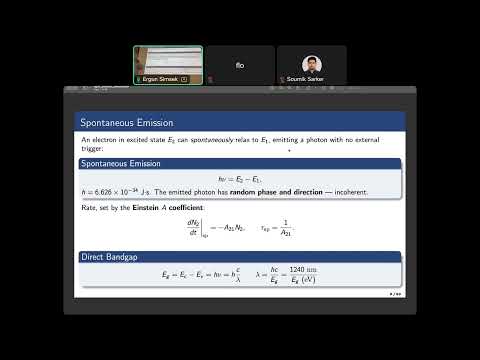
- Spontaneous emission occurs when an excited electron drops to a lower level and emits a photon with random phase and direction.
- Stimulated emission uses an incoming photon to trigger an excited electron to emit a matching photon, enabling optical amplification.
- Einstein's A coefficient describes spontaneous emission, with the excited-state lifetime given by approximately 1/A.
- The relation λ (nm) = 1240/Eg (eV) maps semiconductor band gap to emission wavelength; a 2 eV gap corresponds to about 620 nm.
- The ratio of spontaneous to stimulated emission grows with optical frequency, so laser operation requires pumping and population inversion, where the upper-level population exceeds the lower-level population.
- Simsek's example compares A = 10^9 with Bρ = 10^3, showing spontaneous emission dominates unless photon density is increased.
- The band gap is the energy difference between the valence-band maximum and conduction-band minimum.
- Dielectrics have large band gaps, semiconductors have more accessible gaps, and metals have overlapping or closely spaced bands.
- Electrons can be promoted into the conduction band when supplied energy exceeds the band gap, leaving holes in the valence band.
- In a direct-band-gap material, the conduction-band minimum and valence-band maximum align in momentum space, allowing efficient light emission.
- Gallium arsenide, indium phosphide, and gallium nitride are examples of direct-band-gap materials; silicon and germanium are indirect.
- Indirect transitions require a momentum change, often involving phonons, which makes silicon and germanium less suitable for efficient LEDs.
- At 1550 nm, InGaAs with a band-gap wavelength near 1654 nm absorbs light, while InP with a band-gap wavelength near 990 nm does not.
- A P-N junction combines a hole-rich P region and an electron-rich N region, creating a depletion region and built-in electric field.
- Forward bias injects electrons and holes toward the junction, where their recombination can emit photons.
- Radiative recombination produces light, while nonradiative recombination transfers energy to heat through processes such as phonon generation.
- The radiative fraction of total recombination defines internal quantum efficiency.
- A semiconductor refractive index near 3.5 creates a small escape cone at the semiconductor-air interface, trapping much of the generated light through total internal reflection.
- External quantum efficiency accounts for internal quantum efficiency and light extraction; Simsek gives about 5% as a representative LED value.
- For a 50 mA LED emitting near 870 nm with 5% efficiency, the estimated optical output is about 3.6 mW.
- LED response behaves like a low-pass filter, with an approximate 3 dB bandwidth of 1/(2πτ); a 2 ns lifetime gives about 80 MHz.
- Maintaining a DC bias can shorten carrier lifetime and raise LED modulation bandwidth, but reduces efficiency and creates a speed-efficiency tradeoff.
- Gallium nitride emits near 365 nm in its basic form; modifying its band gap can shift emission toward visible violet and blue wavelengths.
- Blue LEDs are harder to produce than red LEDs, and RGB displays combine red, green, and blue emitters to create other colors.
- Roughened surfaces, photonic crystals, and multilayer refractive-index structures can help light escape instead of remaining trapped inside the diode.
- Simsek describes semiconductor fabrication using layered and doped materials such as InGaAs and InP.
- An ultrafast laser can pattern a periodic surface line by line, while a specialized vortex lens can create an interference pattern for single-shot periodic structuring.
- These surface and material structures can alter how light propagates and exits a semiconductor device.
- A continuous-wave laser shares the P-N junction basis of an LED but adds an optical cavity that sends photons back and forth through the gain medium.
- Repeated passes increase opportunities for stimulated emission, allowing photon amplification when the medium is pumped.
- The cavity aligns the output into a more coherent field, unlike the random phase and direction of LED emission.
- A semiconductor laser cavity uses reflective end facets, with one facet typically made slightly less reflective to provide an output.
- Light travels a round-trip distance of 2L through a gain region of length L, and resonant wavelengths must satisfy a standing-wave condition involving cavity length and refractive index.
- The cavity supports discrete longitudinal modes that appear as periodic peaks in an optical spectrum.
- The frequency spacing between adjacent cavity modes is the free spectral range, FSR = c/(2ngL).
- Wavelength spacing is approximately λ²/(2ngL), so increasing cavity length decreases the spacing between modes.
- For a 3 μm GaAs cavity with group index 3.64 at 870 nm, Simsek calculates an FSR of about 137 GHz, equivalent to roughly 0.35 nm.
- A longer gain medium can reduce the FSR enough for a detector with a 100 GHz bandwidth to resolve the mode spacing.
- Photons lose energy through propagation loss and facet losses as they circulate through the cavity.
- Stimulated emission supplies gain, modified by the fraction of the optical mode overlapping the gain region, which Simsek estimates can be around 0.7 to 0.8.
- Stable laser operation requires round-trip gain and losses to balance; the next lecture will develop the threshold condition.
Transcript excerpt
0:06 Yeah, but we started they all on YouTube, but we started recording in lecture three or four after Florence joined us. I wish like we had recordings from the very beginning. I don't want to see the AI assistant. Ctrl F. Okay, let's minimize this. All right. Uh today we will talk about Oh, I'm not sharing my Today we will talk about uh light generation uh with LEDs. Uh tomorrow like we will be done uh with LED part. Then next class we'll talk about CW lasers, continuous wave lasers.
0:55 And the next class uh we will talk about ultra fast lasers. Okay. And I really want you to understand like what is autocorrelation, what is frog like why would they care about them and basic calculations uh like if repetition rate is this how much intensity is happening blah blah. So so we will do that next next class. So today's subject is like very simple uh but it requires some concepts from semiconductors and I I don't know if you have taken courses on semiconductors but if you aren't then this might be a good introduction. Um yeah so we'll talk about light generation uh light emitting diodes uh basics about like semiconductor band
1:43 structure what's a conduction band what's a balance band what's a band gap and then uh how you know led works yeah we we forward bias them and you'll see why we do do that uh hopefully this will cover today's stuff then next class we will start from uh talking about like laser diodes Okay. And in fact like this slide is almost everything I want you to learn or like remember from this chapter. So we have two types of light sources like coherent and incoherent. So when you say incoherent for example LED is one of
This is the start of the transcript. Save this video free for the whole transcript, searchable and time-coded.
In this course
Related notes
Summary, takeaways, and chapters were generated by AI from the video's transcript and may contain errors. The video belongs to its creator, Ergun Simsek.