ENEE 684 Lecture 17: Active Photonic Devices (part 2)
Overview
Ergun Simsek explains how electro-optic and carrier-based effects enable photonic modulation, then develops Mach-Zehnder modulator operation, performance limits, and IQ modulation for high-capacity optical communications. He introduces ring-resonator filtering and sensing, deriving the resonance condition and showing how critical coupling produces a transmission dip; key engineering tradeoffs include lithium-niobate traveling-wave bandwidth, drive voltage, insertion loss, and fabrication symmetry.
Key takeaways
- Silicon modulators exploit carrier-induced refractive-index and absorption changes rather than the Pockels effect, with reverse-biased PN junctions offering faster carrier response than broad PIN injection structures.
- A symmetric push-pull Mach-Zehnder modulator applies opposite phase shifts to its arms, enabling intensity modulation with low chirp and roughly half the drive voltage of a single-arm phase modulator.
- Traveling-wave electrodes avoid the high capacitance of a lumped modulator and can support roughly 100 GHz operation, but RF-optical velocity mismatch and device length remain important bandwidth limits.
- IQ modulators use two Mach-Zehnder modulators to control the real and imaginary optical-field components independently, enabling QAM and higher data capacity per optical carrier.
- A ring resonates when its round-trip phase satisfies βL = 2πm; matching self-coupling to round-trip transmission produces critical coupling and an ideal zero in through-port transmission.
- Ring resonators serve as wavelength-selective WDM filters, highly sensitive sensors, and platforms for optical frequency-comb generation.
Chapters
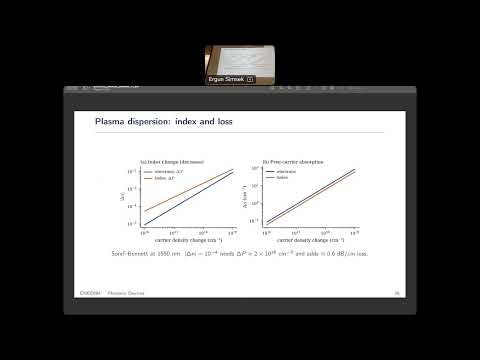
- Silicon has negligible Pockels response, so its refractive index is instead modulated by changing free-electron and hole concentrations.
- A forward-biased PIN structure injects carriers across a relatively broad intrinsic region, while a reverse-biased PN junction changes the depletion region over a shorter distance.
- Carrier changes affect both refractive index and absorption, enabling silicon intensity or phase modulators.
- Reverse-biased silicon PN modulators can reach tens of gigahertz, while carrier transit and junction design constrain their speed.
- The Franz-Keldysh effect occurs in bulk semiconductors when a strong electric field bends the conduction and valence bands and changes optical absorption.
- Quantum wells confine carriers in a thin, lower-bandgap layer, producing discrete energy levels and an electric-field-dependent absorption response.
- Franz-Keldysh and quantum-well electroabsorption can support modulators, but strong fields risk device degradation.
- Temperature can tune refractive index and red-shift resonances, making it useful for adjusting ring resonators even though thermal response is slow.
- The Mach-Zehnder interferometer uses a 50/50 split, phase control in two arms, and recombination to convert phase difference into output intensity.
- Lithium-niobate Mach-Zehnder modulators emerged in the 1970s; erbium-doped fiber amplifiers later helped manage optical loss in long-haul systems.
- Push-pull drive became important because opposite phase shifts in the two arms can modulate intensity while suppressing unwanted chirp.
- Nested modulators and digital signal processing enabled advanced formats that encode multiple bits per symbol and scale toward terabit-per-second links.
- A symmetric push-pull Mach-Zehnder modulator drives its two optical arms with equal and opposite electric fields, producing opposite phase changes.
- A long electrode should operate as a terminated transmission line rather than as a lumped capacitor, since large capacitance limits bandwidth.
- Traveling-wave electrodes carry the RF signal along the device and can be designed for approximately 50-ohm impedance and matched termination.
- Mismatch between RF-wave and optical-wave velocities limits modulation bandwidth.
- The differential phase between the two arms controls output intensity, while their common phase controls the output optical phase.
- For balanced arms, output field follows a cosine dependence on differential phase and output power follows a cosine-squared dependence.
- A differential phase of π produces destructive interference at the output, while phase-aligned arms produce maximum transmission.
- Biasing at quadrature gives a useful operating slope for converting an applied data voltage into on-off intensity changes.
- Push-pull operation can achieve the same differential phase shift with about half the voltage required by a single-arm phase modulator.
- Modulator performance is often assessed using the voltage-length product VπL and insertion loss.
- Fabrication asymmetry, built-in charge, doping, and defects shift the ideal transfer curve, so users must measure and calibrate the actual bias points.
- Lithium-niobate devices can drift with time and temperature, making feedback control useful for maintaining the desired output.
- Extinction ratio compares the maximum and minimum output powers; practical devices commonly achieve around 25 to 30 dB rather than infinite extinction.
- Insertion loss measures the reduction from input optical power to maximum transmitted power; lithium-niobate examples are often near 3 dB.
- Unequal optical power in the two arms limits destructive interference and therefore caps the achievable extinction ratio.
- Mode-overlap or power-splitting calculations can estimate the penalty from an imbalanced coupler.
- For intensity modulation without changing the optical frequency, a symmetric push-pull design aims for a chirp coefficient near zero.
- An intentionally asymmetric field overlap can produce chirp, which is useful when phase or frequency modulation is desired.
- Driving an entire long electrode as a capacitor creates high capacitance and an RC bandwidth limit; traveling-wave electrodes reduce this constraint.
- Traveling-wave lithium-niobate modulators can reach bandwidths around 100 GHz, while advanced photodetector geometries can reduce contact capacitance and support still higher frequencies.
- The traveling-wave bandwidth depends on the velocity mismatch between the RF mode and optical mode, represented by their effective indices.
- A longer modulator increases RF-optical walk-off and reduces bandwidth, while shortening the device raises the required drive voltage.
- Typical indices cited for lithium niobate are about 2.1 to 2.2 for guided light and about 4.2 to 4.3 for a wide RF electrode.
- Electrode and cladding design can improve velocity matching; thin-film lithium-niobate research has demonstrated very high-speed devices, including designs near 150 GHz.
- An IQ modulator combines two Mach-Zehnder modulators with a phase offset so their outputs represent in-phase and quadrature components.
- Independent drive voltages control the real and imaginary parts of the optical field, enabling quadrature amplitude modulation.
- Changing both amplitude and phase allows one optical carrier to represent multiple data symbols rather than a simple on-off signal.
- Using separate TE and TM polarization channels adds another degree of freedom for increasing communication capacity.
- In dense wavelength-division multiplexing, separate ring resonators can select individual wavelengths from a combined fiber signal.
- Ring resonators are also used as sensors because their resonances respond sensitively to environmental changes, including trace concentrations.
- Optical frequency-comb generation is a major application discussed for the research group.
- Simsek previews converting visible-wavelength data toward the 1550-nanometer communications band using pumps near 1370 nanometers.
- An add-drop ring places a resonator between two bus waveguides, coupling selected resonant light from the input bus to a drop port.
- The coupling coefficients describe transfer from a bus waveguide into the ring, while self-coupling describes light that remains in the bus.
- An all-pass ring uses one bus waveguide; away from resonance most light continues through, while a correctly designed resonance creates a strong transmission dip.
- Ring radius, waveguide width, thickness, and coupling gaps determine resonance and coupling behavior.
- A round trip through a ring applies both amplitude loss and a phase shift, represented by a factor involving loss over length and phase βL.
- Resonance occurs when the round-trip phase satisfies βL = 2πm for an integer mode number m, so the circulating field returns in phase.
- A four-port coupler model relates input and output fields using self-coupling and cross-coupling coefficients, including their relative phase.
- Combining the coupler relations with the round-trip field gives an analytical expression for through-port transmission.
- At resonance, critical coupling occurs when the self-coupling amplitude matches the ring's round-trip amplitude transmission, producing a zero through-port output in the ideal model.
- Undercoupled and overcoupled rings still show resonance dips, but not the same complete cancellation as critical coupling.
- Add-drop designs can route resonant energy to the drop port when the couplings of the two bus waveguides satisfy the appropriate balance with round-trip loss.
- Measured spectra show periodic resonance features; frequency and wavelength axes represent the same resonances differently, and numerical prediction proceeds through effective-index and dispersion calculations.
Transcript excerpt
0:04 Thank you. In the end, this AI business is going really crazy. Like in the long future, we won't need computational scientists. We will just need experimentalists and a $2 million research lab. Okay. Uh last week, we were talking about uh lithium niobate mostly. Uh Pockels effect, Kerr effect. We said that when we change the effective uh fields um intensity, then we can change the refractive index of materials. So, for the Pockels effect, it was proportional to the applied electric field. For the Kerr effect, it was proportional to the
0:51 uh second power of the electric field, basically intensity. So, intensity is always positive. Um We said that, you know, lithium niobate, gallium arsenide, indium phosphide, they are good materials for, you know, changing the refractive index with applied electric field, and then we can make modulators, both intensity modulators and uh phase modulators. So, to This is the part from last week that we couldn't finish. Uh so, we will finish it today. Then we will move to uh Mach-Zehnder modulators, and um then we will start talking about ring resonators. And probably next week, we'll And and I'm sorry, Wednesday, we'll talk about an FEM solver for uh effective index of ring resonators, then how to obtain integrated dispersion,
1:40 then how to obtain the full spectrum of uh ring resonators. Um But here, like we have like uh so, this is like silicon. This region is silicon. And then this uh transparent region is like silicon dioxide. Here have like a gates. And then we have two different configurations. So, the thing is for Excuse, silicon doesn't have Pockels effect. So, when we change uh apply electric field, the refractive index changes almost like nothing. Okay? Which is Pockels coefficients are almost equal to zero, 10 to the power minus 25
This is the start of the transcript. Save this video free for the whole transcript, searchable and time-coded.
In this course
Related notes
Summary, takeaways, and chapters were generated by AI from the video's transcript and may contain errors. The video belongs to its creator, Ergun Simsek.