ENEE 684 Lecture 22
Overview
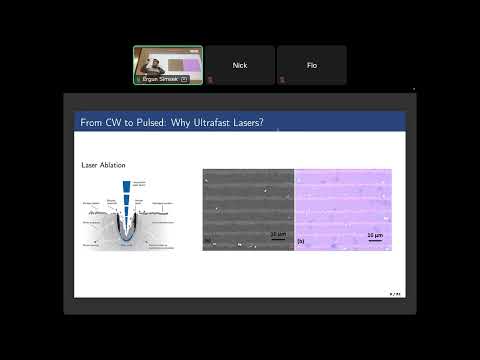
Ergun Simsek introduces ultrafast lasers by explaining why applications such as pump-probe spectroscopy, nonlinear frequency conversion, and precise ablation need pulses rather than continuous-wave output. He connects broad gain bandwidth and phase-locked cavity modes to pulse duration and peak power, then compares active and passive mode locking, Kerr-lens lasers, dispersion control, and fiber lasers, citing Ti:sapphire systems with roughly 80 MHz repetition rates and 100 fs pulses.
Key takeaways
- Ultrafast pulse formation requires both broad gain bandwidth, which supports many cavity modes, and phase locking, which makes those modes interfere constructively at regular intervals.
- A Ti:sapphire laser can span roughly 680 nm to 1.06 μm, and an approximately 80 MHz repetition rate corresponds to pulses spaced about 12.5 ns apart.
- Mode locking concentrates energy into short pulses rather than creating additional energy, so peak intensity can greatly exceed average intensity as the number of locked modes increases.
- Active mode locking offers direct electronic control but is typically limited to picosecond-scale pulses, while passive saturable absorbers and Kerr-lens mode locking can reach roughly 100 fs and 30 fs, respectively.
- Dispersion compensation uses wavelength-selective optics or media with opposite dispersion signs to prevent pulse broadening; common fiber laser gain media include erbium near 1.55 μm and ytterbium near 1.03 to 1.06 μm.
- FROG combines a delayed pulse replica, nonlinear second-harmonic generation, and spectrometer measurements to characterize the frequency content and temporal behavior of ultrashort pulses.
Chapters
- Ergun Simsek introduces ultrafast lasers and contrasts pulsed output with continuous-wave laser operation.
- Pump-probe time-resolved spectroscopy compares a probe reflected from a material before and after its refractive index, temperature, or conductivity changes.
- Pulses support nonlinear processes including two-photon absorption, second-harmonic generation, supercontinuum generation, and optical parametric amplification.
- Second-harmonic generation converts 800 nm light to 400 nm, enabling further frequency doubling toward shorter wavelengths for fine-scale ablation.
- A pulsed laser needs broad gain bandwidth to support many resonant modes, plus phase locking to make those modes add into pulses.
- For a linear cavity, the free spectral range is approximately c/(2L); a ring cavity uses its round-trip length in the corresponding FSR calculation.
- The approximate number of supported modes is gain bandwidth divided by FSR, with large mode counts producing shorter, sharper pulses.
- Simsek gives a roughly 1.9 m effective cavity and an approximately 80 MHz FSR as an example from a Ti:sapphire laser.
- Titanium-doped sapphire provides broad emission, roughly 680 nm to 1.06 μm, when pumped with light such as a 532 nm green laser.
- Gratings select the desired output wavelength from the gain medium's broad emission range.
- Sapphire's high thermal conductivity helps carry heat away, although Simsek notes that the lab system still uses chilled water and needs time to stabilize.
- The effective cavity length depends on the full mirror path, not only the physical length of the gain crystal.
- A MATLAB illustration sums modes with random phases and compares 100 modes with 200,000 modes.
- With random phases, the field varies irregularly rather than forming a clean, stable pulse train.
- Passive mode locking uses intensity-dependent loss: weak light is absorbed while stronger light saturates the absorber and passes through.
- Candidate saturable absorber materials include graphene, MoS₂, WS₂, and semiconductor structures.
- Mode locking aligns the phases of cavity modes so their fields constructively interfere at regular intervals.
- The resulting waveform has strong peaks separated by low-intensity intervals, with repetition period set by the cavity FSR.
- Simsek derives a pulse-like intensity profile from the coherent sum of modes, using a squared-sinc form to describe the peaks.
- The average-to-peak intensity relationship depends on mode count, illustrating how mode locking concentrates energy in time rather than creating energy.
- Pulse duration is measured by full width at half maximum, or FWHM, of the intensity peak.
- The lecture gives an approximate FWHM relation of 0.886 times the repetition period divided by the number of locked modes.
- A larger mode count narrows the pulse and raises peak intensity relative to average intensity; Simsek compares 100 modes with 200,000 modes.
- The lab Ti:sapphire oscillator is described as producing roughly 100 fs pulses at about 80 MHz, or around 12.5 ns between pulses.
- Active mode locking modulates cavity loss or refractive index at the repetition frequency, using an electro-optic or acousto-optic modulator.
- The lecture presents active mode locking as simpler to control but typically limited to pulses around a picosecond or longer.
- Passive mode locking uses a saturable absorber whose loss falls at high intensity, supporting much shorter pulses, around 100 fs in the Ti:sapphire example.
- A broader optical frequency comb corresponds to a narrower pulse in time, following the time-frequency tradeoff.
- Kerr-lens mode locking uses the intensity-dependent refractive index of a nonlinear material to focus intense light more strongly.
- An aperture favors the tightly focused, high-intensity pulse while rejecting weaker, broader light.
- Simsek compares approximate pulse durations of 1 ps for active mode locking, 100 fs for passive mode locking, and 30 fs for Kerr-lens mode locking.
- Kerr-lens operation can require an initial perturbation to start locking, and wavelength-dependent refractive index introduces dispersion that must be compensated.
- Dispersion changes a pulse's spectral components differently and can broaden the pulse as it propagates.
- Fiber systems can balance dispersion of opposite signs by designing dimensions and materials to provide positive or negative group-velocity dispersion.
- Erbium-doped fiber lasers are associated with wavelengths near 1.55 μm, while ytterbium-doped systems operate near 1.03 to 1.06 μm.
- Commercial fiber lasers and complex fiber cavities may combine laser diodes, wavelength-division multiplexers, isolators, band-pass filters, and feedback paths.
- Ultrafast laser setups use prism pairs, grating pairs, and chirped mirrors to compensate dispersion and preserve pulse shape.
- Prisms spatially separate wavelengths, and a second prism or optical element can recombine them with adjusted propagation delays.
- Diffraction gratings provide wavelength-dependent reflection and can spread broadband light for spectral manipulation.
- Simsek notes that older systems required manual mirror and knob adjustments, while current setups can automate alignment and dispersion control.
- A linear cavity with an effective length near 1.9 m has an approximately 80 MHz repetition rate and a pulse interval near 12.9 ns in the lecture's example.
- A ring cavity's repetition rate depends on its round-trip length and the medium's group index; a roughly 2 m fiber path is given as an example near 100 MHz.
- Oscillator pulses begin at relatively low energy, after which amplification can raise their energy.
- Generating pulses is only the first challenge; stable operation also requires careful alignment and dispersion management.
- Simsek references Donna Strickland and the 2018 Nobel Prize in Physics in connection with the development of ultrafast laser techniques.
- Frequency-resolved optical gating, or FROG, measures pulse information using a split pulse, a variable delay, a second-harmonic-generation crystal, and a spectrometer.
- The spectrometer separates wavelengths by diffraction and records intensity across the spectrum, helping characterize an otherwise unknown pulse.
- The closing announcements cover Homework 8, a correction that an indium gallium nitride band-gap relation should be quadratic, a class break, and upcoming course presentations.
Transcript excerpt
0:09 like a minute like breather, you know, you don't have to I wish but no, he he was a really good guy. Um like tomorrow there will be the funeral. I'm sure all of our friends and family they will be there. Okay. Uh all right. Um so today we'll start talking about uh ultraast lasers. Okay. And we'll see the main difference between regular lasers uh ultra fast lasers. Um so like today's like lecture is mostly like introductory. uh then we will have bunch of equations next chapter so that we can um you know uh we can
1:00 study our own uh uh lasers. So like in my in my lab like we have a mai uh ultraast laser operating from 700 nanometer up to like 1 micron. uh but like you you'll see the power intensity the density changes as a function of frequency you will also see like why the dimensions matter. So we cannot have a like a nano laser which is operating at 1550. Um one of the most important um parts of this lecture is like like the the main difference between CW lasers and pulse lasers, right? So for pulse lasers we need materials um which have a very high bandwidth like uh high
1:50 gain uh around like a long uh wavelengths. Um and we should have like so many so many uh uh resonant modes then that resonance will help us but that's not enough. We should also have something called like phase locking. Okay. So there are two different mechanisms to achieve phase locking. So we'll see how we do that. Um like there are like linear cavities there are like ring resonators. uh there are two main types and then we also talk about like care uh lens space
This is the start of the transcript. Save this video free for the whole transcript, searchable and time-coded.
In this course
Related notes
Summary, takeaways, and chapters were generated by AI from the video's transcript and may contain errors. The video belongs to its creator, Ergun Simsek.