Endocrinology Lecture 28 - Glucagon, GIP, GLP-1, and GLP-2
Overview
Glucagon raises blood glucose during fasting by activating a liver GPCR pathway that drives glycogenolysis, while gut-derived GIP and GLP-1 amplify insulin release after eating and can also suppress feeding through brain circuits. The lecture connects proglucagon processing and DPP-4 breakdown to engineered long-acting drugs: semaglutide has an approximately 165-hour half-life, and trials cited report about 15% weight loss with semaglutide and up to 20% with tirzepatide.
Key takeaways
- Glucagon and insulin counterbalance blood glucose: low glucose triggers alpha-cell glucagon, which activates hepatic cAMP-PKA signaling and glycogen breakdown.
- Oral glucose triggers more insulin than injected glucose at similar blood glucose levels because gut incretins, including GIP, add to the insulin response.
- GIP is released by nutrient-sensing duodenal K cells, acts on pancreatic beta cells and brain satiety circuits, and is rapidly inactivated by DPP-4.
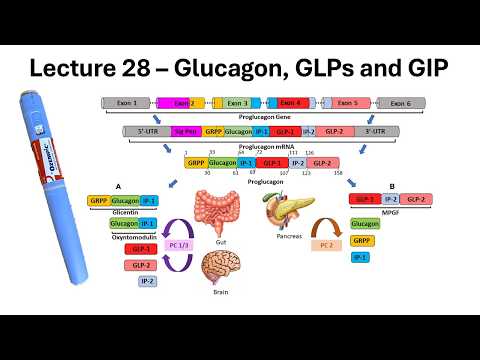
- Proglucagon processing depends on the enzyme expressed: pancreatic PC2 produces glucagon, while gut L-cell PC1/3 produces GLP-1 and GLP-2.
- Engineered long-acting incretin drugs evade rapid breakdown and persist far longer than native hormones; the lecture contrasts semaglutide's roughly 165-hour half-life with GLP-1's 1 to 2 minutes.
- The lecture cites approximately 15% weight loss after 68 weeks of semaglutide and up to 20% after 72 weeks of tirzepatide, while noting that weight often returns after treatment ends.
Chapters
- Pancreatic islet glucagon-producing cells are alpha cells, also called A cells, rather than the textbook's apparent typo, D cells.
- PC2 cleaves proglucagon in pancreatic alpha cells to produce glucagon.
- Low blood glucose stimulates glucagon release; its major targets include the liver, kidneys, and pancreas.
- In the liver, glucagon receptor signaling activates adenylyl cyclase, cAMP, and PKA, leading to glycogenolysis and increased blood glucose.
- A 1960s comparison found a stronger insulin response when glucose was consumed orally than when it was injected, even with similar blood glucose levels.
- The additional insulin response to nutrients entering through the gut is called the incretin effect.
- People with type 2 diabetes have a blunted incretin effect, and the lecture notes that their insulin response can remain elevated longer after glucose administration.
- K cells in the upper small intestine, including the duodenum, release glucose-dependent insulinotropic polypeptide, or GIP.
- K cells respond to glucose, fats, and amino acids, so meals can raise circulating GIP within minutes.
- GIP acts on pancreatic beta cells to boost insulin secretion, helping explain the stronger insulin response to oral glucose.
- The enzyme DPP-4 cleaves and inactivates GIP rapidly, limiting the duration of its signal.
- GIP receptors occur in the hypothalamus, including the arcuate nucleus, and in the hindbrain, where GIP signaling can reduce food intake.
- Attaching an acyl lipid group extends GIP's activity; mice given acylated GIP ate very little during the first 24 hours and lost body weight.
- Acylated GIP increased c-Fos-positive activity in arcuate neurons, a marker used in the lecture to indicate neuronal activation.
- Mice lacking GIP receptors specifically in the central nervous system did not show the same food-intake and weight effects, supporting a brain-mediated mechanism.
- PC1/3 processes proglucagon in gut L cells to produce GLP-1 and GLP-2, whereas pancreatic PC2 processing produces glucagon.
- GLP stands for glucagon-like peptide, reflecting that GLP-1 and GLP-2 come from the same proglucagon precursor as glucagon.
- GIP and GLP-1 share incretin effects, including stimulation of insulin release, and these hormone systems also send feeding-suppression signals to the brain.
- The Gila monster produces exendin-4, a peptide similar enough to human GLP-1 to activate human GLP-1 receptors.
- Unlike native GLP-1 and GIP, which DPP-4 cleaves at an early peptide site, exendin-4 resists this breakdown.
- Drug design extended hormone activity through DPP-4-resistant substitutions and lipid side chains; the lecture gives semaglutide a half-life of about 165 hours compared with 1 to 2 minutes for native GLP-1.
- Ozempic and Wegovy are semaglutide formulations used at different doses, while Mounjaro is tirzepatide, a dual GIP and GLP-1 receptor agonist.
- GLP-1 reduces gastric emptying, keeping the stomach full longer and potentially delaying the rise of the appetite-stimulating stomach hormone ghrelin.
- GLP-1 agonists also act on brain satiety pathways, combining reduced hunger signaling with increased fullness.
- GIP signaling can contribute to feeding suppression through brain receptors, adding another satiety pathway for drugs that activate both GIP and GLP-1 receptors.
- A 40-week treatment comparison reported improved glucose-related blood measures with semaglutide and tirzepatide in patients with diabetes.
- In a 68-week study, semaglutide produced approximately 15% average weight loss; a separate 72-week tirzepatide study reported losses approaching 20% at higher doses.
- The lecture emphasizes that weight commonly returns after either drug is stopped, making ongoing treatment or sustained diet and exercise changes important for maintaining loss.
Transcript excerpt
0:02 So, today we are talking about [snorts] glucagon, uh GIP and GLPs. Uh-huh, yep, hot topic. So, um we kind of already I've already kind of laid out a bit about glucagon, but I'm going to go over again just briefly that uh within the pancreas we have these islets of Langerhans, okay? We talked about how the majority of the cells in those islets are insulin producing. That was last time. But I did mention that uh the second highest category is glucagon producing cells. Um I also had mentioned that those glucagon producing cells, they're D cells. That's what the original thing
0:50 said. I copied this straight out of the textbook, but then I realized that this was actually like a typo cuz in elsewhere in the textbook they refer to it as A cells or alpha cells. And then in some of the papers I was reading it's all alpha cells. This was the only place where it said D cells. So, you'll see that I've changed it here cuz that's a typo in the textbook I copied. Not my fault. It's the textbook. Anyway, I don't know if any of you are paying that close attention, but anyway, last time we called them D cells, but they are A cells. And those are the ones that are in red, okay? So, you know, the green ones, those are the insulin producing ones. As you can see, there's a much smaller proportion than are producing glucagon. Okay. And glucagon, just like insulin, is released into the bloodstream from these
1:36 islets of Langerhans. Um like many of the hormones we've been talking about, it comes from a prepro complex uh of of uh a gene that makes a big old mRNA. That mRNA produces a protein that gets cleaved.
This is the start of the transcript. Save this video free for the whole transcript, searchable and time-coded.
Related notes
Summary, takeaways, and chapters were generated by AI from the video's transcript and may contain errors. The video belongs to its creator, Dr. Chris Thompson.