Radiometric Dating and the Age of the Earth 2026 1412 L35
Overview
The lecture connects nuclear decay to radiometric dating, moving from isotope notation, decay chains, and radiation detection to first-order decay calculations. It calculates a wood sample's radiocarbon age as about 2,233 years and explains how isotope systems, Hawaiian hotspot volcanoes, tree rings, ice cores, and magnetic reversals provide overlapping evidence for Earth's age of roughly 4.5 billion years.
Key takeaways
- Radioactive decay follows first-order kinetics, allowing sample age to be calculated from the ratio of remaining activity to an initial reference activity.
- The worked radiocarbon example uses 11.6 disintegrations per second for archaeological wood and 15 for fresh wood to estimate an age of approximately 2,233 years.
- Radiation hazard depends on more than half-life: strontium-90 can behave chemically like calcium and remain in bones, while iodine-131 decays quickly and soluble cesium can be cleared from the body more readily.
- Different isotope systems cover different time ranges: carbon-14 reaches about 50,000 years, uranium-thorium about 300,000 years, and potassium-argon and uranium-lead methods extend to billions of years.
- Independent records strengthen geological dating: Hawaiian volcano ages imply Pacific Plate motion near 3.2 inches per year, close to the satellite measurement of 3.1 inches per year.
- Tree-ring counts, carbon-14 measurements, ice-core layers, and magnetic reversals provide evidence that cross-checks radiometric dating rather than relying on a single method.
Chapters
- Electron-positron annihilation converts mass into energy, illustrating mass-energy conservation through E=mc².
- Spontaneous fission splits a heavy nucleus into smaller nuclei and free neutrons; a liquid-drop analogy illustrates how a nucleus can deform and divide.
- Light stable nuclei often have roughly equal numbers of protons and neutrons, while heavier nuclei need proportionally more neutrons to offset proton repulsion.
- A uranium decay chain proceeds through multiple alpha and beta emissions, changing the element and isotope until a stable lead isotope forms.
- Radon is a noble gas produced in uranium decay chains; unlike many solid daughter products, it can escape rock and accumulate in poorly ventilated basements.
- The lecture links radon exposure to lung cancer risk and describes basement detectors and ventilation fans as ways to monitor and reduce accumulation.
- For iodine-127, atomic number 53 identifies 53 protons, and subtracting 53 from mass number 127 gives 74 neutrons.
- Indium-113 has 49 protons and 64 neutrons; a nucleus with 6 protons and 7 neutrons is carbon-13.
- Nuclear equations balance mass number and atomic number, with gamma emission changing neither quantity.
- Alpha particles can be stopped by paper or skin, beta particles penetrate farther, and gamma rays require substantial shielding such as thick concrete or lead.
- Balancing proton counts identifies the product element: carbon-14 beta decay produces nitrogen-14, while carbon-11 positron emission produces boron-11.
- A beta particle represents an electron emitted from the nucleus as a neutron becomes a proton; positron emission decreases the proton count by one.
- A Geiger-Mueller tube ionizes argon gas when radiation enters, producing electrical pulses heard as clicks and counted by the meter.
- The pancake probe's thin window detects particles that cannot pass through its metal body, while gamma radiation can also be detected through the probe's side or back.
- Comparing readings with no barrier, paper, and the metal probe body helps distinguish alpha, beta, and gamma contributions by differences in counts.
- A scintillation detector converts radiation into light and uses a photomultiplier tube to amplify weak signals.
- Activity describes decays from a source, using units such as becquerels or curies; counts per minute reports the detector's observed events.
- Dose units account for energy absorbed by tissue and biological effect; the lecture contrasts a weighting factor of 1 for beta and gamma radiation with 20 for ingested alpha emitters.
- Radioactive activity follows first-order decay, so the half-life indicates how quickly a sample's activity falls by half.
- Short-lived iodine-131, with an approximately 8-day half-life, releases activity quickly, while uranium-238's half-life is about 4.5 billion years.
- Chemical behavior and retention in the body also matter: the lecture highlights strontium-90 because it can behave like calcium and persist in bones near blood-forming marrow.
- The worked sample has 11.6 disintegrations per second, compared with 15 disintegrations per second for an equal mass of fresh wood.
- Applying the first-order decay equation and the carbon-14 half-life gives an estimated sample age of about 2,233 years.
- Radiocarbon dating estimates when an organism stopped exchanging carbon with its environment, after which its carbon-14 activity declines.
- Cosmic-ray interactions produce carbon-14 from atmospheric nitrogen; carbon-14 enters carbon dioxide, plants, wood, and animals through the carbon cycle.
- Carbon-14 dating is useful to roughly 50,000 years; uranium-thorium methods can reach about 300,000 years, and potassium-40 to argon-40 dating can reach billions of years.
- Rubidium-strontium, uranium-lead, and thorium-lead systems extend geological dating toward Earth's formation, approximately 4.5 billion years ago.
- As the Pacific Plate moves over a hotspot, it forms a chain of progressively older volcanoes; potassium-argon dating traces the Hawaiian-Emperor chain back about 80 million years.
- The lecture compares a geological plate-motion estimate of about 3.2 inches per year with satellite measurements of about 3.1 inches per year.
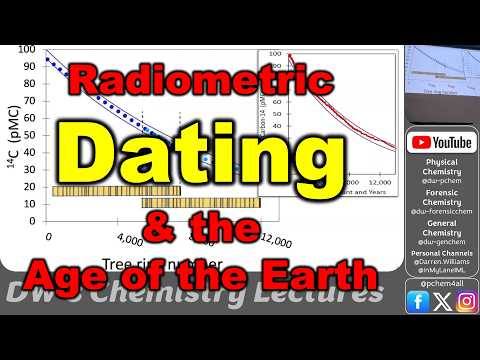
- Overlapping tree-ring sequences reach roughly 12,000 years and align with carbon-14 records; ice-core layers and seafloor magnetic reversals provide additional independent checks, with magnetic records reaching about 180 million years.
Transcript excerpt
0:00 Let's get started. All right. So this was um hopefully you'll get this from the last time we talked about annihilation and that the electron and posetron both have mass and then when they annihilate each other the mass turns into energy you know E= MC² it's all energy now and of course the first law uh of thermodynamics well that's yeah we talk about mass the conservation of mass and mass is conserved and so on but we really mean mass energy because of this relativity equation and So the mass disappears, but we haven't lost anything cuz it's turned into energy. And then this whole dating profile, this is for carbon 14, and it's intating. And so I thought that was very clever. We'll understand why it doesn't want to date uh older than 50,000 years today. Yeah.
0:51 So we're talking about nuclear radiation detection and radiometric dating today. So that was the whole thing with the carbon 14. And so these are all of this is a review of all of our types of nuclear transitions. Before we move on, were there any of these that you wanted more information on or that I could clarify? Yes. >> Yes. >> Yes. Can I get you to close the door for me, please? So the spontaneous vision one is just the elements. If you look at the periodic table, elements above bismouth really I mean lead anything really anything over bismouth bismouth bismouth naturally occurring bismouth isn't radioactive. So pelonium and higher which means then you get over here to the actonide. So the bottom row
1:40 of the F block those are all naturally radioactive which means they are unstable. They just fall apart spontaneously. So that's what spontaneous vision is. So you have and I just picked one of the um one of the
This is the start of the transcript. Save this video free for the whole transcript, searchable and time-coded.
In this course
Related notes
Summary, takeaways, and chapters were generated by AI from the video's transcript and may contain errors. The video belongs to its creator, DWs General Chemistry Videos.