Respiratory Dieseases 2of2
Overview
Robert Kellar explains restrictive pulmonary disease as impaired lung expansion and reduced capacity, then connects persistent inflammation to fibrosis and acute respiratory distress syndrome (ARDS). He covers ARDS triggers and progression, compares the 2002 SARS outbreak with COVID-19, and concludes with pneumonia types and their effects on gas exchange, noting that ARDS mortality fell from roughly 50 to 60% in the 1980s to the mid-to-upper 20s or low 30s in later estimates excluding COVID-19.
Key takeaways
- Restrictive pulmonary disease primarily limits inspiration and lung expansion, while obesity and pleural disorders can contribute through restricted chest-wall movement.
- Persistent inflammation can turn acute lung injury into chronic remodeling: macrophage activity and collagen deposition create fibrosis that no longer supports effective gas exchange.
- ARDS can follow direct lung injury, such as pneumonia or aspiration, or indirect insults such as septic shock, trauma, and burns; excessive ventilator inflation is another preventable risk.
- The lecture reports that about 1 in 5 COVID-19 patients developed severe illness that could progress to ARDS, while most cases were mild or moderate.
- Pneumonia infects functional lung parenchyma and can be bacterial, fungal, or viral; chronic or hospital-acquired forms can lead to severe tissue damage and bronchiectasis.
- Emphysema and chronic bronchitis damage the lungs in different ways: emphysema removes gas-exchange surface area, while chronic bronchitis inflames airways and increases mucus production.
Chapters
- The lecture contrasts restrictive pulmonary disease with the obstructive diseases covered in the previous class.
- There is no class or assignment during Thanksgiving week; the next topic after the break is cardiovascular disease.
- The final assignment is a post-quiz due that evening.
- Restrictive disorders reduce lung expansion and capacity, with inhalation affected more than exhalation.
- Pleural disease and obesity can restrict chest-wall movement and make inspiration difficult.
- Chronic inflammation recruits macrophages that remodel tissue and deposit collagen, producing fibrosis and nonfunctional scar tissue.
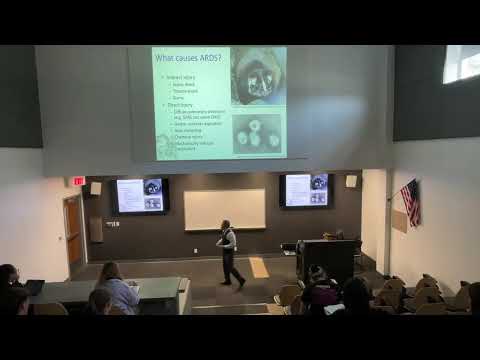
- ARDS, also called lung shock, involves diffuse alveolar damage, capillary injury, and a strong inflammatory response involving neutrophils and macrophages.
- Neutrophil enzymes and free radicals damage lung tissue; persistent inflammation can lead to collagen deposition and scarring that impairs gas exchange.
- The lecture cites ARDS mortality of about 50 to 60% in the 1980s and later estimates in the mid-to-upper 20s or low 30s, excluding COVID-19.
- Triggers include pneumonia and other pulmonary infections, septic or trauma shock, burns, aspiration, near-drowning, chemical inhalation, and ventilator-induced injury from excessive inflation.
- The lecture reviews the 2002 SARS outbreak in China and describes severe acute respiratory syndrome as involving lower-lung infection and diffuse alveolar disease.
- A palm civet is discussed as a possible animal source associated with early SARS; the lecture distinguishes that history from unresolved questions about COVID-19 origins.
- ARDS symptoms include dyspnea, rapid breathing, cyanosis, hypoxemia, and pulmonary edema; some patients respond poorly to oxygen therapy.
- Serial lung images show fluid-related opacities spreading from lower lung regions upward over roughly two weeks.
- The lecture states that most COVID-19 cases were mild or moderate, while about 1 in 5 developed severe illness that could progress to ARDS.
- Robert Kellar describes the virus's origin as unresolved, noting both market and laboratory hypotheses connected to Wuhan and NIH-funded research without claiming conclusive evidence.
- He argues that vaccination, including immunity after infection, helped reduce susceptible hosts and transmission, while emphasizing that influenza and SARS-CoV-2 mutate rapidly.
- The discussion notes that COVID-19 vaccines were authorized faster than previous vaccines and that variant prediction may use computational modeling.
- The lecture says restrictive impairment, reduced lung expansion, and lower lung volume were more common after COVID-19 than obstructive outcomes such as asthma or bronchiectasis.
- Pneumonia is identified as a leading cause of ARDS; it infects lung parenchyma, including alveoli and respiratory bronchioles involved in gas exchange.
- Pneumonia may be bacterial, fungal, or viral, and neutrophil-rich fluid in lung tissue disrupts both gas exchange and lung inflation.
- The lecture distinguishes bronchopneumonia from broader lobar involvement and describes hospital-acquired, often Gram-negative pneumonia as a nosocomial infection.
- Repeated chronic pneumonia can damage airways and contribute to bronchiectasis, with persistent pus production and scarring.
- Students are asked to draw and compare emphysema, which reduces gas-exchange surface area, with chronic bronchitis, which features airway inflammation and excess mucus.
- Robert Kellar offers feedback on student diagrams and plans to share selected examples after Thanksgiving.
Transcript excerpt
0:07 What did the femur say to the patella? The femur say to the patella. I need you. What do you call a alligator and a vest? >> An investigator. Nicely done. [clears throat] Why do crabs? Um, never volunteer. Why do crabs never volunteer? They're crabby. They are crabby. I
0:55 agree. But they're also shellfish. Good. Okay. So, a week from today, you will all be either eating or prepping to eat or you just finished and now you're taking a nap. Okay. So, we won't have any class next week. No assignments. Last assignment is uh post quiz tonight. Wouldn't be a bad idea next week to maybe take a look at the material just so you don't lose the pace. That's kind of the danger of taking a week off. And then we'll be back for our final week after Thanksgiving. Uh and we'll do
1:42 cardiovascular. So, as we wrap up today, it'll be a shorter lecture uh respiratory. We're going to be doing restrictive pulmonary diseases. We talked about obstructive on Tuesday. So today is finishing out with restrictive. Um so these are reduced expansion um and reduced lung capacity. So on restrictive we've got sort of normal expiratory um or near normal or it's proportionally reduced. But our big issue is up here on inspatory. So these are restrictive. It's it's more exaggerated when you try to inhale with inspatory. So, the patients wrestle with not being able to inhale as much. Um there's chest wall disorders that will
2:29 cause this um like plural diseases. We'll get into um like a pluritis or fluid in the plural space uh in two weeks when we talk about congestive heart failure. We sort of alluded to it when we were talking about some of the uh different types of adalctasis in the
This is the start of the transcript. Save this video free for the whole transcript, searchable and time-coded.
In this course
Related notes
Summary, takeaways, and chapters were generated by AI from the video's transcript and may contain errors. The video belongs to its creator, Robert Kellar, Ph.D..