Electromagnetic fields, lecture 3. - line / surface inegrals and examples
Overview
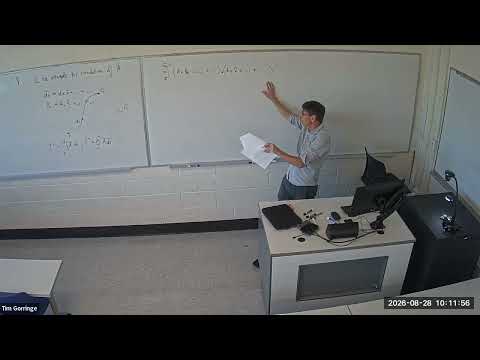
Tim Gorringe develops integral vector calculus from the local ideas of divergence, gradient, and curl, explaining how line integrals measure circulation and surface integrals measure flux. He connects these integrals to differential quantities in rectangular coordinates and works through two fields: A = -y x̂ + x ŷ, with zero divergence and curl 2ẑ, and A = x x̂ + y ŷ, whose circulation around a unit square is zero.
Key takeaways
- A line integral ∫A · d𝐫 measures circulation by accumulating only the component of A parallel to each path segment.
- A surface integral ∫A · d𝐀 measures flux because the area vector d𝐀 is normal to the surface and selects the field’s perpendicular component.
- For A = -y x̂ + x ŷ, divergence is zero while curl is the constant vector 2ẑ, distinguishing the absence of sources and sinks from the presence of rotation.
- For A = x x̂ + y ŷ, the four sides of a unit-square loop contribute +1/2, +1/2, -1/2, and -1/2, giving zero net circulation.
- The dot product simplifies rectangular-coordinate integrals by eliminating products of perpendicular unit vectors, leaving only matching x, y, and z components.
Chapters
- Divergence and curl describe local sources of flux and circulation at a point, while gradient describes the local change of a scalar field.
- The lecture shifts from differential vector calculus to line and surface integrals, which evaluate circulation along paths and flux through surfaces.
- Tim Gorringe plans to apply both differential and integral methods to examples in rectangular coordinates.
- A line integral from point P to point Q adds contributions along a macroscopic path through a vector field A.
- Each small path step d𝐫 contributes A · d𝐫, so the dot product selects the field component parallel to the path.
- An open line integral has endpoints P and Q; a closed-loop integral is denoted with a circle on the integral sign.
- In rectangular coordinates, d𝐫 = dx x̂ + dy ŷ + dz ẑ and A = Aₓ x̂ + Aᵧ ŷ + A_z ẑ.
- Because unlike unit vectors are perpendicular, the dot product leaves only Aₓ dx + Aᵧ dy + A_z dz.
- The main challenge is describing the path mathematically, including its shape, direction, and limits.
- A surface element d𝐀 points perpendicular to the surface, and A · d𝐀 selects the field component normal to it.
- Integrating A · d𝐀 across a surface sums the local flux contributions; the surface may be open or closed.
- In rectangular coordinates, d𝐀 can be resolved into x, y, and z components, yielding terms Aₓ dAₓ + Aᵧ dAᵧ + A_z dA_z.
- As with line integrals, evaluating the integral requires specifying how the small elements assemble into the full surface.
- Divergence represents local flux density; multiplying it by a small volume element gives the flux contribution associated with that volume.
- Flux through a macroscopic closed surface is found by integrating the field’s normal component over the surface.
- Curl represents local circulation density; its dot product with an oriented area element gives a local circulation contribution.
- A closed line integral gives circulation around a macroscopic loop, with the result depending on the loop’s size, shape, and orientation.
- The first example uses a two-dimensional field with components Aₓ = -y and Aᵧ = x, with no z component.
- Its field lines circle the origin: the field points upward on the positive x-axis and leftward on the positive y-axis.
- The rectangular-coordinate divergence is ∂Aₓ/∂x + ∂Aᵧ/∂y + ∂A_z/∂z; each term is zero for this field.
- The zero divergence matches the closed-loop field-line sketch, which has no apparent sources or sinks.
- Gorringe evaluates curl using the 3-by-3 determinant form with unit vectors, partial derivatives, and the components of A.
- For Aₓ = -y, Aᵧ = x, and A_z = 0, the x and y curl components vanish.
- The z component is ∂Aᵧ/∂x - ∂Aₓ/∂y = 1 - (-1) = 2, so curl A = 2ẑ everywhere.
- The constant positive z direction indicates uniform local circulation pointing out of the board.
- The second field is A = x x̂ + y ŷ, with no z component.
- Its field lines point radially outward from the origin, growing in magnitude with distance along the x and y axes.
- Gorringe evaluates circulation around a rectangular loop by splitting the path into four separately parameterized segments.
- The loop is a unit square with x and y limits from 0 to 1 on the outward segments.
- Along the bottom and right sides, the integrals of x dx and y dy each contribute +1/2.
- Along the top and left sides, the reversed path directions make the corresponding integrals each contribute -1/2.
- The four contributions sum to zero, consistent with the radial field having no circulation around the unit square.
- A flux calculation for this field is referenced in the lecture notes but is not completed during the class.
Transcript excerpt
0:07 So in the last class we talked about in differential vector calculus. We talked about div, grab and curl and using differential vector calculus to represent um the change the variation of both vector fields and scalar fields. So div and curl measure the um sources of flux and the sources of rotation in vector fields and uh gradient measures the change of a scalar field and those are the tools we need. Um, specifically divergence and curl
0:58 measure the sources local sources of flux and circulation. The the local sources of uh flux and rotation for a vector field at a at a specific point at a given point. Um, and likewise gradient for a scalar field. It tells you the uh local value of the gradient or the slope of the of the scalar field. Today's class we're going to move on to uh integral vector calculus and we're going to be talking about uh line integrals and surface integrals that are integral representation of the concepts of flux and circulation for a vector field. So I'm going to
1:47 introduce line integrals and surface integrals as methods for computing the circulation around a kind of macroscopic loop and a mac over a macroscopic surface. And then we're going to apply what we've learned on both differential vector calculus and integral vector calculus to some examples. So I'm going to work through a couple of illustrations of um diff grad and curl and line and surface integrals. And next Monday's class is also more examples of diff grat and curl and line and surface integers. So so that's basically the
2:35 plan. Let me start with line interseals are used for valuating circulation of a of a vector field. I'll just call that A. So these are the integral parallel to our curl which evaluated the
This is the start of the transcript. Save this video free for the whole transcript, searchable and time-coded.
In this course
Related notes
Summary, takeaways, and chapters were generated by AI from the video's transcript and may contain errors. The video belongs to its creator, tim gorringe.