Electromagnetic fields, lecture 6 - spherical coordinates and diff / int vector calculus
Overview
Tim Gorringe develops spherical coordinates for electromagnetic-field problems, covering the coordinate transformations, position and line elements, area and volume elements, and spherical-coordinate grad, div, and curl. He applies the geometry to a radial inverse-square field, showing that its flux through a centered sphere is 4π, independent of the sphere’s radius.
Key takeaways
- Spherical coordinates use r as distance from the origin, θ from +z, and φ in the xy-plane from +x toward +y; θ spans 0 to π and φ spans 0 to 2π.
- The spherical displacement element is dr r̂ + r dθ θ̂ + r sin θ dφ φ̂, because angular coordinate changes correspond to arc lengths rather than straight-line distances.
- The spherical volume element is r² sin θ dr dθ dφ, and the outward area element on a sphere of radius r is r² sin θ dθ dφ r̂.
- Spherical unit vectors change direction with position, so spherical grad, div, and curl include geometric scale factors absent from their rectangular-coordinate forms.
- For a radial field proportional to r̂/r², flux through any centered spherical surface is constant: the field’s 1/r² decrease cancels the sphere’s r² area increase, giving 4π for the field r̂/r².
Chapters
- Rectangular coordinates suit lattice-like charge arrangements, cylindrical coordinates suit wires, and spherical coordinates suit spherical symmetry.
- The lecture follows the previous class’s cylindrical-coordinate sequence: define coordinates and unit vectors, develop calculus and integral elements, then work an example.
- The radial coordinate r is the distance from the origin, while θ is the polar angle measured from +z and ranges from 0 to π.
- The azimuthal angle φ is measured in the xy-plane from +x toward +y; the rectangular relations include z = r cos θ.
- Right-triangle trigonometry gives the coordinate conversions, and applying Pythagoras twice gives r² = x² + y² + z².
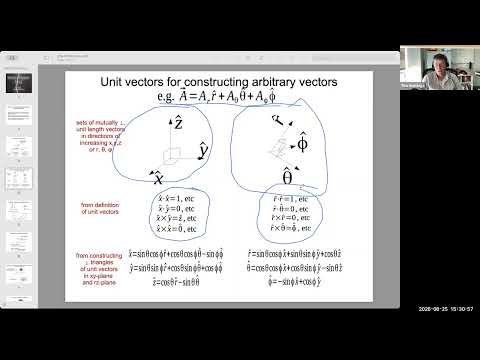
- The orthonormal spherical basis consists of r̂, θ̂, and φ̂, which can express any three-dimensional vector.
- Unlike fixed rectangular x̂, ŷ, and ẑ, spherical unit-vector directions depend on the position angles θ and φ.
- Changes in the spherical basis with θ and φ account for extra terms in spherical-coordinate vector calculus; the lecture presents the basis-derivative relationships as a reference table.
- The position vector is r r̂; θ and φ are implicit in the direction of r̂ rather than appearing as separate position-vector terms.
- A differential displacement is dr r̂ + r dθ θ̂ + r sin θ dφ φ̂.
- The angular distances are arc lengths: a θ step sweeps an arc of length r dθ, while a φ step sweeps one of length r sin θ dφ.
- The outward radial area element is r² sin θ dθ dφ r̂, formed by steps in θ and φ.
- The other oriented area elements are r sin θ dr dφ θ̂ and r dr dθ φ̂.
- Taking steps in r, θ, and φ gives the volume element r² sin θ dr dθ dφ; the factors of r arise from the two angular arc lengths.
- For a scalar field u, the gradient has components along r̂, θ̂, and φ̂.
- Its spherical-coordinate form is ∇u = (∂u/∂r)r̂ + (1/r)(∂u/∂θ)θ̂ + (1/(r sin θ))(∂u/∂φ)φ̂.
- The factors 1/r and 1/(r sin θ) convert angular derivatives into spatial rates of change and preserve gradient units.
- Spherical divergence combines derivatives of the radial, polar, and azimuthal field components with geometric factors from r² and sin θ.
- Those factors reflect the changing face areas of a spherical-coordinate volume element, unlike the equal, flat faces of a rectangular cube.
- The curl can be organized as a 3-by-3 determinant using r̂, θ̂, and φ̂, but its component expressions also require spherical scale factors.
- Gorringe presents the spherical grad, div, and curl formulas without deriving every term and recommends looking up the expressions when needed.
- The example field points radially outward and has magnitude proportional to 1/r².
- A point-charge electric field and a point-mass gravitational field provide familiar examples of this radial inverse-square pattern.
- Field-vector and field-line sketches show the direction away from the origin and decreasing strength with distance.
- For a sphere of radius R centered at the origin, the field is r̂/R² and the outward area element is R² sin θ dθ dφ r̂.
- Because the field and area-element directions are parallel, their dot product leaves the scalar integrand sin θ dθ dφ.
- Integrating φ from 0 to 2π and θ from 0 to π gives 2π × 2 = 4π.
- The factors R² in the area and 1/R² in the field cancel, so flux remains 4π for any sphere radius.
- Rectangular, cylindrical, and spherical coordinates are presented as complementary tools for electromagnetic-field problems.
- The next class is set to introduce Gauss’s theorem and Stokes’s theorem, linking integral and differential vector calculus.
Transcript excerpt
0:02 In the last class, we talked about how different problems uh in electromagnetism in electromagnetic fields are suited to different coordinate systems. So some problems are suited to rectangular coordinates like um crystal like charges in a lattice arrangement. Uh some are suited to cylindrical coordinates. That might be a a current carrying or charged wire would be suited to cylindrical coordinates. Others are suited to spherical coordinates if they've got a spherical geometry, a spherical symmetry to them. Uh so we want to be able to work in rectangular, cylindrical and spherical coordinates to uh understand our problems in
0:49 electromagnetism and electromagnetic fields. In the last class we introduced cylindrical coordinates. We talked about the cylindrical coordinate language, the cylindrical coordinate unit vectors. We talked about div, grad, and curl. The ingredients of uh differential vector calculus in cylindrical coordinates. We talked about line, surface, and volume integrals and elements in cylindrical coordinates. Uh and we looked at a particular example of a field that was simply expressed in cylindrical coordinates. Today's class, we want to do the same thing in spherical coordinates. I want to introduce spherical coordinates. What are they? They are r, theta, and five. Though we're going to discuss that. uh what are the unit vectors in spherical coordinates? What are the um expressions
1:39 for uh div, grad and curl in spherical coordinates? And how do we uh write down line uh surface and volume integrals and line surface and volume elements in in spherical coordinates? We're going to work through all of those things and at the end look at a simple example in spherical coordinates. We're very much doing the same following the same path that we did for cylindrical coordinates last class. We're just following that same path for spherical coordinates this
This is the start of the transcript. Save this video free for the whole transcript, searchable and time-coded.
In this course
Related notes
Summary, takeaways, and chapters were generated by AI from the video's transcript and may contain errors. The video belongs to its creator, tim gorringe.