Electromagnetic fields, lecture 7 - Divergence & curl theorems and examples
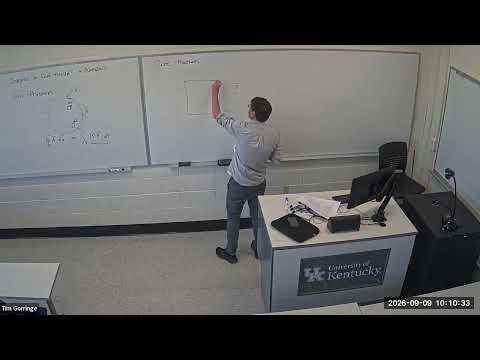 Watch on YouTube →
Overview
Tim Gorringe explains Gauss's divergence theorem and Stokes' curl theorem, connecting surface flux to volume divergence and boundary circulation to surface curl. He verifies both with spherical and cylindrical examples: the field r̂/r² has flux 4π and divergence 4πδ³(r), while the azimuthal unit field φ̂ gives a circular line integral and disk curl integral of 2πR.
Key takeaways
- Gauss's theorem converts the outward flux through a closed surface into the volume integral of divergence, allowing either integral to be chosen for convenience.
- Stokes' theorem equates circulation around a boundary with the surface integral of curl, provided the curve direction matches the surface orientation.
- The field r̂/r² has zero divergence away from the origin but distributional divergence 4πδ³(r), producing flux 4π through any sphere containing the origin.
- For the cylindrical field φ̂, the curl is ẑ/ρ; integrating it across a radius-R disk gives 2πR, exactly the circulation around the disk's boundary.
- The examples illustrate how singular sources such as point charges can be represented with Dirac delta functions even when the ordinary divergence is zero everywhere else.
Chapters
- The lecture wraps up differential and integral vector calculus before moving on to electrostatics.
- Gauss's divergence theorem relates the flux of a vector field through a closed surface to the volume integral of its divergence.
- Stokes' curl theorem relates circulation around a boundary curve to the surface integral of the field's curl.
- For a volume V bounded by a closed surface S, the theorem is ∮S A · dA = ∫V (∇ · A) dV.
- The surface element vector dA points outward from the enclosed volume.
- Divergence acts as flux per unit volume, so integrating it over V accounts for the total flux through S.
- For a surface S bounded by a closed curve C, the theorem is ∮C A · ds = ∫S (∇ × A) · dA.
- The direction of the boundary line elements and the orientation of the surface element must be consistent.
- Curl represents circulation per unit area, so the surface integral sums local circulation contributions into the circulation around C.
- The first example uses the radial field A = r̂/r², with field lines directed outward and magnitude decreasing as 1/r².
- A spherical surface of radius R centered at the origin provides a simple closed surface for testing Gauss's theorem.
- In spherical coordinates, the area element is dA = r² sinθ dθ dφ r̂, with θ from 0 to π and φ from 0 to 2π.
- The dot product A · dA cancels the r² factors, leaving sinθ dθ dφ.
- Integrating φ from 0 to 2π and θ from 0 to π gives total outward flux 4π, independent of sphere radius R.
- A sign mistake in evaluating the cosine limits is noticed and corrected, preserving the positive result 4π.
- The spherical-coordinate divergence formula gives zero for r̂/r² at every point away from the origin.
- The origin is singular, so the full divergence is represented distributionally as ∇ · (r̂/r²) = 4πδ³(r).
- The three-dimensional Dirac delta is zero away from the origin and is defined by integrating to 1 over a region containing the origin.
- Integrating 4πδ³(r) over a sphere containing the origin gives 4π.
- The volume integral of the divergence therefore matches the previously calculated spherical flux of 4π.
- The example models a point source: divergence vanishes away from the origin, where the field lines begin.
- The second example uses the cylindrical-coordinate field A = φ̂, which has unit magnitude and circles the z-axis.
- For a circular boundary of radius R, the line element is ds = R dφ φ̂, with φ running from 0 to 2π.
- The calculation compares circulation around the circle with the curl integrated across its enclosed disk.
- In the cylindrical-coordinate curl formula, only the φ component Aφ = 1 contributes.
- The resulting curl is ∇ × A = ẑ/ρ, directed perpendicular to the circular field lines.
- The line integral around radius R is ∫₀²π R dφ = 2πR.
- For the disk, dA = ρ dρ dφ ẑ, so (∇ × A) · dA reduces to dρ dφ.
- Integrating ρ from 0 to R and φ from 0 to 2π gives 2πR, matching the boundary circulation.
- The lecture closes the vector-calculus unit and notes that these theorems will support later electromagnetism topics.
Transcript excerpt
0:02 Okay, the last few classes you've been watching videos uh on div, grad and curl, differential vector calculus, line, surface and volume integrals, integral vector calculus in cylindrical coordinates in spherical coordinates. So we can apply our differential integral vector calculus to all sorts of problems that are suitable to rectangular or cylindrical or spherical coordinates. In today's class, I wanted to wrap up integral differential vector calculus so that we can move on in the next class to
0:52 electrostatics um with the divergence theorem, the curl theorem and couple of examples of divergence theorem and curl theorem and divergence theorem and curl theorem. Sometimes I call it Gaus's theorem and Stokes theorem. Uh they relate uh quantities from differential uh vector calculus like div and curl to quantities from integral vector calculus uh like surface integrals and volume integrals and uh they have a sort of mathematical interpretation to them but they also have a a nice physics interpretation to them. And you actually met them and you actually met examples
1:40 of the divergence theorem and the pearl theorem in the homework because I think there's a couple of homework questions that ask you to compare a for example surface integral over some uh macroscopic surface with a volume integral of the divergence of a field within that surface. So that's an example of uh the the divergence theorem and there's was another problem that had a similar example I think of the cur anyway I'm going to introduce the two theorems for all the two theorems and write down the two theorems and then we'll look at some more examples of so I'll start with divergence theorem
2:40 And I'm going to start by just sketching some region of space in which we've got a vector field. This is just some region of space with
This is the start of the transcript. Save this video free for the whole transcript, searchable and time-coded.
Related notes
Summary, takeaways, and chapters were generated by AI from the video's transcript and may contain errors. The video belongs to its creator, tim gorringe.