EEL4514C Communication Systems and Components, Fall 2026, Lecture 29
Overview
The lecture moves from PCM and pulse-modulation review to the benefits and design goals of digital communication, then introduces baseband line coding. It explains how error-correction coding, compression, and flexible multiplexing address digital transmission trade-offs, defines spectral and energy efficiency, and presents Shannon's capacity result before illustrating unipolar NRZ and its synchronization and DC-component limitations.
Key takeaways
- Uncompressed PCM requires 2Bn bits per second for a bandwidth-B signal encoded with n bits per sample; 4 kHz voice sampled at 8 kHz with 8-bit quantization therefore uses 64 kb/s.
- Threefold repetition coding enables majority-vote correction of one bit error but cuts the information rate to one-third, illustrating the reliability-versus-rate trade-off.
- Speech compression can reduce 64 kb/s PCM voice to below 10 kb/s by exploiting redundancy, including similarities between adjacent samples.
- Spectral efficiency is measured in bits per second per hertz, while energy efficiency is tied to the relationship between SNR and bit-error rate.
- Shannon capacity predicts that sufficiently long codes can make error probability arbitrarily small at transmission rates below channel capacity, although practical finite-length systems retain errors.
- Unipolar NRZ maps ones to a nonzero pulse and zeros to no pulse, but long runs impair synchronization and an unequal balance of ones and zeros creates a DC component.
Chapters
- Non-ideal sampling and reconstruction introduce frequency-domain distortion; an equalizer can compensate within the signal bandwidth, while a low-pass filter removes unwanted high-frequency components.
- PAM encodes sample values as pulse amplitudes, while PWM and PPM encode them in pulse width or position; constant-amplitude pulses can suit power amplifiers but require accurate timing.
- PCM applies anti-alias filtering, sampling, quantization, and binary encoding; sampling a bandwidth-B signal at 2B samples per second and encoding each sample with n bits requires 2Bn bits per second.
- Voice PCM at 4 kHz bandwidth uses 8,000 samples per second and 8 bits per sample, or 64 kb/s, while speech compression can reduce the rate below 10 kb/s.
- Digital receivers can recover exact bit values despite modest waveform distortion by deciding whether each received symbol represents a 0 or a 1.
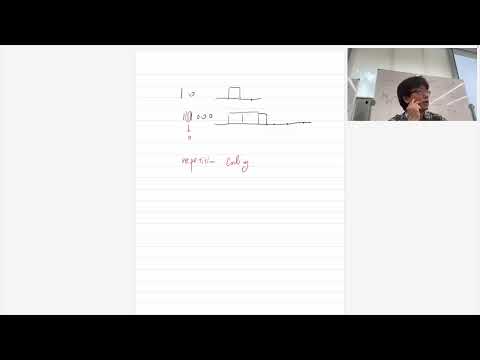
- Threefold repetition coding sends 111 for a 1 and 000 for a 0; majority voting can correct a single flipped bit, but the method reduces the information rate to one-third.
- Sending two data bits plus an XOR parity bit adds less redundancy than repetition and can detect an inconsistency; identifying the erroneous bit requires additional coding or information.
- Error-correction coding provides a practical way to improve reliability that analog communication cannot apply directly to the transmitted message.
- Source coding exploits signal redundancy, such as similarity between adjacent speech samples, and can encode sample differences instead of full sample values.
- A voice signal represented as 64 kb/s PCM can typically be compressed to below 10 kb/s, reducing the bandwidth needed for transmission.
- Encryption uses a key to protect message contents from unauthorized recovery, whereas scrambling rearranges or randomizes bit patterns for transmission-system purposes.
- Scrambling helps avoid long runs of zeros or ones that hinder synchronization and can shape the transmitted power spectral density to better suit a channel.
- Already-digital information can be transmitted without first undergoing analog sampling and quantization.
- Digital storage on hard disks, SSDs, and memory avoids the progressive signal degradation associated with analog media such as tape.
- A digital physical layer can carry voice, video, and other data using the same underlying transmission methods.
- Different service needs, such as email and phone-call latency, can be handled by higher communication layers rather than requiring a different physical-layer modulation for each service.
- Digital systems can share channels through time-division multiplexing and support time-division duplexing, in addition to frequency-based allocation.
- OFDM, used in Wi-Fi and 5G systems, divides transmissions among orthogonal frequency components; code, delay, and Doppler domains can also support sharing.
- Digital signals can be regenerated repeatedly without accumulating the noise that degrades repeated analog copies.
- More signal-processing complexity can increase performance: the lecture contrasts early Wi-Fi rates near 1 to 2 Mb/s with a stated Wi-Fi 7 maximum of about 46 Gb/s.
- Spectral efficiency measures transmitted bit rate per second per hertz and is desirable at high values.
- Energy efficiency relates transmission energy or signal-to-noise ratio (SNR) to bit-error rate; higher signal energy can improve noise robustness but may waste power.
- Claude Shannon's information-theory result establishes a positive channel capacity for a Gaussian-noise channel, linking achievable communication rate to SNR.
- With sufficiently long codes and rates below capacity, error probability can be made arbitrarily small; finite practical codes still have nonzero error probability.
- A useful digital modulation scheme should make timing synchronization reliable and avoid problematic long runs of identical bits.
- Power spectral density (PSD) describes a random transmitted signal's frequency content; pulse design should fit the frequencies passed by the channel.
- Error detection identifies inconsistencies, while error correction reconstructs likely transmitted bits; for example, a received 101 violates the XOR parity relation for a two-bit message.
- Transparency means that in the absence of noise, the receiver can recover the transmitted data without ambiguity.
- A modem transmitter performs channel encoding, bit-to-symbol mapping, pulse shaping, and modulation; reception includes downconversion, timing recovery, matched filtering, equalization, and channel decoding.
- Line coding is a form of digital modulation for baseband channels; the lecture focuses on binary symbols represented by pulses S0 and S1.
- Non-return-to-zero (NRZ) signals are not required to return to zero during a symbol interval, while return-to-zero (RZ) pulses return to zero within that interval.
- The example sequence 11010 is encoded by selecting a pulse shape for each bit over successive symbol intervals.
- Unipolar NRZ uses one nonzero amplitude: the example maps each 1 in 11010 to a square pulse of amplitude A and each 0 to no pulse.
- Long runs of identical bits make synchronization difficult, and a receiver may need framing or known sequence length to determine where a message ends.
- When ones occur more often than zeros, unipolar NRZ has a nonzero average and therefore a DC component, which is undesirable for many channels.
- The lecture previews bipolar signaling as a way to center the waveform and remove the DC component when the probabilities of 1 and 0 are equal.
Transcript excerpt
0:04 Okay, let's get started. So, yeah, let's recover let's recall what we covered covered in our last lecture. Okay, so in our last lecture, we talked about non-ideal practical sampling. We finished talking about that and then we introduced the pulse modulation, right? And then we focused more on the pulse code modulation, right? And we just stopped at here. Okay, and for the non-ideal practical sampling, so this is so [clears throat] so this is what we got for the the final signal, right? And and then so basically compare this guy. So here we include this non-ideal reconstruction as well, right? So if we compare so here so basically we have this FLF component. So that is due to the non-ideal sampling, okay? And
0:54 you can see that so we have lots of high frequency components and so basically if you look at this and then let L equal to zero, then we only have GF here, right? Which is exactly what we want. So basically we just let L equal to zero and then we can see that so the signal becomes PF times F not times GF, right? And F not equals to basically this guy, okay? And for this guy, again, there are a lot of higher frequency component here, right? We can use a low pass filter to filter those out, right? And just make sure I I'm recording. I am. Right? And [clears throat] and so basically now our job is to get
1:41 GF, right? By considering by considering both the non-ideal sampling and the non-ideal reconstruction, okay? And GF not F not due to the non-ideal sampling and the PF due to non-ideal reconstruction. Okay? And so basically this is what we can to design a equalizer to remove all the distortions because of this two
This is the start of the transcript. Save this video free for the whole transcript, searchable and time-coded.
In this course
Related notes
Summary, takeaways, and chapters were generated by AI from the video's transcript and may contain errors. The video belongs to its creator, Mingyue Ji.