ECircuits-Lec1-2026
 Watch on YouTube →
Overview
The opening ECircuits lecture lays out the course logistics and a practical approach to electronics: connect ideal circuit analysis to the nonideal behavior of real components, then use that understanding to design circuits. Students will study op-amps, diodes, BJTs, and MOSFETs through seven labs, 10 homework assignments with the lowest score dropped, two take-home exams, and an in-person final.
Key takeaways
- The course treats ideal circuit equations as starting points, then examines how finite gain, input impedance, output impedance, and component tolerances affect real circuits.
- Students should order the listed lab components early and consider sharing orders: parts cost about $19, with approximately $9 shipping, and some components can take two weeks to arrive.
- The seven-lab structure requires advance preparation: prelabs are due 15 minutes before each session, and in-lab results are due by Friday night.
- Design-oriented analysis prioritizes realistic, sufficiently accurate estimates over unnecessary decimal precision, especially when nominal component values vary between units.
- The curriculum links transistor-level devices to larger systems: students study MOSFETs, BJTs, and diodes, then apply them toward designing an op-amp.
- Ohm's law, KCL, and KVL are foundational tools for both introductory circuit problems and complex electronics, with KCL or KVL chosen according to which makes a particular circuit easier to solve.
Chapters
- Canvas is the official location for course announcements, files, and links; students should check the homepage because links in email may not work.
- The optional GroupMe is for informal discussion of lectures, homework, and quizzes, where peers, TAs, or the instructor may answer questions.
- The first of seven labs starts September 14, leaving the first three weeks for students to order components and prepare equipment.
- Students order their own components through suppliers such as DigiKey or Mouser; the listed parts total about $19 before roughly $9 shipping.
- The required list includes op-amps, field-effect transistors, and a transistor array IC, with substitute parts listed when components are unavailable.
- Combining orders with classmates can reduce per-person shipping costs; orders are recommended by the first or second week to avoid delivery delays.
- Students may reuse resistor and capacitor kits from earlier courses or buy kits listed in the course materials, including options around $10.
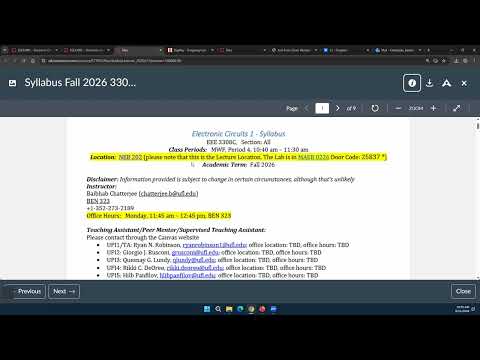
- Canvas contains lecture notes, syllabus details, TA and lab-section information, and materials for upcoming lectures.
- Homework 1 covers voltage and current division and is due August 31; lab 1 materials are already available for advance preparation.
- Lectures and the final exam meet in NB 202, while labs take place in MAB 226 beginning September 14.
- Five undergraduate peer instructors each support two lab sections and will share office locations and hours.
- The course extends prior linear-circuit knowledge to op-amps, diodes, BJTs, and MOSFETs.
- A central goal is to explain why real components depart from ideal equations, including the assumptions and limitations behind circuit models.
- Design-oriented analysis favors useful, fast estimates over excessive precision when real components vary, such as nominal 1 kΩ resistors measuring 0.95 kΩ or 1.02 kΩ.
- The course progresses from ideal and nonideal op-amps to semiconductor devices, then returns to designing an op-amp from transistor-level components.
- Exam 1 is planned for the last week of September and exam 2 for the last week of October; both are take-home assignments posted on Canvas with about a week to complete.
- The in-person final is scheduled for December 8, from 3 to 5 p.m. in NB 202.
- There are 10 homework assignments, with the lowest score dropped; the best nine contribute 18% of the grade.
- Seven labs contribute 28% total at 4% each, while the three exams contribute 18% each.
- Each lab has a prelab to complete outside the lab and an in-lab section involving hands-on measurements and tasks.
- Prelabs are due 15 minutes before a student's lab begins; in-lab results are due by Friday night of that lab week.
- Lab 1 preparation covers impedance, Thévenin and Norton equivalents, and calculating circuit voltages, currents, and input or output resistance.
- Lab 1 bench activities introduce the function generator, oscilloscope, DC voltage generation, and resistance measurements; the session lasts about 1 hour 45 minutes.
- The recommended reference is Sedra and Smith's Microelectronic Circuits, seventh or eighth edition; lecture notes and worked examples will also be posted.
- The instructor identifies research applications in wearable and implantable medical devices, including sensing and hardware processing of ECG data.
- The research explores body-area communication that uses the body's conductivity as a possible lower-power alternative to Bluetooth.
- Wearable studies focus on humans and implantable studies on animals; undergraduate researchers are welcome to inquire about lab opportunities.
- A smartphone PCB integrates chips for functions such as power management, sensing, processing, and communication, with examples from companies including Broadcom, Texas Instruments, and Bosch.
- MOSFETs are fundamental to many digital ICs, while BJTs and diodes also appear in electronic systems, including protection circuits.
- The course's device fundamentals apply to real circuit-design work, although semiconductor technologies and industry needs continue to change.
- Circuit designers should remain adaptable and expect to keep learning after graduation, whether working in industry, academia, or a startup.
- Nodal analysis uses Kirchhoff's Current Law, while loop analysis uses Kirchhoff's Voltage Law; choosing the simpler method depends on the circuit.
- KCL states that signed currents at a node sum to zero, reflecting that current entering a node must equal current leaving it.
- KVL states that signed voltage rises and drops around a closed loop sum to zero; a source voltage equals the total drops across circuit elements.
- Ohm's law, KCL, and KVL underpin later analysis, beginning with voltage division in the next class.
Transcript excerpt
0:04 All right. So, uh we have our campus page up. Can can all of you see this? Uh the light is a little bit uh bright. Is this better or the previous one was better? This is okay. Right. All right. So, uh the Canvas page is up for the course. Um and I'll be making all the announcement on Canvas. Uh, of course, please uh go to the homepage when you are trying to look for any announcements or any links uh because I saw that I made an announcement yesterday or the day before and the links that were there in the announcement. For example, the links to access the syllabus or the parts list and so on. Um, those links might not be accessible through the email, right? And some of you already noted that uh in the group me chat. So
0:53 please make sure that you go to the homepage whenever you're looking for any particular file or any particular link. So I'll be updating everything on the homepage. Um so first of all uh there is a group me link. So please join uh the group me link for again unofficial discussions about let's say lecture materials um homeworks quizzes and so on. So I think it's a it's a good opportunity to help each other because um many a times when you are facing a particular problem or you're trying to solve a particular problem for a homework for example um sometimes other students already have the answer so you don't even need to go to the TA or don't need to wait for the office hours for the TA or the professor just just post the question on the group and I'm sure somebody would answer it it could be me
1:41 it could be one of the TAs it could be
This is the start of the transcript. Save this video free for the whole transcript, searchable and time-coded.
Related notes
Summary, takeaways, and chapters were generated by AI from the video's transcript and may contain errors. The video belongs to its creator, WISE Lab - UF ECE.