EAS4200 Aerospace Structures, Lecture 7, 2026 fall
 Watch on YouTube →
Overview
Ting Dong derives how the stress tensor maps a plane’s unit normal to its traction, then uses the eigenvalue problem to identify principal stresses and their mutually perpendicular directions. The lecture connects those results to Mohr’s three circles, including the maximum shear stress formula and the 45° rotation, and contrasts ductile failure by shear with brittle failure governed by normal stress.
Key takeaways
- For any plane with unit normal n, the stress tensor gives the traction through t(n) = σn; the plane’s normal and shear stresses come from decomposing that traction.
- A principal plane has zero shear stress, which makes its normal n an eigenvector of the stress tensor and its normal stress σₙ an eigenvalue.
- In three dimensions, det(σ − σₙI) = 0 is a cubic characteristic equation with three principal stresses, and their directions are mutually perpendicular.
- Mohr’s largest circle spans σ₁ to σ₃, so the maximum shear stress is (σ₁ − σ₃)/2 and occurs after a 45° physical rotation from a principal plane.
- The lecture distinguishes failure criteria by material behavior: ductile tensile-test specimens tend to shear along roughly 45° planes, while brittle materials are associated with maximum-normal-stress failure.
Chapters
- An axial force P on a bar with cross-sectional area A produces normal stress on a cut perpendicular to the bar’s axis.
- An inclined cut has both normal and shear stress components, showing that stress depends on the plane’s orientation.
- The central question is how to find planes with maximum or minimum normal stress.
- A plane is specified by its unit normal vector n; changing n changes the plane’s orientation.
- The traction vector t(n) on a plane can be decomposed into normal stress and shear stress components.
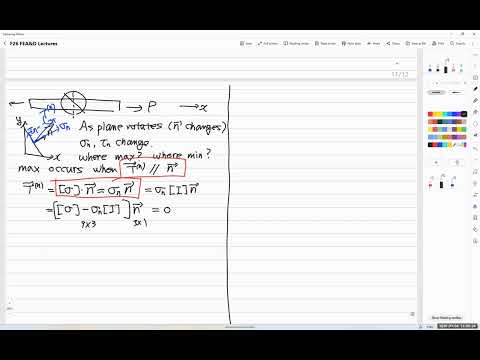
- The stress tensor maps the plane normal to traction through t(n) = σn, allowing stresses on arbitrary planes to be computed from the tensor.
- A principal plane has no shear traction, so its traction vector is parallel to its unit normal.
- Writing t(n) = σn and requiring σn to equal σₙn gives (σ − σₙI)n = 0.
- A physically meaningful solution requires a nonzero normal vector, so σ − σₙI must be singular and its determinant must be zero.
- Setting det(σ − σₙI) = 0 produces a cubic equation for a three-dimensional stress tensor.
- The roots are the three principal stresses, conventionally ordered as σ₁, σ₂, and σ₃ from largest to smallest.
- Ting Dong reviews expansion of a 3×3 determinant by minors to show how the characteristic equation is formed.
- The lecture expands the determinant for a numerical 3×3 stress matrix and factors the resulting cubic.
- The stated principal-stress values are 4, 1, and −2, ordered as maximum σ₁ = 4, intermediate σ₂ = 1, and minimum σ₃ = −2.
- Principal stresses describe planes where the stress is purely normal, with no shear component.
- Substitute each principal stress into (σ − σₙI)n = 0 to find its corresponding principal direction.
- Because the determinant is zero, the equations are linearly dependent; the unit-normal condition nₓ² + nᵧ² + n_z² = 1 supplies the additional constraint.
- The three principal directions are mutually perpendicular and define a coordinate system in which the stress tensor has only normal components.
- Mohr’s circle plots normal stress σₙ against shear stress τ; the principal stresses lie on the horizontal axis where τ = 0.
- In three dimensions, the three circles correspond to the stress pairs σ₁–σ₂, σ₂–σ₃, and σ₁–σ₃.
- The largest circle gives τmax = (σ₁ − σ₃)/2, with center at mean normal stress (σ₁ + σ₃)/2.
- A 45° physical rotation from a principal plane reaches maximum shear because the Mohr-circle angle is twice the physical angle.
- The tensile-test specimen shown has a failure surface near 45°, consistent with ductile materials failing under maximum shear stress.
- Brittle examples such as rock, wood, and glass are described as breaking across a plane closer to 90° to the tensile axis.
- The lecture contrasts maximum shear stress as a ductile-failure criterion with maximum normal stress as a brittle-failure criterion.
Transcript excerpt
0:00 And anybody start uh taking the attendance? I don't know how how it works but probably you and the unit take. Okay, good. So we starting from a stress. We starting from stress. So let's think about it. We have a unex bar and you apply for P say and cross-section area will be A. So if I cut a cross-section here and let's say this is your X direction,
0:50 what stress do I have on that plane? unexual bar and I cut the imaginary cross-section. What stress do you have on the plane? Which one? Normal stress. You have no stress. Are there any other stresses? Have you learned SH stress? [snorts] Okay. Now then on the same problem what if I cut the plane here with angle theta from the vertical axis what stress component do you think do you have there will be normal stress and there will be she stress do you know that okay so stress is different from sport sense that it is function of force also
1:38 function of you only get one you change play you scrap that's why you learn so far right so now the question comes up is if I play around the plane there must be some plane that I have maximum stress there must be some plane that I have a minimum I want to figure out where do I have the can imag coordinate. Okay. And let's like the
2:42 plane that we imaginary cut is by this. So let's say this is your plane. Okay. The cut plane. How we represent the plane. If I cut the uh plane the parallel to the XY plane, we often call it XY plane. If you cut the XG coordinate and we call it XG plane, right? That's how we do it. It has two
This is the start of the transcript. Save this video free for the whole transcript, searchable and time-coded.
Related notes
Summary, takeaways, and chapters were generated by AI from the video's transcript and may contain errors. The video belongs to its creator, Ting Dong.