EAS4200 Aerospace Structures, Lecture 12, 2026 fall
 Watch on YouTube →
Overview
Ting Dong reviews the EAS4200 Aerospace Structures exam scope and the mechanics needed to solve problems involving surface traction, stress tensors, principal stresses, and combined loading. The review emphasizes deriving unit plane normals, applying consistent shear-stress signs, using eigenvalues and eigenvectors for principal stresses, and decomposing loads into tension, bending, transverse shear, and torsion; strain and principal-strain topics are reserved for Exam 2.
Key takeaways
- Normalize every plane-normal vector before using it in the traction relation; otherwise the calculated stress projection is scaled incorrectly.
- A symmetric 3×3 stress tensor has six independent components, and shear signs depend on both the plane index and the shear-direction index.
- Exam 1 requires principal stresses from eigenvalues and principal directions from eigenvectors, with stresses reported in descending order and maximum shear calculated as (σ1 − σ3) / 2.
- Combined-loading solutions begin by classifying each force as axial, bending, transverse shear, or torsion, then calculating and superposing the resulting stress components.
- For the inclined-plane homework case, the full area B × t is required because the plane traverses the entire cross-section; area choice changes if material is removed from part of the section.
- In bending, the sign in σxx = −My/I and the sign of the coordinate locate tensile and compressive regions; the largest bending stress occurs at the greatest distance from the neutral surface.
Chapters
- Exam 1 is scheduled for Monday from 8:20 to 10:20 p.m. and covers material through principal stresses, maximum shear stress, and principal directions.
- Strain matrices and principal strains are excluded from Exam 1 because students have not yet practiced them in homework; they are assigned to Exam 2.
- The exam has four calculation questions and one five-point class-feedback question, with calculations modeled on class examples and homework.
- Ting Dong says equations will be supplied with the exam problems, so preparation should prioritize understanding and problem setup over memorization.
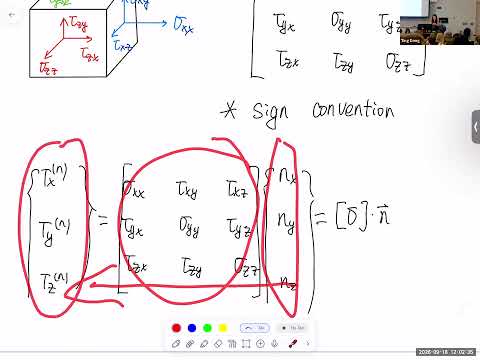
- Surface traction is resolved into normal stress and shear stress using the plane's unit normal vector.
- A vector normal to a plane must be normalized before calculating projections; using a non-unit vector changes the resulting magnitude.
- When a plane is described by its orientation or angles to the x, y, and z axes, its normal can be constructed from direction cosines.
- The unit-normal condition, with magnitude equal to one, supplies an equation for finding unknown direction components.
- A stress state at a point is represented by a 3×3 matrix, but symmetry reduces its nine entries to six independent components.
- Normal stress is positive in tension and negative in compression; the same signs can be interpreted using positive and negative faces.
- For shear-stress subscripts, the first index identifies the plane and the second identifies the direction of the shear component.
- Under the sign convention reviewed, matching signs for the plane and direction indices give a positive shear component, while opposite signs give a negative component.
- The relation between the stress tensor, unit normal, and surface traction can be used in either direction: calculate traction from stress or infer stress from known tractions.
- Known tractions on differently oriented faces provide equations for determining the unknown stress components.
- A force becomes a traction or stress only after division by the relevant area; if force, thickness, and dimensions are given, calculate that area first.
- For the inclined-plane homework problem, use the full cross-sectional area B × t because the plane crosses the entire section; check other potential failure locations only when the task asks for overall structural safety.
- Calculate principal stresses as eigenvalues of the stress matrix and principal directions as the corresponding eigenvectors.
- For Exam 1, use the eigenvalue method rather than relying on the familiar 2D principal-stress equations from mechanics of materials.
- Report the values in the ordered convention σ1 ≥ σ2 ≥ σ3; principal-direction vectors may point in either of two opposite directions along the same axis.
- Maximum shear stress equals one-half the difference between the maximum and minimum principal stresses: (σ1 − σ3) / 2.
- Analyze combined loading by identifying which applied forces create axial stress, bending moments, transverse shear, and torque.
- For bending, determine the force's moment arm and the relevant area moment of inertia; for torsion, identify torque, radius, and polar moment J.
- The review uses σ = F/A for axial stress, bending stress based on moment and inertia, VQ/(It) for transverse shear, and Tc/J for torsional shear.
- Ting Dong recommends returning to mechanics-of-materials fundamentals when a combined-loading problem is confusing, rather than relying only on practicing many similar examples.
- For rectangular and circular sections, transverse shear stress can be calculated from VQ/(It); simplified maximum-stress formulas follow from that distribution.
- In the illustrated circular-section problem, transverse shear is zero at the outer boundary and maximum at the center; the diameter is used as the local thickness for the maximum calculation.
- Bending about one axis produces maximum tensile and compressive normal stresses on opposite sides of the section, with a neutral surface between them.
- For the course's simplified superposition approach, evaluate candidate points A, B, C, and D and add the stress components caused by each force direction.
- The added example finds the stress matrix at point A by treating Fx, Fy, and Fz separately, then combining their stress contributions.
- Fx creates uniform axial normal stress; Fy and Fz each create bending stress and transverse shear, with the shear contribution depending on the point's position on the section.
- At point A, the example's Fy-induced transverse shear and Fz-induced bending stress are zero, while the Fz-induced transverse shear is nonzero and positive on the positive x-plane in the positive z-direction.
- For the bending relation σxx = −My/I, the minus sign determines which side is in compression; the sign of the point's y-coordinate determines the resulting stress sign.
Transcript excerpt
0:00 Can you hear me? Can you hear me? Okay, great. Uh, so if anytime you cannot hear me, just let me know. Um, so we have E exam one on Monday night from 8:20 to 10:20. Um so it will cover the content up until um PR principal stresses and uh principal stress mask share stress and and the directions uh so the strain um because uh and principal strains because those those content we didn't really practice in the homework yet. I will sign homework tonight and it maybe due sometime next week. Um because that that part we we didn't really practice in homework yet. So I will not include that
0:48 part in the exam one. So exam one we will have uh four questions um and one feedback class feedback question that is five points out of 195 points they are I don't think it's mine. uh 95 points. They are the full calculation question and the full calculation question they are very similar to our example probably in the class and also the homework uh problems. Um >> so would you say test >> not strains >> including principal stress it's mathematial stress uh everything related to strain and the strain matrix uh strain matrix and also the principal strains and those
1:36 kind of thing we didn't practice in homework so we're not it will go to exam two yeah um what So I will I will do a exam review today. You can see this class as a huge Q&A section. So any question any concern just raise your hand. Uh we will we will not have any new content. So it's mainly um answer your concerns um for all the knowledge we learned in the previous uh in the in the past month. Um and of
This is the start of the transcript. Save this video free for the whole transcript, searchable and time-coded.
Related notes
Summary, takeaways, and chapters were generated by AI from the video's transcript and may contain errors. The video belongs to its creator, Ting Dong.