EAS4200 Aerospace Structures, Lecture 10, 2026 fall
 Watch on YouTube →
Overview
Ting Dong explains how to identify the critical point in an L-shaped shaft under axial force, bending, transverse shear, and torque, then assemble its stress components into a symmetric 3×3 stress tensor. The lecture shifts to 3D normal and engineering shear strain, distinguishing engineering shear strain from tensorial shear strain, which is half its value and is used in the strain tensor for finding principal strains.
Key takeaways
- For the L-shaped shaft, the critical section is where the bending moment arm is largest, and point A is critical because axial tension and tensile bending stress reinforce each other.
- At the outer point A, transverse shear from the transverse force is zero, but torsion still contributes shear stress through TC/J.
- Stress components at a point belong in a symmetric 3×3 matrix, with equal paired shear terms in the off-diagonal positions.
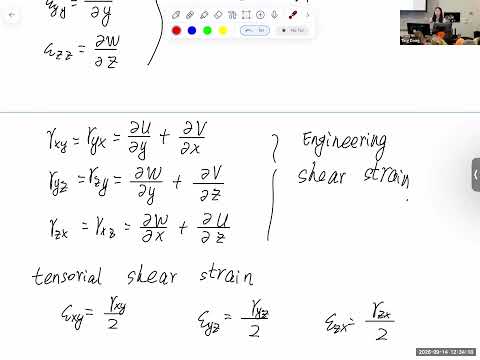
- Normal strain is calculated from displacement gradients, such as εx = ∂u/∂x, while engineering shear strain in the xy plane is γxy = ∂u/∂y + ∂v/∂x.
- Tensorial shear strain is half the engineering shear strain; using tensorial components in the symmetric strain matrix supports calculation of principal strains.
Chapters
- The largest bending moment occurs at the cross-section with the greatest moment arm from the applied force.
- At that section, point A combines axial tensile stress with the maximum tensile bending stress; point C has maximum compressive bending stress.
- Transverse shear stress is zero at the outer point A, while torque contributes shear stress there through the term TC/J.
- Dong assembles the normal and shear components at A into a symmetric 3×3 stress matrix, using the sign convention and matching off-diagonal shear terms.
- Normal strains in the x, y, and z directions come from displacement derivatives: u with respect to x, v with respect to y, and w with respect to z.
- Engineering shear strain describes the change from a right angle under shear; in the xy plane, γxy = ∂u/∂y + ∂v/∂x.
- The same displacement-derivative pattern defines shear strains in the yz and zx planes, with γxy = γyx by symmetry.
- When deformation limits govern a structure, the lecture applies a 3×3 strain matrix to identify principal strains and their directions.
- Normal strains occupy the diagonal entries; tensorial shear strains occupy the off-diagonal entries of the symmetric matrix.
- Tensorial shear strain is half of engineering shear strain, so the engineering value is the sum of the corresponding off-diagonal displacement derivatives.
- The matrix’s eigenvalues represent principal strains, which indicate the maximum normal deformation at a point.
Transcript excerpt
0:00 I guess I mistakenly estimate how how long do we need for to complete this problem. Um but the health is fine because it's already um 126. Um tell me which part you feel confused. >> Stay quiet. >> Figuring out what was >> critical location. Okay. Um you you guys need to stay quiet. I can wait in the back. Can you hear me? So uh the first question where is the critical location? I remember in the uh when I talk about this problem I said
0:46 that as struct engineer we need to figure out where the critical location uh because I mean when people ask this question um they will not decide for you uh what is the critical location. So this quiz problem is more like a simplified stay quiet. Thank you. It's more like a simplified uh example problem we did in class because this is the L shape. Um and this is just a uh shaft. So for this one because we do have this one to generate bending moment. Well for shear stress generate torque it doesn't matter which cross-section uh on the outer circuit that same shear stress generate torque which is maximum. Right? uh for normal stress caused by bending it doesn't matter which cross-section any point have the same normal stress genension so the thing that determine
1:34 which point the critical location is this one right so now if we know that okay the bending moment generated by this force is equal to force time distance so let's say if you consider cross-section here this distance and move this direction this distance so of course the max moment is on the cross this cross-section, right? Because this one has maximum distance moment arm, maximum moment arm. And now for this um
This is the start of the transcript. Save this video free for the whole transcript, searchable and time-coded.
Related notes
Summary, takeaways, and chapters were generated by AI from the video's transcript and may contain errors. The video belongs to its creator, Ting Dong.