Aerospace Structures, Lecture 27, 2026 Fall
 Watch on YouTube →
Overview
Ting Dong reviews three aerospace-structures exam problems involving fatigue, constrained strain, and combined loading, emphasizing how to identify critical locations and choose the correct stress equations. The lecture then clarifies gross-section stress calculations for cracked parts and compares circular and elliptical shafts in torsion, finding that an elliptical shaft with semiaxes a > b develops greater maximum shear stress at equal twist and carries greater torque at equal allowable shear stress.
Key takeaways
- A fully reversed fatigue load has zero mean stress, so the Goodman equation is unnecessary; a load cycling from 0 to 1,000 lb has nonzero mean stress and requires Goodman analysis.
- The critical bending location cannot be chosen from geometry alone: compare the fatigue stress concentration at a notch with the larger bending moment at midspan.
- A constrained dimension B implies εy = 0, providing the compatibility condition needed to solve for the unknown applied force.
- For combined loading, resolve angled forces into coordinate components, calculate each stress contribution independently, then superpose the components at the identified critical point.
- Nominal stress in the cracked-section homework uses the gross cross-sectional area, while fracture-mechanics crack length a is half the stated total length 2a.
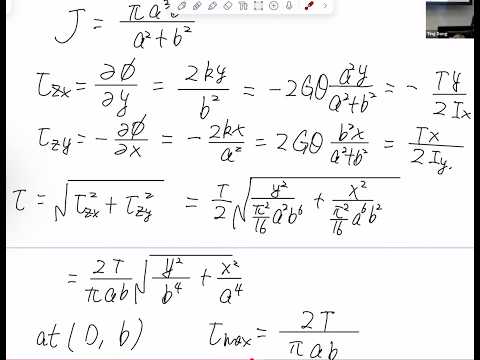
- For elliptical and circular shafts with a > b, the elliptical shaft has a greater maximum shear stress at equal twist by the factor 2a²/(a² + b²), and carries greater torque at equal shear stress by the factor a/b.
Chapters
- The first problem compares point A near a stress concentration with point B at midspan, accounting for both stress concentration and bending moment arm.
- At A, the reaction is F/2 and the moment arm is 4; at B, the moment arm is 8, so both locations require calculation before choosing the critical point.
- Use the fatigue stress concentration factor, notch sensitivity, and the 10^5-cycle fatigue-strength threshold to calculate the safety factor.
- The 30-point rubric penalizes using a static stress concentration factor instead of the fatigue factor, or applying the Goodman equation to a fully reversed load.
- A free-end load varying from 0 to 1,000 lb creates nonzero mean stress, unlike the fully reversed loading in the preceding problem.
- Calculate maximum and minimum bending stress first; the minimum is zero, so mean stress and stress amplitude are each half the maximum stress.
- Apply the Goodman equation, then use the resulting fatigue parameters to determine the cycle life.
- The 20-point grading rubric assigns 10 points to correctly applying Goodman and deducts 12 points for treating the loading as fully reversed.
- The third problem states that dimension B does not change, which means the strain in the BC or y direction is zero.
- Resolve the applied force and support reaction into stresses on the 2-by-2 cross section, using consistent pound-inch units to obtain psi.
- Substitute the stress components into the y-direction strain relation and set εy = 0 to solve for the unknown force F.
- Decompose an angled load into x and y components and calculate their separate bending, transverse-shear, and torsional effects before superposing the stresses.
- The x component bends about the y axis with a 20-unit moment arm; the y component bends about the z axis with a 10-unit arm.
- Because F cos 30° and its moment arm produce the larger bending stress, point A is selected as the critical location.
- Combine the normal and shear components in the stress matrix, preserve the negative sign for shear on the positive x plane in the negative y direction, and check the result with von Mises theory.
- For the homework crack problem, calculate nominal normal stress using the entire cross-sectional area rather than subtracting the hole or crack area.
- When the total crack spacing is defined as 2a, use a as the half-length in the fracture-mechanics calculation.
- To locate the extreme value along an elliptical boundary, substitute the boundary equation for y² and obtain a quadratic in x² with no linear term.
- The symmetry of that quadratic places the extreme at x = 0; the derived torsion, polar-moment, and maximum-shear-stress equations may be reused in later homework and exams.
- The final example compares shafts of equal length and material, one circular and one elliptical, with elliptical semiaxes a and b and a > b.
- It asks which shaft has greater maximum shear stress at equal angle of twist, and which carries greater torque at equal shear stress.
- For a fair comparison, use the maximum shear stress on the outer surface and express each shaft's stress or torque in terms of the quantity held equal.
- For a circular shaft, combine τ = Tr/J with T = GJθ to relate maximum outer-surface shear stress to angle of twist.
- For the elliptical shaft, substitute its torsion constant and maximum-shear relation; at equal twist, the elliptical-to-circular maximum-stress ratio is 2a²/(a² + b²), which exceeds 1 when a > b.
- At equal allowable shear stress, the torque ratio for elliptical versus circular sections is a/b, also greater than 1.
- The elliptical section therefore produces higher maximum shear stress at equal twist and resists greater torque at equal shear stress, consistent with its additional material.
Transcript excerpt
0:47 I'm sorry, I forgot to turn it off. >> Thank you very much. >> Um I'm sorry. I I thought I Let's check the Thank you for reminding me. Uh let's check the recording. Here's um let's let's do it again. So for this one we have uh we have two location we consider uh one is the stress concentration here one is the middle
1:35 point because one with larger moment arm one is uh stress concentration factor so without calculation we don't really know which one higher um as I said is very close to um the actual practice problem I provided the first actual practice problem I provided um so uh theoretical stress concentration factor um square root a notch index and fatigue stress concentration factor here. And for this nominal stress is MC / I specifically for the M it is reaction force equal to half of F because one F going downward two reaction force going upward. So it should be half and also it's symmetric half of F moment arm should be four because now at this location this dimension is four and C
2:25 over I C is point uh 0.5 um so now if we write a normal stress at function of F um and times the stress concentrate factor we have this one and at a point B well B point it's just the middle point so now we have half of F. Now the moment arm becomes um 4 + 4 right so is eight and radius larger and now if we compare the point A and point B well um we should use point A but of course you do need to have this uh this calculation. Um now we identify this is a critical point and for calculating A and B based
This is the start of the transcript. Save this video free for the whole transcript, searchable and time-coded.
Related notes
Summary, takeaways, and chapters were generated by AI from the video's transcript and may contain errors. The video belongs to its creator, Ting Dong.