EAS4200 Aerospace Structures, Lecture 5, 2026 fall
 Watch on YouTube →
Overview
Ting Dong reviews how the stress tensor gives traction on an arbitrary plane through t = σn, then applies that method to a glued-joint strength check. For a simplified tensile member with a 50 mm by 70 mm cross-section and a 40° joint, the normal-stress limit of 700 MPa governs over the 560 MPa shear limit, giving a maximum load of about 5.93 MN.
Key takeaways
- Traction on an arbitrary plane follows t = σn, so global stress components alone are insufficient when a structure may fail along an inclined joint.
- For the 50 mm by 70 mm example, axial stress is σxx = P/(ab), and a joint normal with components cos 50° and sin 50° gives σn = (P/ab)cos² 50° and τ = (P/ab)cos 50° sin 50°.
- The example's 700 MPa normal allowable produces a load limit of about 5.93 MN, while the 560 MPa shear allowable produces about 6.10 MN; the lower normal limit controls.
- A safe load must satisfy both normal and shear allowable-stress checks, so the governing capacity is the smaller of the two independently calculated limits.
- Reversing a plane's unit normal changes traction signs but not the physical failure prediction when the stress sign convention and projections are applied consistently.
- Adding bending, torque, or transverse shear changes the stress tensor but not the core workflow of finding plane traction and resolving it into normal and shear components.
Chapters
- Homework can be handwritten on paper or an iPad; graders focus on clear steps, correct equations, and correct substitutions rather than a prescribed format.
- Attendance is optional and contributes extra credit outside the 100-point base grade.
- Three drops are already built into the final grade, and Ting Dong says no additional drops will be granted, including for excused absences.
- Exam 3 dates are being coordinated with the department, with November 16, 17, and 19 discussed as possible options.
- A structure can fail at an inclined weak joint even when its global X, Y, and Z stress components appear acceptable.
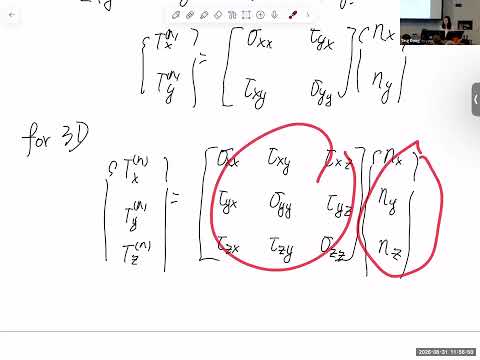
- The 2D force-balance derivation is extended to 3D, where traction on a plane is determined from the stress tensor and that plane's unit normal.
- The key relation is t = σn, which converts the stress state at a point into the traction vector acting on a selected plane.
- Tension and compression create normal stress, while torsion and transverse loading can create shear stress; bending also contributes normal stress.
- Combine the stress components generated by the structure's applied forces and moments, then calculate traction on the potentially weak plane.
- Resolve that traction into normal and shear stress and compare each value with the joint's corresponding allowable strength.
- The same framework can solve for maximum load or minimum required thickness by treating the desired design quantity as the unknown.
- The example uses a tensile force P in the X direction and a rectangular cross-section with dimensions a = 50 mm and b = 70 mm.
- The inclined glued joint is set at 40°, and its allowable normal and shear stresses are 700 MPa and 560 MPa.
- Ting Dong presents the case as a simplified baseline; adding bending, torque, or transverse shear would change the stress tensor entries but not the solution procedure.
- For the example's purely axial tensile loading, the only nonzero stress component is σxx = P/(ab).
- The joint plane's unit normal is determined from its direction angles; for the upward-facing plane, the in-plane components are cos 50° and sin 50°, with zero Z component.
- The opposite-facing normal reverses the component signs, but the physical failure result is unchanged when signs are handled consistently.
- Apply t = σn to find the traction vector on the glued plane; in this axial example, its magnitude is proportional to (P/ab)cos 50°.
- Project traction onto the unit normal to obtain σn = (P/ab)cos² 50°.
- Subtract the normal component from traction, or use the equivalent projection relation, to obtain τ = (P/ab)cos 50° sin 50°.
- Keep the tensile sign convention in the stress tensor; use magnitudes when comparing the resulting stresses with allowable strengths.
- Using ab = 3,500 mm² and the 700 MPa normal limit gives a normal-stress load limit of approximately 5.93 MN.
- Using the 560 MPa shear limit gives a shear-stress load limit of approximately 6.10 MN.
- The maximum safe applied load is the smaller limit, about 5.93 MN, because the normal-stress criterion governs.
- Checking only the larger allowable-based load would exceed the normal-stress limit, even though the shear criterion remains satisfied.
- For more complex loading, populate the stress tensor with normal and shear components from tension, compression, bending, and torsion; for example, torsion can produce τxz or τxy depending on the point considered.
- Different coordinate axes or either orientation of the same joint plane may change intermediate signs, but a consistent calculation must give the same failure prediction.
- The reusable sequence is to determine the stress state, find the plane's unit normal, calculate traction, resolve normal and shear stresses, and compare both with their allowables.
- The same process applies to other geometries, including L-shaped structures and different cross-sections, once their stress components are calculated.
Transcript excerpt
0:01 time of class. Um, so I got some question about homework formatting. Time for class. Uh, I got some question about it like homework formatting. We don't really care about the format of how you solve the problem. Just make it clear that TA can understand um what you are doing there. Um, but there's no like specific format you have to follow. We check the content. So basically what we normally do is that uh let's say for a problem we just separate to several steps and then we distribute uh points to each step and to see if you have correct understanding. Uh so basically you need to use the correct equation you need to have the correct number plug into the equation and those kind of thing. Um so we don't care much about like really what kind of format just make sure that uh you show all the
0:50 steps. Uh, and also I got an email asking like if it's okay to write on iPad. It's it's perfectly fine to use iPad. It doesn't need to be like really written on paper. Um, and also uh about the attendance uh I like we are we only had one attendant but already start receiving emails about um absence excuse and ask me. I mean um as I I think I emphasized in the first class and also in the syllabus um attendance for this class is really optional. It's really optional. So uh the grades is extra credits outside of 100. So even you skip the class for the whole house semester it does not really neatly impact your grade. So that's the first thing and also the second thing out of the three
1:40 points in your final grade uh we have three drops to accommodate all kind of
This is the start of the transcript. Save this video free for the whole transcript, searchable and time-coded.
In this course
Related notes
Summary, takeaways, and chapters were generated by AI from the video's transcript and may contain errors. The video belongs to its creator, Ting Dong.