EAS4200 Aerospace Structures, Lecture 29, 2026 Fall
 Watch on YouTube →
Overview
Ting Dong applies thin-walled open-section torsion theory to an I-beam: the torsional constant is the sum of the constants of its rectangular strips, maximum shear stress occurs in the thickest strip, and twist per unit length is T/(GJ). The example uses a 5,000 N·m torque and a shear modulus of 210 GPa, then begins deriving thin-walled closed-section shear flow using q = τt and contour coordinates.
Key takeaways
- For a thin-walled open I-section, approximate the torsional constant by adding the narrow-rectangle contributions, J ≈ Σ(bt³/3), including both flanges and the web.
- The lecture’s narrow-rectangle torsion relation makes shear stress rise with strip thickness, so the thicker I-beam flange, not the thinner web, governs the stated maximum-stress location.
- Once J is known, twist per unit length follows θ = T/(GJ); the worked example uses T = 5,000 N·m and G = 210 GPa.
- Rearranging the same set of thin rectangular strips does not change J under the open-section method presented, because the total remains the sum of the individual strip constants.
- Closed thin-walled sections require a different torsion analysis; the derivation begins with shear flow q = τt and an along-wall coordinate s.
- The thin-wall assumption treats stress through the thickness direction n as zero, leaving the shear-stress component along the wall contour.
Chapters
- The lecture continues the previous class’s treatment of shear stress in narrow rectangular cross-sections and combinations of such strips.
- Ting Dong says attendance is encouraged but not required, with attendance counted as a bonus.
- Ting Dong says an exam average below 80 would prompt a curve and commits to adjusting grades so 40% of students receive an A.
- The I-beam represents a wing spar, which primarily carries bending-induced normal stress but must also withstand wing torque.
- The applied torque is 5,000 N·m, and the problem asks for maximum shear stress, its location, and angle of twist per unit length.
- The example focuses on torsion and excludes stress concentrations.
- Ting Dong divides the open I-section into two flange strips and one vertical web strip.
- Each narrow rectangular strip contributes approximately bt³/3 to the torsional constant, with the two flange contributions counted separately.
- The web’s effective height is the total section height D minus the thicknesses of the top and bottom flanges; the three contributions are added to obtain J.
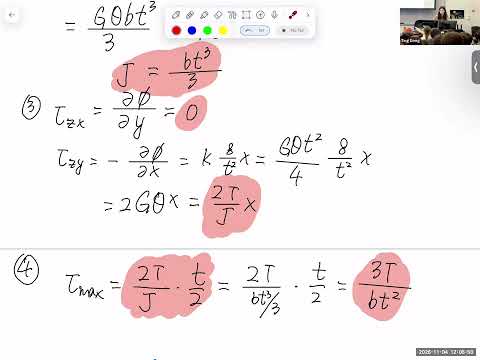
- For the open-section calculation, shear stress is related to torque, J, and half the strip thickness.
- Unlike the circular-shaft relation τ = Tr/J, the narrow-rectangle result makes the stress increase with strip thickness when comparing components under the lecture’s method.
- The maximum is located at the top and bottom of the thicker flange strips; those locations have equal stress magnitude.
- Ting Dong distinguishes this result from axial stress σ = F/A, where a smaller area raises stress.
- The torsion relation T = GJθ connects applied torque, shear modulus, torsional constant, and rotation.
- Angle of twist per unit length is calculated as θ = T/(GJ).
- The example uses the previously calculated I-beam J and converts the given 210 GPa shear modulus to pascals for consistent units.
- Ting Dong compares the original I-shape with differently connected arrangements made from the same flange and web strips.
- Under the open-section theory used here, total J remains the sum of the individual strip constants, so rearranging the same strips does not change the predicted torsional response.
- A student asks whether tabulated beam moment of inertia can supply J; Ting Dong clarifies that bending moment of inertia and torsional constant are different properties.
- Ting Dong contrasts open sections with closed cells, including airfoil-like and thin-walled circular examples.
- Closed-section torsion requires a different theory from the open I-beam strip-summation method.
- The new derivation considers a general closed contour whose wall thickness can vary around the section.
- The closed-section derivation assumes wall thickness is much smaller than the total wall-contour length.
- Shear flow is defined as q = τt, where τ is wall shear stress and t is local wall thickness.
- Coordinates s and n follow the wall: s runs along the contour and n is perpendicular through the thickness.
- Because the n-direction dimension is small under the thin-wall assumption, Ting Dong takes the through-thickness shear-stress component as zero; the remaining stress acts along s, and the derivation continues in the next class.
Transcript excerpt
0:00 So in last class we talked about that um shear stress for nar cross-section and we used the equation for shear stress distribution and um what if is a combination of different different narrow rectang cross-section and I gave the conclusion that So this is for one single narct
0:55 cross-section and if it combination or it just bend in any way as long as it maintain as a um I just want to add a more about being crazy. Um let's say in this way there are so many professors that are so um care about the um student learning they require attendance to be mandatory. Sound familiar? And for me I feel the same way. I also want you guys to come to the class to learn more. Um but I don't want to make too much pressure for you guys. That's why I make attendance as bonus part and attendance is not required for this. I try to encourage the attendance
1:45 in terms of the exam and quiz grades in the first class in the when I talk about syllabus I said that um if the average is below 80 I consider it's my fault because either I make the exam too crazy or I didn't explain certain topic which make the majority of students make mistake in them and I take responsible for that and that's why I curve the average to A in term of the final grades, I also made a promise that 40% students in the end will get A. I will adjust the grading scale to make sure that 40 students person students will get A. So I don't think I'm the craziest professor in our department. I'm doing my best to create a
2:35 environment that encourage you guys to learn while do not get too much stress
This is the start of the transcript. Save this video free for the whole transcript, searchable and time-coded.
In this course
Related notes
Summary, takeaways, and chapters were generated by AI from the video's transcript and may contain errors. The video belongs to its creator, Ting Dong.