EAS4200 Aerospace Structures, Lecture 15, 2026 fall
 Watch on YouTube →
Overview
Ting Dong explains how the von Mises distortion-energy criterion and Tresca maximum-shear criterion predict ductile yielding, while maximum-principal-stress theory is used for brittle materials. A worked example combines bending and torsion in a circular member with a 14,000 psi yield strength, then the lecture introduces aircraft fatigue through cyclic loading, the de Havilland Comet and Aloha Airlines Flight 243, and inspection methods.
Key takeaways
- For a ductile material, the same multiaxial stress state can produce different design decisions: the example is safe under von Mises but fails under the more conservative Tresca criterion.
- A brittle-material maximum-principal-stress check must use the principal stress calculated from the full stress state, not just the normal stress caused by bending.
- Von Mises failure assessment compares equivalent stress with material strength; Young's modulus and Poisson's ratio are not needed for that final comparison.
- Repeated aircraft pressurization and flight loading can grow small fatigue cracks until the remaining material cannot carry the load, even if the damage is initially difficult to see.
- The de Havilland Comet failures show how square-window corners concentrate stress during pressurization cycles, while Aloha Airlines Flight 243 demonstrates the danger of accumulated fatigue damage after more than 89,000 cycles.
- Aircraft fatigue management relies on tracking service cycles and using inspections such as ultrasonic, eddy-current, and dye-penetrant testing, alongside design measures that reduce stress concentrations.
Chapters
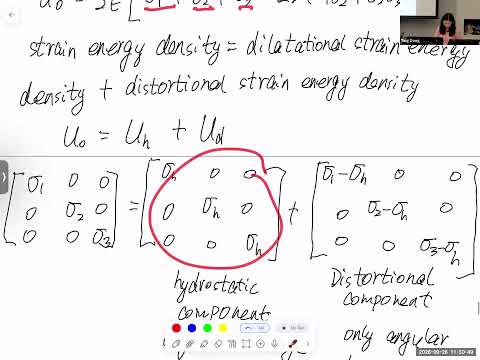
- The distortion-energy approach reduces a 3D stress state to principal stresses σ1, σ2, and σ3, with shear components zero in principal coordinates.
- It separates hydrostatic stress, illustrated by equal pressure on all six faces of a deep-sea structure, from distortional energy associated with yielding.
- Distortional energy can be represented by an equivalent von Mises stress, which is compared with the material's measured strength.
- For plane stress, the lecture compares Tresca maximum-shear, von Mises distortion-energy, and maximum-principal-stress, or Rankine, failure envelopes.
- Rankine is presented primarily for brittle materials; Tresca and von Mises are used for ductile materials.
- Tresca is more conservative than von Mises: a stress state can fall inside the von Mises safe region while lying outside the Tresca envelope.
- The choice depends on design goals and test evidence; the lecture describes von Mises as often giving a better failure prediction and Tresca as a conservative option.
- The example uses a circular member with a 1-inch radius, a 40-inch bending lever arm, a 250-pound transverse force, and an applied torque.
- The material's uniaxial yield strength is given as 14,000 psi, providing the reference for the failure checks.
- The problem asks whether the member fails under brittle-material and ductile-material criteria, rather than requiring a new derivation of basic beam stresses.
- The critical cross-section is where the bending moment and torsion act; points A and C on the circular section are equivalent in stress magnitude.
- Bending creates maximum tensile normal stress at A and maximum compressive normal stress at C, while torsional shear has equal magnitude at both points.
- The transverse-shear contribution is zero at these outer points, so the example combines bending normal stress with torsional shear stress.
- The lecture uses σxx for the bending normal stress and τxz = τzx for the torsional shear components in the stress matrix.
- The stress matrix is transformed mathematically to obtain principal stresses; the maximum principal stress is not simply the bending stress σxx.
- Combining bending and torsional shear increases the maximum principal stress above the bending-only normal stress.
- For the brittle-material case, the maximum-principal-stress criterion compares σ1 with the 14,000 psi yield-strength value provided in the example.
- The calculated maximum principal stress is below 14,000 psi, so the example is considered safe under this criterion.
- Tresca checks the maximum principal-stress difference, using the largest shear stress implied by σ1 and σ3.
- For the same example, the Tresca result exceeds the 14,000 psi reference, so it predicts failure.
- Von Mises calculates an equivalent stress from the squared differences between σ1, σ2, and σ3, then compares that value with the material strength.
- The von Mises equivalent stress is below 14,000 psi, so it predicts safety; Young's modulus and Poisson's ratio are not needed for this final stress comparison.
- The appropriate strength limit depends on what counts as failure: ultimate strength can represent fracture, while yield strength limits permanent deformation.
- Repeated loading into the plastic region leaves accumulated deformation after unloading, unlike loading that stays in the elastic range.
- For aircraft structures, the lecture emphasizes avoiding yield in many applications so repeated flights do not progressively change the structure's shape.
- Fatigue makes the distinction important because cyclic plastic deformation can accumulate even when each load is later removed.
- The fatigue introduction describes takeoff, climb, cruise, and landing as repeated cycles that flex aircraft structures thousands of times.
- Cyclic loading can create microscopic defects and cracks in metal; continued stress grows cracks until the remaining uncracked section can no longer carry the load.
- Fatigue damage may remain invisible for a long time and then lead to sudden failure, much like repeatedly bending a paper clip.
- Ting Dong identifies corrosion and fatigue as common aircraft-structure failure concerns and highlights fatigue as an engineering design and maintenance problem.
- The 1950s de Havilland Comet failures were traced to fatigue cracks near square-window corners, where stress concentrations intensified repeated cabin-pressurization loads.
- The 1988 Aloha Airlines Flight 243 rupture followed more than 89,000 pressurization cycles; a crew member died, and the event prompted stronger inspection practices for older aircraft.
- Aircraft fatigue management combines service-life limits and cycle records with ultrasonic, eddy-current, and dye-penetrant inspection techniques.
- The lecture also mentions structural sensors, self-healing alloys, smart composites, and AI-based fatigue prediction as developing ways to detect or anticipate damage.
Transcript excerpt
0:01 So in the last class we talked about uh we mainly focus on the distortion angry theory. Um so uh we derive from the energy density uh strain and density and simplify um by reducing the n number of variables. So we start from a 3D situation that we had six um strain components, six stress components um and reduce to three stress component three strain components by um orienting in the way that is only principal stresses and principal strains and all the shear stress she strain are zero. And then also with the relation between the stra uh principal stresses and principal strains um we reduce to three variables sigma 1, sigma 2, sigma 3 with material property of course young
0:49 motor to ratio and out of this um total strain and density we separate the part the hydrostatic component that theoretically based on well based on this theory does not cause damage does not cause failure of structure. So just imagine that you have a structure thrown into the deep sea and then they have the pressure on all six surfaces equivalent those structure will not fail because the pressure equivalent pressure on all six surfaces. Um so that the theory um we separate this part and we only have this part we consider based on their theory the distortional component will cause the failure of structure. So uh we plug in for this component we plug in sigma 1 equal to sigma 2 equal to sigma
1:36 3 equal to sigma h. So this is a hydrostatic component the correspond part of the strain and density and then we use total minus hydrostatic components in terms of the end density we get the part that we consider actually cause the damage cause of failure of structure and this is the
This is the start of the transcript. Save this video free for the whole transcript, searchable and time-coded.
Related notes
Summary, takeaways, and chapters were generated by AI from the video's transcript and may contain errors. The video belongs to its creator, Ting Dong.