EAS4200 Aerospace Structures, Lecture 14, 2026 fall
 Watch on YouTube →
Overview
Ting Dong explains how ductile and brittle materials motivate different failure criteria, then derives the von Mises criterion by separating strain energy into hydrostatic and distortion components. The lecture compares von Mises, Tresca, and maximum principal stress criteria using plane-stress failure envelopes, showing why Tresca is more conservative than von Mises for ductile materials and why maximum principal stress is commonly used for brittle materials.
Key takeaways
- Ductile yielding is modeled through distortion rather than hydrostatic volume change, which is the physical basis for the von Mises criterion.
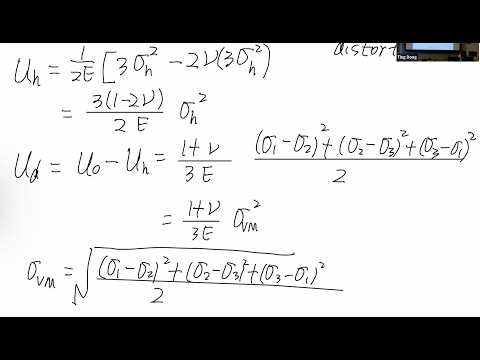
- The von Mises equivalent stress is σv = sqrt(((σ1 − σ2)² + (σ2 − σ3)² + (σ3 − σ1)²)/2), and yielding is predicted when σv ≥ Sy.
- For plane stress, von Mises produces the elliptical boundary σa² − σaσb + σb² = Sy², while Tresca produces a piecewise-linear boundary.
- Tresca predicts yielding when the largest principal-stress difference reaches the uniaxial yield strength, making it more conservative than von Mises in some multiaxial stress regions.
- Rankine theory compares principal normal stresses against tensile or compressive strength and is commonly suited to brittle materials, while Tresca and von Mises are commonly used for ductile materials.
Chapters
- Under uniaxial tension, brittle materials fail on the plane normal to the applied load, where principal normal stress is greatest.
- Ductile materials fail by sliding associated with shear stress, which reaches its maximum on a plane oriented 45 degrees to a tensile load.
- Torsion reverses the illustrative comparison: brittle failure follows a plane of maximum principal normal stress, while ductile failure is associated with the cross-section's maximum shear stress.
- For one-dimensional loading, strain energy density is one-half the product of axial stress and axial strain.
- A general three-dimensional stress state has six independent components: three normal stresses and three shear stresses, paired with their strains.
- Integrating strain energy density over a structure's volume gives its total strain energy.
- Rotating to principal coordinates eliminates the three shear stress components and their corresponding shear strains.
- The strain energy density can therefore be expressed using principal stresses σ1, σ2, and σ3 and their principal strains.
- For isotropic linear elasticity, Young's modulus E and Poisson's ratio ν relate the principal strains to the principal stresses.
- The hydrostatic component applies equal normal stress on all faces, analogous to uniform pressure on a cube, and produces volume change.
- Subtracting the mean principal stress σh = (σ1 + σ2 + σ3)/3 leaves the distortional components that change shape.
- The distortion-energy theory assumes hydrostatic loading alone does not cause ductile yielding, while distortional energy drives failure.
- Von Mises stress is defined as σv = sqrt(((σ1 − σ2)² + (σ2 − σ3)² + (σ3 − σ1)²)/2).
- This equivalent stress is a mathematical measure derived from distortion energy, not a separate physical stress component.
- In a uniaxial tensile test at yield, σ1 = Sy and σ2 = σ3 = 0, so σv equals the material's yield strength Sy.
- For a three-dimensional loading state, compare the calculated von Mises stress with the yield strength measured in a uniaxial tensile test.
- The ductile material is predicted to yield when σv reaches or exceeds Sy.
- The criterion lets engineers assess combined normal and shear loading using one scalar equivalent stress.
- For plane stress with principal stresses σa and σb and a third principal stress of zero, σv² = σa² − σaσb + σb².
- The equation σa² − σaσb + σb² = Sy² defines an elliptical failure boundary in the σa–σb plane.
- Stress combinations inside the ellipse are predicted safe by this criterion; points on or outside the boundary reach or exceed yield.
- The Tresca criterion is also called the maximum shear stress theory; it compares the largest principal-stress difference with yield strength.
- Using ordered principal stresses, yielding is predicted when σ1 − σ3 reaches Sy, equivalent to maximum shear stress reaching Sy/2 in a uniaxial calibration test.
- Its plane-stress failure envelope is piecewise linear, and the lecture identifies it as more conservative than von Mises for ductile materials.
- The maximum principal stress criterion, also called Rankine theory, predicts brittle failure when a principal tensile or compressive stress reaches the corresponding material strength.
- With equal tensile and compressive strengths, its plane-stress envelope is square; real brittle materials may require distinct tensile and compressive limits.
- The Rankine, Tresca, and von Mises boundaries differ: the lecture recommends maximum principal stress for brittle materials and Tresca or von Mises for ductile materials.
- Where Tresca predicts failure but von Mises predicts safety, Tresca is the more conservative ductile-material assessment.
Transcript excerpt
0:00 Uh for students sitting in the back, can you hear me? Okay, great. Uh if you cannot hear me anytime, just raise your hand. Um so today we're going to talk about the fata theory. So it's basically um the last topic of this first chapter. Um and I I'm pretty sure you guys probably already learned in the previous mass materials class like um for brittle material for uh duct material and then you have a tensile test you have the torsion test and the fail on different plane. Remember that one. If it's a brittle material and when you fail you when you have a tensile test, which plane fail? If you have a brittle material and apply tensile tensile force, which plane will fail?
0:49 Right? Um and if it's ductile material and you apply tensile force, which 45 degree, right? And also if is the brittle material if I apply toion which plane fail >> 45 and if is duct material when you apply toion it is uh yes so I guess you guys will remember those part so this is mainly because uh we have different failure theory in general uh the simplest two we can say is that if it's written material uh we can consider it break uh because at bond be break between uh internally. So it break because of normal stress. So when you apply the tensile force the
1:36 cross-section which is a which is section that is perpendicular to the actual direction that is the se cross-section that is a plane that has maximum normal stress right has maximum principal stresses. So in that situation it fail 90° but if it's duct material it failed because of sliding between atoms. So it failed because of sheer stress not normal stress and when you apply tensile
This is the start of the transcript. Save this video free for the whole transcript, searchable and time-coded.
Related notes
Summary, takeaways, and chapters were generated by AI from the video's transcript and may contain errors. The video belongs to its creator, Ting Dong.