EAS4200 Aerospace Structures, Lecture 13, 2026 fall
 Watch on YouTube →
Overview
Ting Dong reviews exam solutions and grading criteria, then develops isotropic stress-strain calculations for EAS4200 Aerospace Structures. The lecture applies traction vectors, bending and torsion stress, unit normals, principal stresses, and Hooke's law, culminating in a frictionless rigid-punch example using a 100 × 100 × 10 mm specimen and a 101 × 101 × 9 mm die cavity.
Key takeaways
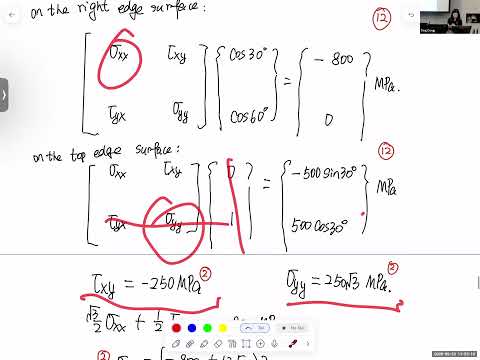
- Traction on a surface is calculated from the stress tensor and its unit normal; reversing the face normal reverses the traction description but does not change the recovered stress tensor when signs are applied consistently.
- Stress contributions depend on both the applied load and the point of interest: a transverse shear force can produce zero shear stress at a location, and bending normal stress is zero on the neutral surface.
- For isotropic linear elasticity, Young's modulus and Poisson's ratio determine the shear modulus through G = E/[2(1 + ν)], so only two independent elastic constants are needed.
- When deformation dimensions are known but the load is not, calculate strain from the dimensional changes first, use the constitutive relation to find stress, and then recover force with F = σA.
- In the rigid-die example, the change from 100 × 100 × 10 mm to 101 × 101 × 9 mm gives lateral strains of 0.01 and a thickness strain of −0.1; frictionless contact sets shear components to zero.
Chapters
- Ting Dong explains that exam solutions and grading rubrics are reviewed in class rather than posted online, to discourage reposting.
- The first problem uses the traction relation between the stress matrix, a unit normal, and surface traction.
- Equivalent left and right faces, or top and bottom faces, give the same stress solution when the surface-normal sign is handled consistently.
- Either a 2 × 2 stress matrix or a 3 × 3 matrix with zero components is acceptable.
- Ting Dong separates applied forces into Fx, Fy, and Fz to identify their stress contributions at the specified point.
- Fx and Fy create bending moments, with normal stress calculated using the bending relation; an axial force also contributes normal stress through F/A.
- A force offset from the cross-section creates torque, producing shear stress through the torsion relation Tc/J.
- Transverse shear may exist across a section but can be zero at a particular point; bending from Fz likewise gives zero normal stress at the stated neutral-surface location.
- For the five stress components in the force-component problem, Ting Dong describes six points per component, with additional credit for the stress matrix and governing equations.
- Rubric deductions distinguish wrong equations, moment or inertia terms, subscripts, signs, calculation errors, and adding stress components that should be zero.
- For stress transformation, the unit normal, traction equation, normal stress, and shear stress each receive five points, for 20 points total.
- A unit vector equally inclined to the x, y, and z axes has equal direction components; showing intermediate steps can preserve credit even if a component value is mistyped.
- The final exam problem uses deliberately simple values, yielding principal stresses of 80, 20, and 10 and a maximum shear stress of 35.
- Ting Dong describes a 10-point rubric for the calculation, including separate credit for intermediate steps and maximum stress.
- The teaching assistants are expected to finish grading within one week; students can discuss discrepancies with Ting Dong after reviewing returned exams.
- A 3D stress-strain relation uses six independent stress components and six independent strain components, represented by a 6 × 6 constitutive matrix.
- Stress can be calculated from external loads and geometry, then converted to strain and deformation; the relation can also be used in reverse when deformation is known.
- For an isotropic material, Young's modulus and Poisson's ratio determine the shear modulus through G = E/[2(1 + ν)].
- Strain components are dimensionless ratios, including both normal strain and engineering shear strain.
- The example models a deformable specimen compressed inside a rigid die, which is treated as having no deformation.
- The specimen begins at 100 × 100 × 10 mm, while the cavity dimensions are 101 × 101 × 9 mm.
- The specimen's material properties are Young's modulus of 10 GPa and Poisson's ratio of 0.3.
- Assuming frictionless contact removes shear stress at the contacting surfaces, simplifying the problem to normal strains and stresses.
- Because the applied force is not given but initial and final dimensions are known, Ting Dong starts from strain rather than stress.
- The two lateral strains are each (101 − 100)/100 = 0.01.
- The thickness strain is (9 − 10)/10 = −0.1, indicating compression in the z direction.
- With frictionless contact, the shear strain components are zero, so the normal-strain terms drive the constitutive calculation.
- Ting Dong inserts the normal strains and isotropic material properties into the constitutive relation to calculate the normal stress components.
- The shear stress and shear strain components are zero under the stated no-friction assumption.
- Once the compressive z-direction stress is known, the applied force magnitude follows from F = σA using the specimen's cross-sectional area.
- Using millimetres for area and megapascals for stress produces force in newtons.
- Ting Dong summarizes that the rigid-punch problem completes the stress-strain relation examples.
- Students are directed to office hours for homework questions.
Transcript excerpt
0:01 Let's quickly talk about the grading rubric because um I know some of you guys suggest just like to be more transparent about our grading. I think for the uh the only thing I don't do is posting the grading rug and solution of our test and exam quiz and exam on on canvas because it happened in my previous class before that somehow students upload to different websites. Uh I don't want to see that happen. So that's why I only show the solution and gradient rubric of our quiz and exams during the class. And of course you can al also after you get your exam back you can also watch the record the video um and and see if if the grading is reasonable. Uh but I did not prefer to anyone to post my um solution or rubric online. Um that's why and uh for the first problem uh this
0:51 is very similar to our uh example problem in the class. uh so uh it's basically as I said I I also emphasize in my exam review pass maybe it's too small so basically this is the status stress matrix times the unit um matrix time the unit normal vector if the subtraction so for this one is subtraction given you normally given you calculate the uh status stress and of course you can write this one as three by3 so basically you have 0 0 0 Um both are fine. Either you use 2x2 or 3x3. Um and the key thing here is that we have two equivalent surface which is uh left and right and um we have if so
1:42 for the equation I put here is based on I choose this one but of course you can also use this one. Um so this is the
This is the start of the transcript. Save this video free for the whole transcript, searchable and time-coded.
Related notes
Summary, takeaways, and chapters were generated by AI from the video's transcript and may contain errors. The video belongs to its creator, Ting Dong.