CSCD 420 Sep 30 2026
Overview
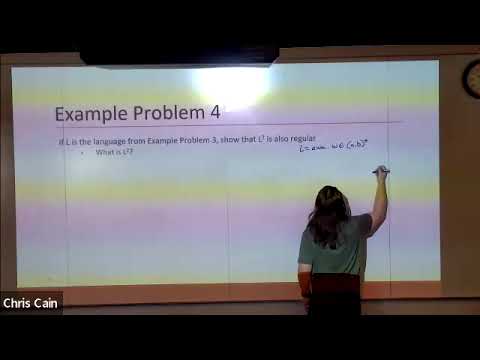
Chris Cain explains how finite automata recognize regular languages, first constructing a DFA for strings that begin and end with A and then designing one for L², where two independent strings from L are concatenated. He introduces nondeterminism through password-search examples, defines NFAs with lambda transitions and branching paths, and explains that NFAs recognize the same languages as DFAs despite allowing simpler machine designs.
Key takeaways
- A regular language requires only finite memory, so a DFA can recognize a fixed substring such as 001 regardless of the input length.
- When defining L² for L = AWA, use distinct variables W₁ and W₂ because the two arbitrary substrings can differ.
- An NFA accepts when at least one path reaches an accepting state; rejecting or stuck paths do not override a successful path.
- Lambda transitions let an NFA change states without consuming input, while missing transitions let it reject a path early without a trap state.
- An NFA with Q states can have up to 2^Q subsets of active states, which supports conversion to an equivalent DFA.
- Nondeterministic polynomial time models efficient verification of a proposed solution, while P versus NP asks whether deterministic polynomial-time solving is equally powerful.
Chapters
- A language is regular when a finite amount of memory suffices to accept or reject strings of any length.
- A DFA can recognize binary strings containing the fixed substring 001 by tracking progress through that finite pattern.
- The class contrasts this with all palindromes, which have no maximum length and cannot be recognized with finite memory.
- A DFA for strings beginning and ending with A uses states that track whether an initial A has appeared and whether the current final character is A.
- L² means a string from L concatenated with another string from L; the two component strings may be identical or different.
- For L = AWA, the concatenation has the form A W₁ A A W₂ A.
- Using separate variables W₁ and W₂ matters because the arbitrary substrings in each half need not match.
- A DFA for L² must accept exactly the concatenated language, not merely reuse the DFA for L.
- The start state cannot be accepting because every string in L² contains at least four A characters.
- A leading B can go directly to a trap state, since a string that begins with B cannot match the required structure.
- More constraints in a language often require more states to record progress and relevant choices.
- The construction tracks a possible end of the first L segment, then requires the adjacent A that begins the second segment.
- States record progress through the A W₁ A A W₂ A pattern, including whether a candidate final A has been followed by a B.
- When a string admits multiple valid divisions into two L strings, this DFA commits to the earliest valid split.
- The DFA only needs to answer membership, yes or no; it does not need to list every possible division.
- Cain introduces nondeterminism as a theoretical model for problems that may have simpler nondeterministic than deterministic solutions.
- A DFA determines one next state from its current state and input character, so its execution can be simulated step by step.
- The class connects nondeterminism to computation theory and the P versus NP question.
- A six-character password using 26 lowercase letters, 26 uppercase letters, and 10 digits has 62⁶ possible combinations.
- Because characters may repeat, each of the six positions has 62 choices, producing about 56.8 billion passwords.
- A deterministic brute-force search checks candidates one by one and may reach the correct password last.
- Cain contrasts searching for an answer with verifying one supplied candidate.
- One model treats nondeterminism as being given a candidate password and checking whether it works.
- Another model imagines a processor with enough cores to test all 62⁶ candidates simultaneously.
- Nondeterminism removes the need to search the branching possibilities, but verification still takes time related to the size of one candidate.
- Cain distinguishes the branching breadth of a search from its depth, which remains relevant to verification.
- An NFA transition can lead to a set of states rather than one state, allowing multiple possible transitions on the same input character.
- A lambda transition moves between states without consuming an input symbol.
- Unlike a DFA, an NFA may omit transitions; if no path can continue, that path rejects.
- For a machine with Q states, the possible sets of active states number up to 2^Q.
- An NFA accepts a string if at least one possible path reaches an accepting state after consuming the input.
- Other paths may reject or get stuck without changing the result if one path accepts.
- For the example involving input 10, the path that reaches a final state makes the NFA accept even when other paths fail.
- Cain states that NFAs and DFAs recognize the same class of languages, although an NFA can be easier to design.
- The subset construction converts an NFA into an equivalent DFA by representing sets of NFA states.
- P versus NP asks whether problems solvable in nondeterministic polynomial time are also solvable in deterministic polynomial time.
- Cain describes P versus NP as unresolved and mentions the million-dollar prize for a proof.
Transcript excerpt
0:01 I can get started working with that. I will also note that I have office hours after this class and I will also be around and available at 1:00 today for anyone who wants especially given that is a homework due date day. This is usually where the most demand is. So you don't have to email me if you want to stop by at one today. Just stop by, get help. Let's make sure that you have your best on the page for your submission tonight. So, what makes a language regular again? Yeah, we talked about this a little bit yesterday, but a a language is regular if it only requires finite memory to represent for any string in the language, we can accept or reject it with a finite amount
0:48 of memory regardless of the length that string. So an example of what worked really well is last time we looked at a problem like all strings in binary containing a substring 001. We only need enough memory to recognize that substring and then move to an accepting or rejecting state. No matter how long the string is, the substring 001 is finite length. So it requires finite memory to be able to accept or reject this language. Whereas the language that I gave as an example with one that might not would be a language of all palendromes where what is the longest palendrome and there is no upper bound. You tell me that there is a longest palendrome I can give you
1:35 an example of a palendrome that is longer. So no amount of memory would ever be enough >> to regulation use a finite amount of memory. >> Yeah. And so these are finite state machines to rec recognize finite memory languages. >> So to show that it's regular, we just
This is the start of the transcript. Save this video free for the whole transcript, searchable and time-coded.
In this course
Related notes
Summary, takeaways, and chapters were generated by AI from the video's transcript and may contain errors. The video belongs to its creator, Chris Cain.