CSCD 420 Sep 29 2026
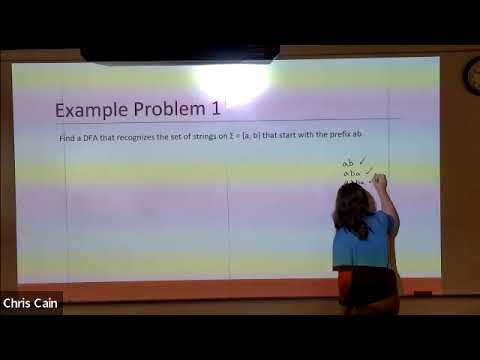 Watch on YouTube →
Overview
Chris Cain reviews DFA construction and uses two examples to show how states can track progress through a string: accepting strings that begin with AB, and rejecting strings that contain the substring 001. He connects these designs to regular languages, explaining that DFAs have finite memory, that a DFA can be complemented by flipping every state’s finality, and that a language can be shown regular by constructing a DFA.
Key takeaways
- A DFA must define a transition for every state and every alphabet symbol; missing transitions prevent the machine from being a complete DFA.
- For the language of strings beginning with AB, states can record whether no prefix symbol, A, or the full AB has been seen, while a nonfinal trap handles prefixes that can no longer be repaired.
- To reject every string containing 001, a DFA needs states for matching none, 0, and 00, plus a nonfinal trap reached when 001 is completed.
- Complementing a DFA requires flipping the finality of every state, which swaps exactly the accepted and rejected languages.
- A DFA can track fixed patterns with finite memory, but it cannot recognize all palindromes of unbounded length because the required memory has no fixed upper bound.
- A language is regular if some DFA recognizes it, so constructing a correct DFA is a constructive proof of regularity.
Chapters
- The class meets in the classroom four days per week and in the lab on Thursdays.
- Chris Cain says the 10-week course is fast-paced and difficult, and recommends supplementary office hours for help with proofs and assignments.
- Cain guarantees an office-hour period for an hour after class; 9 to 10 and usually 1 to 2 are additional possible times, depending on meetings.
- The current assignment is due Wednesday evening, and Cain offers help during office hours.
- A DFA starts at its designated initial state and follows transitions for each input symbol.
- A string is accepted if processing ends in a double-circled final state; otherwise it is rejected.
- Because every input receives exactly one yes-or-no result, a DFA accepts exactly one language.
- Different DFAs can recognize the same language, and Cain accepts logically correct designs even when they are not minimal.
- The target language contains strings over {A, B} whose exact prefix is AB, including AB and ABA.
- Examples such as the empty string, A, B, and BA should be rejected.
- Cain recommends using example strings as unit tests, while noting that passing tests alone does not prove a DFA correct.
- Every state must have an outgoing transition for both A and B so the transition function is total.
- States named for the progress made, such as Qλ, QA, and QAB, make the construction’s meaning clearer than generic labels like Q0 and Q1.
- QAB is final and loops on both A and B, accepting any continuation after the required prefix.
- A nonfinal trap state handles a leading B or the second A in an initial AA, then loops on both symbols so the string cannot recover.
- Qλ is nonfinal, so the empty string is rejected; the completed DFA has defined A and B transitions from every state.
- A DFA may have any number of final states, including none; a DFA with no final states accepts the empty language.
- Making the initial state final is how a DFA accepts the empty string.
- Cain says a single edge labeled with multiple symbols, such as A and B, is valid notation for the two transitions.
- The next design challenge is to accept all strings except those containing the exact substring 001.
- The target language rejects a string as soon as it contains 001 anywhere, regardless of what follows.
- Students work through the construction and consider whether states after partial matches should remain accepting.
- Cain recommends using multiple final states for this problem, since strings remain acceptable until the complete forbidden substring appears.
- The construction must keep reading the full input, including after it reaches a state from which acceptance is no longer possible.
- The initial state represents having seen none of 001; it is final because the empty string does not contain the forbidden substring.
- A 1 from the initial state loops there, while a 0 moves to Q0, representing a partial match of 0.
- From Q0, a 1 returns to the initial state and a 0 advances to Q00; from Q00, a 0 loops because the suffix 00 still matches the start of 001.
- A 1 from Q00 completes 001 and enters a nonfinal trap that loops on both 0 and 1.
- Flipping final and nonfinal status in every state complements a DFA’s language, turning the 001-avoiding DFA into one that accepts strings containing 001.
- A DFA’s finite number of states provides finite memory, which is enough to track a fixed-length substring such as 001.
- Cain uses palindromes as a contrast: no fixed upper bound on input length means a DFA cannot retain enough information to recognize every palindrome.
- Languages recognizable by a DFA are called regular, and constructing a DFA is a direct way to prove that a language is regular.
- Cain introduces the language L = {a w a : w ∈ {a,b}*}, meaning strings that begin and end with a and have any sequence of a and b between them.
- The middle string w may be empty or contain any number of a and b symbols, so the shortest member is aa.
- The exercise begins translating the formal definition into a DFA design, with attention to the initial state and whether the empty string should be accepted.
- Class ends before the construction is completed; Cain asks students to continue thinking about the problem and prioritize the assignment due Wednesday evening.
- Cain emphasizes that the two endpoint a symbols in a w a are distinct positions in the string, even when w also contains a symbols.
- An English description can become misleading if it does not specify the language’s structure precisely.
- The DFA for a w a is left unfinished and is scheduled to continue in the next class.
Transcript excerpt
0:02 That may not be good enough for this class. You It is kind of an announcement that I want to make in the beginning of class. Well, in addition to the schedule, which is the four days that are not Thursday will be in here, Thursday will be in the lab. I wanted to make absolutely sure we're all the same engage with that forward. So, this room four days a week only on Thursday. Sorry for the crazy amounts of confusion in the beginning of the quarter of that. But normally these are our classrooms and they only schedule us in here. So it's very easy to make schedule changes like I only want to be in one room and you make that schedule request right now and you say but it's booked every single minute other than when we scheduled to get out of class. thus changing the room to give one more day in here that wasn't in the lab
0:50 because again I just hate the lab environment where you all have to stand up see the bottom of any material on a slide below the bottom 20% of the slide it's just better to be in the classroom or this class >> like even the labs they like use like half the room to not have computers bring their own computers in >> in order for us to legally have the number of labs that we need there needs to be enough computers in there so that nobody hats right here. >> What room? >> Two nights and that's just Thursdays and we won't be doing anything different on those days except having screens between us and our lovely interaction. I wanted to say that I think I've seen a
1:37 grand total of four people in an office
This is the start of the transcript. Save this video free for the whole transcript, searchable and time-coded.
In this course
Related notes
Summary, takeaways, and chapters were generated by AI from the video's transcript and may contain errors. The video belongs to its creator, Chris Cain.