CHEM1312 20261028
Overview
Tai-Yen Chen finishes Chapter 16 by connecting standard Gibbs energy to equilibrium, ΔG° = −RT ln K, and nonstandard Gibbs energy to reaction quotient, ΔG = ΔG° + RT ln Q = RT ln(Q/K). Worked examples show how to calculate K, Q, and ΔG and use their signs to predict reaction direction; Chen then reviews spontaneity, entropy, and temperature dependence before sharing his experience pursuing a funded chemistry PhD at Texas A&M and the value of research training.
Key takeaways
- Standard Gibbs energy and equilibrium are linked by ΔG° = −RT ln K: negative ΔG° means K > 1, while positive ΔG° means K < 1.
- For a reaction at its current composition, ΔG = RT ln(Q/K); Q < K means forward progress is spontaneous, Q > K means reverse progress is spontaneous, and Q = K means ΔG = 0.
- For N₂ + 3H₂ ⇌ 2NH₃ with partial pressures 0.5, 1, and 2 atm, respectively, Q = 8; with ΔG° = −32.9 kJ at 298 K, ΔG is about −27.748 kJ.
- The signs of ΔH and ΔS predict temperature dependence: ΔH < 0 and ΔS > 0 is spontaneous at all temperatures, while ΔH > 0 and ΔS < 0 is never spontaneous in the forward direction.
- Tai-Yen Chen’s Texas A&M chemistry PhD was funded through departmental support and a stipend, and he identifies literature review, hypothesis testing, and experimental verification as central research skills.
Chapters
- Tai-Yen Chen frames the lecture as the final section of Chapter 16, focused on two equations connecting Gibbs energy with K and Q.
- The course plan is to move next to Chapter 17, where most of the upcoming calculations will occur, then Chapter 18 on atoms.
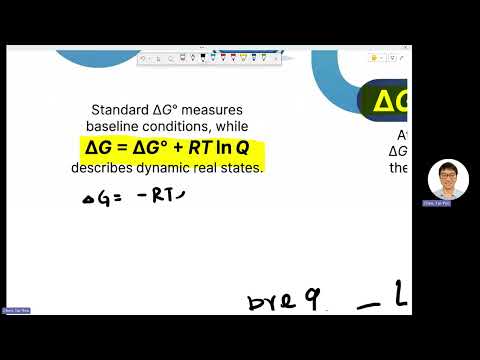
- The circle in ΔG° denotes standard-state conditions; Chen describes using 1 M reactant and product concentrations as the introductory convention.
- K describes the product-to-reactant activity ratio at equilibrium, so ΔG° is paired with K rather than with the current reaction quotient Q.
- The first central relationship is ΔG° = −RT ln K, which lets a known equilibrium constant determine standard Gibbs energy, or vice versa.
- K is dimensionless when defined with activities; R supplies energy-per-mole-per-kelvin units and T is measured in kelvin.
- For calculations, choose R to match the units: 8.314 J mol⁻¹ K⁻¹ for energy calculations, rather than the gas-law value 0.082 when pressure-volume units are not involved.
- The reaction quotient Q uses the same expression as K but is calculated from the system’s current composition, before equilibrium is reached.
- Chen frames ΔG as the energy difference between the equilibrium final state and the current initial state, introducing Q alongside K.
- Starting from ΔG = ΔG° + RT ln Q and substituting ΔG° = −RT ln K gives ΔG = RT ln(Q/K).
- The derivation uses ln A + ln B = ln(AB) and ln A − ln B = ln(A/B), with the ratio Q/K determining the sign of ΔG.
- If ΔG° = 0, then ln K = 0 and K = 1, indicating no preference for products over reactants in the equilibrium ratio.
- A negative ΔG° corresponds to K > 1 and a product-favored equilibrium; a positive ΔG° corresponds to K < 1 and a reactant-favored equilibrium.
- At equilibrium, the actual reaction Gibbs energy is ΔG = 0 and Q = K; standard Gibbs energy ΔG° is not generally zero at equilibrium.
- If ΔG < 0, then Q < K and the forward reaction proceeds toward products; if ΔG > 0, then Q > K and the reaction proceeds toward reactants.
- The comparison follows directly from ΔG = RT ln(Q/K), since R and T are positive and the logarithm changes sign at Q/K = 1.
- Chen emphasizes the paired relationships ΔG° = −RT ln K and ΔG = ΔG° + RT ln Q.
- The sign of ΔG indicates reaction direction: negative favors the forward direction, zero indicates equilibrium, and positive favors the reverse direction.
- Given ΔG° = 4.157 kJ at 250 K, rearrange the standard-state equation to ln K = −ΔG°/(RT).
- Convert 4.157 kJ to 4,157 J and use R = 8.314 J mol⁻¹ K⁻¹; the result is approximately ln K = −2.
- For N₂ + 3H₂ ⇌ 2NH₃, the reaction quotient is Q = P(NH₃)²/[P(N₂)P(H₂)³].
- With P(N₂) = 0.5 atm, P(H₂) = 1 atm, and P(NH₃) = 2 atm, the substituted quotient is Q = 8.
- Using ΔG° = −32.9 kJ and T = 298 K in ΔG = ΔG° + RT ln Q gives ΔG ≈ −27.748 kJ.
- For N₂ + 3H₂ ⇌ 2NH₃ at 400 K, the given partial pressures produce Q = 21²/[4.2 × 1.8³] ≈ 18.
- With K = 41, calculate ΔG° from −RT ln K, then use ΔG = RT ln(Q/K) to obtain approximately −2.74 kJ.
- Because ΔG is negative and Q < K, the reaction proceeds in the forward direction toward NH₃.
- The core thermodynamic equation is ΔG = ΔH − TΔS; its enthalpy and entropy contributions together determine whether ΔG is negative.
- Spontaneous forward processes have ΔG < 0 and ΔS_universe > 0; the two quantities have opposite signs through ΔG = −TΔS_universe.
- The sign of ΔG also predicts direction: negative favors products, zero is equilibrium, and positive favors reactants.
- When ΔH < 0 and ΔS > 0, both terms favor negative ΔG, so the forward reaction is spontaneous at every temperature.
- When ΔH > 0 and ΔS < 0, both contributions make ΔG positive, so the forward reaction is never spontaneous.
- When ΔH > 0 and ΔS > 0, high temperature can make the −TΔS term dominate; when ΔH < 0 and ΔS < 0, low temperature favors spontaneity.
- For comparable substances, gases generally have higher entropy than liquids, which have higher entropy than solids.
- Within the same phase, more complex or heavier molecules tend to have greater entropy because they have more ways to store energy.
- Chen closes the chemistry review by reiterating ΔG° = −RT ln K and ΔG = ΔG° + RT ln Q.
- Chen recounts earning a chemistry PhD at Texas A&M University in College Station after beginning graduate study in 2005; his department covered costs and provided a monthly stipend.
- Coming from a farming family in Taiwan that grew watermelons, he initially worried that studying in the United States would be unaffordable.
- He describes graduate research as learning to search literature, assess evidence, form hypotheses, design experiments, verify claims, and identify follow-up questions.
- Chen encourages students to consider further education as a way to build critical thinking and take a more active role in shaping their careers, while presenting his story as personal experience rather than advice.
Transcript excerpt
2:02 Mhm. >> Okay, so uh any questions before we get started? Everything's good. Today we're going to finish chapter 16. Okay, so um this section not much left. After chapter 16, uh the main thing we're
2:51 going to go through is actually chapter 17. Okay, so there we actually uh most of calculation happen in chapter 17. Okay. Then we go back to uh then we go to this uh chapter 18 talking about atoms. And that's pretty much it for the whole semester. Okay? So, um what we're going to do today is actually very simple. We just only go you know, give you another lectures on two equations today. Yeah, so we want to actually know what those two equations represents. Okay? And then we try to actually correlate the things we learned from previous lecture, the delta G, okay, the Gibbs free energy, how can it be related to the equilibrium constant K
3:40 and chemical quotient Q. Okay, so if you given a specific G values, what will be the uh amplitude of your K and Q, okay, and vice versa. That's pretty much it. Okay, so those are the very last pieces of information that we're going to learn today. Okay? So, on the we have this preview of the today's lecture where you start to see this this things like G, delta G, delta G not, Q and K. Okay, so before it even goes into all the details, the things that you should actually remember and get used to is like every time you see this delta G not, okay, on the top right corner you
4:28 see this little circle. It represents it's under the standard condition meaning that you put in 1 M of your reactant and 1 M of your product and let it to react, okay?
This is the start of the transcript. Save this video free for the whole transcript, searchable and time-coded.
In this course
Related notes
Summary, takeaways, and chapters were generated by AI from the video's transcript and may contain errors. The video belongs to its creator, Tai-Yen Chen.