CHEM1312 20261116
Overview
Tai-Yen Chen introduces nuclear notation, isotope stability, and nuclear reactions, then connects radioactive decay to first-order kinetics and radiometric dating. The lecture explains how to balance alpha, beta-minus, positron, and electron-capture equations, and works through a uranium-238 to lead-206 dating example that yields an estimated rock age of 1.79 billion years.
Key takeaways
- An isotope’s atomic symbol encodes its proton count Z and total nucleon count A; neutron count is A − Z, while the periodic-table atomic mass is an isotope-weighted average.
- The lecture uses magic numbers 2, 8, 20, 28, 50, 82, and 126 as indicators of extra nuclear stability, and uses N/Z thresholds that rise with proton number to screen for likely decay.
- Nuclear equations must conserve both mass number and atomic number: beta-minus decay raises daughter Z by one, positron emission and electron capture lower it by one, and alpha decay lowers A by four and Z by two.
- For radioactive dating, use ln(Aₜ/A₀) = −kt and calculate k from the half-life with k = 0.693/t₁/₂; A₀ refers to the original amount of the parent isotope.
- In the uranium-238 to lead-206 example, Chen converts measured masses to moles, adds remaining uranium and daughter lead to estimate the original parent amount, and obtains a rock age of about 1.79 billion years.
Chapters
- Chen notes that five lectures remain in the course, including this class.
- The upcoming work includes a review lecture, remaining chapter material, and review of midterm three content.
- The lecture’s sequence covers predicting whether a nucleus is stable, identifying its likely decay, and writing nuclear reactions.
- The final application is estimating sample ages from radioactive decay and the amount of parent isotope remaining.
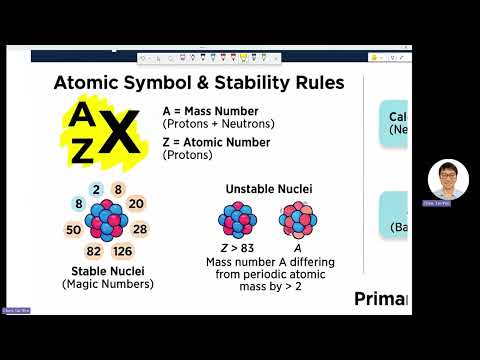
- In the notation ᴬZX, X identifies the element and Z, at lower left, is the atomic number and number of protons.
- A, at upper left, is the mass number: protons plus neutrons, not the element’s periodic-table atomic mass.
- The neutron count is A minus Z, which lets the symbol specify a particular nucleus.
- Isotopes have the same proton number but different neutron counts, so their mass numbers differ.
- Carbon-12 and carbon-13 both have six protons but have different numbers of neutrons.
- The periodic-table atomic mass is an average over naturally occurring isotopes, so it need not be an integer mass number.
- Chen identifies 2, 8, 20, 28, 50, 82, and 126 as nuclear magic numbers; nuclei with a proton or neutron count at one of these values tend to be especially stable.
- He also presents a quick classroom check comparing an isotope’s integer mass number with the periodic-table atomic mass, treating a difference greater than about two as a warning of instability.
- The lecture distinguishes this shortcut from checking neutron-to-proton balance, which is developed next.
- Calculate N/Z using neutron count N and proton count Z, then compare the result with a threshold based on proton-number range.
- Chen’s approximate thresholds are 1.0 for Z 1 to 20, 1.2 for Z 20 to 40, 1.5 for Z 40 to 83, and 1.6 for Z above 83.
- A ratio above the applicable threshold indicates neutron-rich character and favors beta-minus decay; a lower ratio generally points to positron emission or electron capture.
- For nuclei with Z above 83, the lecture gives alpha decay as an exception when the ratio is below the threshold.
- Beta-minus decay emits an electron, written ⁰₋₁e; mass number stays constant while the daughter’s atomic number increases by one.
- Positron emission produces ⁰₊₁e; mass number stays constant while the daughter’s atomic number decreases by one.
- In electron capture, an electron appears on the reactant side and the atomic number decreases by one.
- Alpha decay emits ⁴₂He, reducing the daughter’s mass number by four and atomic number by two; balance both top and bottom numbers.
- The example forms californium-244, ²⁴⁴₉₈Cf, plus two neutrons after an unknown nucleus reacts with an alpha particle.
- Balancing mass numbers gives A + 4 = 244 + 2, so the unknown nucleus has mass number 242.
- Balancing atomic numbers gives Z + 2 = 98, so the unknown has Z = 96, which is curium; the reactant is curium-242.
- Nitrogen-17 has Z = 7 and 10 neutrons, giving N/Z = 10/7, or approximately 1.43.
- For the Z 1 to 20 range, Chen compares this ratio with the lecture’s threshold of 1.0 and identifies the nucleus as neutron-rich.
- The predicted decay is beta-minus, which converts a neutron into a proton and emits an electron.
- Chen applies the first-order integrated rate law, ln(Aₜ/A₀) = −kt, to the amount of a radioactive parent isotope.
- A₀ is the starting amount, Aₜ is the amount remaining after time t, and k is the decay constant.
- The amount can be counted as particles or expressed in moles, but the units must be consistent throughout the calculation.
- In the lecture’s accounting example, 100 starting parent atoms become 70 parent atoms plus 30 daughter atoms.
- The remaining parent amount is Aₜ = 70, while the original amount A₀ is 70 + 30 = 100.
- For dating, the parent isotope is the reactant in the decay process; the daughter product is not the decaying species.
- The half-life relation is k = 0.693/t₁/₂, derived by setting the remaining amount to one-half of its initial value.
- Once k is known, the integrated rate law can be rearranged to solve for elapsed time.
- Chen emphasizes using the half-life of the specific parent isotope named in the problem.
- The worked problem gives a rock with 1 mg of uranium-238 and approximately 0.275 mg of lead-206, and asks for its age.
- The stated uranium-238 half-life is 4.5 × 10⁹ years.
- Using k = 0.693/t₁/₂ gives approximately 1.54 × 10⁻¹⁰ per year.
- The decay calculation requires amounts in moles, so convert uranium-238 mass using 238 g/mol and lead-206 mass using 206 g/mol.
- The surviving uranium-238 is Aₜ; under the problem’s parent-daughter accounting, A₀ is the uranium remaining plus the lead produced.
- Keeping the parent isotope distinct from its daughter prevents assigning the measured lead amount to the wrong side of the decay equation.
- Substituting the mole amounts and k ≈ 1.54 × 10⁻¹⁰ yr⁻¹ into ln(Aₜ/A₀) = −kt gives an age of about 1.79 × 10⁹ years.
- The result corresponds to a rock age of approximately 1,790 million years.
- Chen closes by reinforcing the workflow: identify the parent reactant, convert measured masses to moles, reconstruct A₀, and solve the first-order decay equation.
Transcript excerpt
3:56 Okay. So, uh any questions before getting so today we have two more lectures before we take. So the main two uh lectures we just do a review of okay so that equations in the next lecture so we're going to go question you so after we come back from the 17 right to finish the remaining part of chapter
4:44 which basic. Yeah. So it will become very simple. Okay. And after that lectures all the main concept that we do have for so the lecture of this course. Okay. So there's not many lectures left. Okay. Including to this one, there's only five left, I believe. Okay. >> So now make sure that everybody can see this.
5:33 Okay. So what we are going to do today is single. Okay. So you can see on the left is a zent today. you have to figure it out. And that's why I wanted to tell you today I give you a atomic symbol and you predict it is a stable or nonstable nucleon. Okay. And unstable is going to undergo. Okay. So it was not
6:23 like but it was not enough. Okay. So we go through like how can able to enter the third part which you can see is primary radiate reactions where you learn how to write the nuclear reaction. Okay. A few key words that we would like to learn. Um so what does the pa means? What does factor means in the sense this is our equation. Okay. So you see this right inside. Okay. We also need to learn four fundamental particles in this. Okay. The
7:13 first one is so beta particle. sounds but it's just another of okay so this beta partle you know that is the electron okay and we actually also learn these things called
This is the start of the transcript. Save this video free for the whole transcript, searchable and time-coded.
In this course
Related notes
Summary, takeaways, and chapters were generated by AI from the video's transcript and may contain errors. The video belongs to its creator, Tai-Yen Chen.