CHEM1312 20261109
Overview
Tai-Yen Chen reviews redox balancing and electrochemical cells, then connects cell potential to the equilibrium constant K and reaction quotient Q. The worked examples include balancing a basic-solution reaction containing hydroxide complexes, and calculating a nonstandard cell potential of 2.39 V for an Al/Fe cell using n = 3 and Q = 100.
Key takeaways
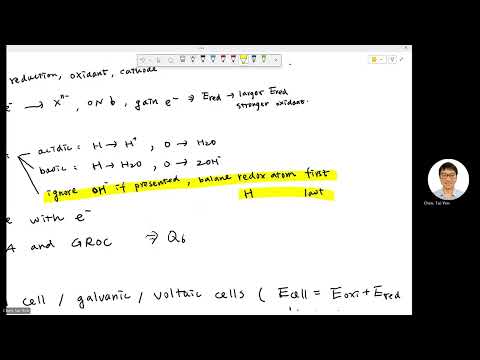
- For basic-solution redox equations containing hydroxide complexes such as Cr(OH)₃, temporarily ignore the embedded OH groups during atom balancing, then restore them and balance remaining hydrogen with H₂O.
- The copper-chromate example balances to 3Cu + 2CrO₄²⁻ + 8H₂O → 3Cu(OH)₂ + 2Cr(OH)₃ + 4OH⁻, with six electrons transferred between the half-reactions before cancellation.
- In a galvanic cell, oxidation occurs at the anode, reduction at the cathode, electrons flow through the external wire from anode to cathode, and E°cell must be positive.
- At 25°C, calculate nonstandard cell potential with Ecell = E°cell − (0.025693 V/n) ln Q; do not multiply electrode potentials when scaling half-reactions.
- For Al + 3Fe³⁺ → Al³⁺ + 3Fe²⁺, n = 3 and Q = [Al³⁺][Fe²⁺]³/[Fe³⁺]³; the given concentrations produce Q = 100 and Ecell ≈ 2.39 V.
Chapters
- Midterm averages increased slightly from 56.4 on Midterm One to 56.9 on Midterm Two.
- Tai-Yen Chen encourages students to attend lectures, practice supplied questions, and use calculators until they can solve a problem in about three minutes.
- With fewer than five weeks remaining, Midterm Three is presented as a strong opportunity to improve course grades.
- Assign oxidation numbers to identify which atoms are oxidized and reduced before balancing the equation.
- Write separate oxidation and reduction half-reactions, then balance atoms before balancing charge.
- In acidic solution, use H₂O to balance oxygen and H⁺ to balance hydrogen; basic-solution balancing requires a different approach.
- For CrO₄²⁻, oxygen contributes −8, so chromium has oxidation number +6.
- Copper metal changes from 0 to +2 in Cu(OH)₂, so copper is oxidized and forms the oxidation half-reaction.
- Chromium changes from +6 in CrO₄²⁻ to +3 in Cr(OH)₃, so chromate is reduced.
- When a product contains a group such as Cr(OH)₃, temporarily ignore its hydroxides while balancing the redox atom and oxygen.
- Four oxygens in CrO₄²⁻ correspond to eight hydroxides on the product side; Cr(OH)₃ already supplies three, so add five OH⁻.
- The resulting eight product-side hydrogens require four H₂O on the reactant side.
- The copper oxidation half-reaction needs two electrons to balance its charge; the chromate reduction half-reaction needs three.
- Multiply the copper half-reaction by 3 and the chromate half-reaction by 2 so both transfer six electrons.
- After canceling electrons and common hydroxide, the balanced equation is 3Cu + 2CrO₄²⁻ + 8H₂O → 3Cu(OH)₂ + 2Cr(OH)₃ + 4OH⁻; the H₂O coefficient is 8.
- A galvanic, voltaic, or electrochemical cell uses two electrodes in separate solutions connected by a salt bridge.
- Oxidation occurs at the anode, reduction at the cathode, and electrons travel through the external wire from anode to cathode.
- In the zinc-copper example, zinc is the anode and copper is the cathode; the salt bridge maintains ionic charge balance.
- Calculate E°cell by adding the oxidation potential at the anode to the reduction potential at the cathode; a voltaic cell has positive E°cell.
- Oxidation potential is the negative of the corresponding reduction potential, and multiplying a half-reaction by a coefficient does not multiply its potential.
- Cell notation follows anode | anode solution || cathode solution | cathode; use || for the salt bridge, | for phase boundaries, and commas for species in the same phase.
- Use an inert platinum electrode when the reacting species are in solution and cannot provide a solid electrode themselves.
- At standard conditions, ΔG° = −RT ln K; for nonstandard conditions, ΔG = ΔG° + RT ln Q.
- For electrochemical reactions, ΔG° = −nFE°cell, connecting standard cell potential to the equilibrium constant.
- The electron-transfer count n comes from the balanced overall redox equation, not from an unbalanced half-reaction.
- At 25°C in aqueous solution, use E°cell = (0.025693 V/n) ln K.
- For nonstandard conditions, use Ecell = E°cell − (0.025693 V/n) ln Q.
- In the earlier copper-chromate example, matching the half-reaction electrons gives n = 6.
- A problem that supplies concentrations for individual reactants or products requires calculating Q.
- For an electrochemical cell under nonstandard conditions, select Ecell = E°cell − (0.025693 V/n) ln Q.
- The calculation requires three pieces: E°cell, the balanced electron count n, and Q from the net reaction.
- The example gives [Fe²⁺] = 1 M, [Fe³⁺] = 0.1 M, [Al³⁺] = 0.1 M, E°red(Al³⁺/Al) = −1.66 V, and E°red(Fe³⁺/Fe²⁺) = +0.77 V.
- Write both listed redox couples initially as reduction half-reactions, then use the voltaic-cell condition to choose which one must be reversed.
- A voltaic cell must have a positive E°cell, which identifies aluminum oxidation and iron(III) reduction as the spontaneous directions.
- Reverse Al³⁺ + 3e⁻ → Al to obtain Al → Al³⁺ + 3e⁻, with E°ox = +1.66 V.
- Keep Fe³⁺ + e⁻ → Fe²⁺ as the reduction half-reaction, with E°red = +0.77 V.
- Add the potentials to obtain E°cell = 1.66 + 0.77 = 2.43 V; reverse or multiply reaction equations as needed without scaling their potentials.
- Aluminum oxidation produces three electrons, while each Fe³⁺ reduction consumes one, so multiply the iron half-reaction by 3.
- The balanced net reaction is Al + 3Fe³⁺ → Al³⁺ + 3Fe²⁺, giving n = 3.
- The iron reduction potential remains +0.77 V after its half-reaction is multiplied, because cell potential is an intensive property.
- For Al + 3Fe³⁺ → Al³⁺ + 3Fe²⁺, write Q = [Al³⁺][Fe²⁺]³/[Fe³⁺]³.
- Exclude solid aluminum from Q because pure solids do not appear in the reaction quotient.
- Substituting the supplied concentrations gives Q = (0.1)(1)³/(0.1)³ = 100.
- Substitute E°cell = 2.43 V, n = 3, and Q = 100 into Ecell = E°cell − (0.025693 V/n) ln Q.
- The resulting nonstandard cell potential is approximately 2.39 V.
- The solution sequence is: identify the spontaneous half-reactions, balance electron transfer, calculate E°cell and n, construct Q, then apply the Nernst equation.
Transcript excerpt
2:27 I >> Okay, so um
4:50 any questions before before we get started this kind of code and you know the weather is actually not so nice today. But I'm very glad that you made it. Okay, so um on the board is actually the the grade distribution of midterm one and midterm two. Okay, top panel is actually midterm one, bottom one is actually midterm two. The average of midterm one and midterm two are very similar, right? The average is actually 56 .4 and we improved to 56.9. Okay, so this is actually uh um great midterm two distribution because typically people actually expect we have a drop in terms of average by by two 10 points, right? But we actually hold on to the same or even slightly
5:38 better grade than midterm one. Okay, so I think that's actually a great sign that we can actually conquer the most challenging um sections of this course. Okay, so you know there's actually not much more time left for this semester, right? So you know in two weeks we have our Thanksgiving, one more week of lectures, then the sale final. So basically less five weeks from now. Okay, so if you have been I believe the people who actually come to the in-person lecture our people actually kind of get already know how to actually prepare for the remaining of the class. Okay, so just do the things that you know what to do, okay? And then
6:27 do your best and I think you will see all the returns very soon. Okay. Midterm three is actually the one that I encourage everybody to really study really hard because this actually the one very likely you can get the best score among the three. Okay, so you don't want to actually miss
This is the start of the transcript. Save this video free for the whole transcript, searchable and time-coded.
In this course
Related notes
Summary, takeaways, and chapters were generated by AI from the video's transcript and may contain errors. The video belongs to its creator, Tai-Yen Chen.