CHEM1312 20261021
 Watch on YouTube →
Overview
Tai-Yen Chen reviews CHEM 1312 Midterm 2 material from Chapters 13 to 15, emphasizing how to identify solution types, handle titration stages, and apply Ksp to solubility and precipitation. Worked examples cover a weak-acid/strong-base titration, CaF2 solubility, AgCl precipitation, common-ion effects, and how anion basicity determines pH-dependent solubility; Chen closes with a timed, question-focused study plan.
Key takeaways
- For titration pH problems, first use stoichiometry and an ICE table to identify the solution after reaction, then select the appropriate Chapter 13 pH equation.
- At the half-equivalence point of a weak-acid/strong-base titration, [HA] equals [A-], so the Henderson-Hasselbalch equation reduces to pH = pKa.
- Ksp calculations require molar concentrations and stoichiometric coefficients; for CaF2, a molar solubility s gives [Ca2+] = s and [F-] = 2s.
- A precipitate forms when Qsp exceeds Ksp; in the AgCl example, Qsp = 2 × 10^-10 exceeds Ksp = 1.6 × 10^-10.
- In a common-ion problem, combine ion contributions in the equilibrium concentration, as with CaF2 in 0.035 M NaF, where [F-] = 2s + 0.035 M.
- To identify pH-dependent solubility, examine the anion: anions that are conjugate bases of weak acids, such as F-, NO2-, and CN-, are weak bases, while conjugate bases of strong acids such as Cl- and NO3- are effectively neutral.
Chapters
0:00
Opening Questions About Survey Points and Course Grades
- The opening exchange clarifies that the midterm survey contributes 2 points within the course's 100-point scale.
- Students ask whether survey credit is extra credit, prompting a distinction between points included in the course grade and bonus points.
4:18
Canvas Survey Credit, Course Evaluation Bonus, and Midterm Partial Credit
- Chen says students who completed the midterm survey should see 2 teamwork points on Canvas; students missing credit may have mistyped their PeopleSoft ID and should email him.
- Submitting a screenshot of the final course evaluation on Teams earns another 2 points beyond the 100-point scale.
- Midterm 2 partial-credit submissions are due Monday, November 2, by 11:00, after exam materials become available.
7:11
A Three-Chapter Review Strategy: Identify the Solution Before Choosing Equations
- The review covers Chapters 13, 14, and 15, with Chen recommending that students distill material into fundamental principles rather than memorize disconnected details.
- For Chapter 13 pH problems, first identify what kind of solution is present, then choose the applicable equation.
- For Chapter 14 titrations, use an ICE table to determine the equilibrium solution before applying the relevant Chapter 13 pH method.
10:13
Chapter 15 Ksp Equations, Molar Solubility, and Precipitation Tests
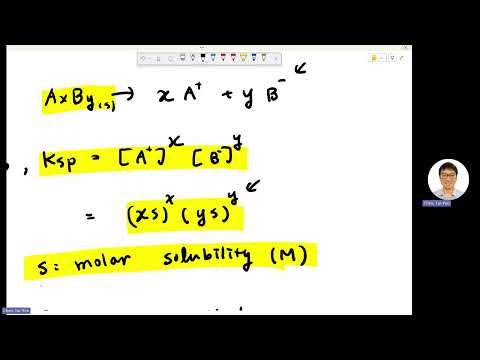
- For a salt that dissociates into x cations and y anions, write Ksp using the ion concentrations raised to their stoichiometric powers.
- Convert gram solubility to molar solubility in moles per liter before using it in a Ksp calculation.
- After mixing soluble salts, calculate Qsp from the relevant ion concentrations: Qsp greater than Ksp predicts a precipitate, while Qsp less than Ksp predicts none.
13:57
How pH and Common Ions Affect Insoluble-Salt Solubility
- For most insoluble salts, assess the anion when predicting pH effects; added H+ consumes basic anions and can drive more salt to dissolve.
- Adding OH- reduces the solubility of salts with OH- as an anion, while OH- generally has no effect on salts whose anion is a weak base.
- A common ion from another source shifts the dissolution equilibrium, so its concentration must be included when solving for solubility.
17:28
Find the Half-Equivalence Volume in an HClO and KOH Titration
- The example titrates 49.8 mL of 0.494 M HClO with 0.781 M KOH and asks for the half-equivalence volume.
- Treat KOH as a strong-base titrant and HClO as a weak-acid analyte; use equal acid and base moles at equivalence.
- The calculated equivalence volume is about 31.45 mL, so the half-equivalence volume is about 15.7 mL.
23:04
At Half Equivalence, a Weak-Acid Buffer Has pH Equal to pKa
- The reaction HA + OH- produces A- and water; at half equivalence, half of the original HA has been neutralized.
- Because the remaining HA and produced A- have equal amounts, their ratio in the Henderson-Hasselbalch equation is 1.
- With the example's corrected Ka of 3 × 10^-5, the half-equivalence pH equals pKa, or -log(Ka).
28:13
Calculate CaF2 Ksp from Gram Solubility
- The example gives 0.0167 g of dissolved CaF2 in 1 L and a formula mass of 78.1 g/mol.
- Convert the mass to a molar solubility of approximately 2.14 × 10^-4 M before evaluating Ksp.
- For CaF2 dissolving as Ca2+ + 2 F-, use [Ca2+] = s and [F-] = 2s, so Ksp = s(2s)^2.
34:47
Predict AgCl Precipitation by Comparing Qsp with Ksp
- For AgCl, Ksp = [Ag+][Cl-], and the supplied Ksp is 1.6 × 10^-10.
- CaCl2 contributes 2 Cl- per formula unit, while AgNO3 contributes Ag+ in a 1:1 ratio; use those stoichiometric factors to determine ion concentrations.
- The example obtains Qsp = 2 × 10^-10, greater than Ksp, so AgCl precipitates.
43:55
Use Stoichiometric Coefficients to Track Dissolved Ion Concentrations
- For a hypothetical salt Ag2X3 with molar solubility s, dissolution produces [Ag+] = 2s and [X-] = 3s.
- A dissociation equation's coefficients determine how much of each ion forms; they are not factors for dividing the final ion concentration.
- When calculating Qsp, use the total concentration of each relevant ion in solution, including ions contributed by soluble salts.
51:28
Find CaF2 Solubility in NaF Using the Common-Ion Effect
- For CaF2, write Ksp = [Ca2+][F-]^2 and let its molar solubility be s, giving [Ca2+] = s and an additional 2s of fluoride.
- The example adds 0.035 M NaF, which contributes 0.035 M F-; therefore total fluoride is 2s + 0.035 M.
- Using Ksp = 4 × 10^-12 and the small-s approximation gives s ≈ 4 × 10^-12/(0.035)^2, or about 3.3 × 10^-9 M.
59:37
Prepare for Midterm 2 with Videos, Practice Questions, and Timed Exams
- Chen recommends finishing the lecture videos and every assigned question before moving on to the practice exam.
- For problems that remain difficult, revisit the question videos, which provide worked solution steps.
- Take the practice exam using only a calculator and aim to finish each question in about 3.5 minutes; previous exams from classmates offer additional practice.
Summary, takeaways, and chapters were generated by AI from the video's transcript and may contain errors. The video belongs to its creator, Tai-Yen Chen.