CHEM1312 20261118
Overview
Tai-Yen Chen concludes Chapter 18 by showing how nuclear mass defect becomes binding energy, then explains controlled fission and the main energy-transfer stages in a nuclear power plant. A worked indium-122 example connects a stated mass defect of about 1.1057 amu to roughly 1,030 MeV per atom and 8.44 MeV per nucleon; the final review revisits thermodynamics, electrochemistry, and nuclear-decay equations for the upcoming exam.
Key takeaways
- Nuclear binding energy comes from mass defect: multiplying the mass difference by c² gives the energy associated with assembling a nucleus from its constituent nucleons.
- For indium-122, the lecture's worked values are about 1,029.9 MeV per atom and 8.44 MeV per nucleon, with the latter found by dividing by 122.
- A fission reactor must control its neutron chain reaction; control rods absorb neutrons, while a sustained reaction averages one subsequent fission per fission event.
- A pressurized primary water loop transfers reactor heat through a steam generator to a separate secondary loop, whose steam drives the turbine and electrical generator.
- Electroplating calculations proceed from current and time to charge, from charge to moles of electrons using Faraday's constant, and then through reaction stoichiometry to deposited mass.
- The final review links Gibbs energy to equilibrium through ΔG° = −RT ln K and ΔG = ΔG° + RT ln Q, while electrochemical cell potential connects to free energy through ΔG = −nFE.
Chapters
- Chen previews the final Chapter 18 concepts: nuclear energy, a mass-to-energy calculation, and nuclear power plant operation.
- He notes that the next Monday lecture will review material for the upcoming exam and reminds students to track course deadlines and evaluation tasks.
- The lecture connects unstable nuclei and nuclear reactions to the possibility of releasing energy.
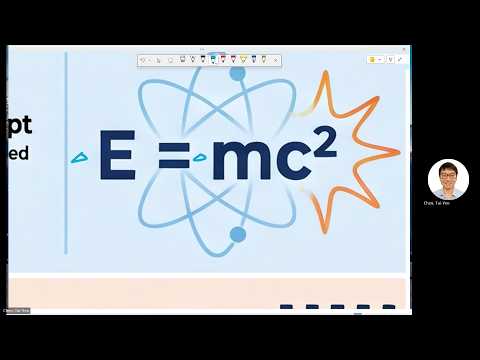
- Einstein's relation, ΔE = Δm c², converts a difference in mass into released energy.
- The example gives indium-122 an actual atomic mass of 121.91280 amu and asks for binding energy in several units.
- Chen distinguishes energy per atom from energy per nucleon and per mole, so the requested denominator must be tracked.
- Indium has atomic number 49, so indium-122 contains 49 protons and 73 neutrons.
- The calculation sums constituent masses: 49 proton masses plus 73 neutron masses, producing a hypothetical mass near 123.0160 amu.
- Subtracting the stated actual atomic mass gives the mass defect used in the subsequent energy calculation.
- Chen uses 1 amu ≈ 931.5 MeV/c², allowing the c² terms in Δm c² to cancel.
- Using the lecture's stated mass defect of about 1.1057 amu gives approximately 1,029.9 MeV per atom.
- Dividing by the mass number 122 gives approximately 8.44 MeV per nucleon.
- The example emphasizes that converting from energy per atom to energy per mole requires multiplying by Avogadro's number.
- For kilojoules per atom, convert amu to kilograms, apply c², and convert joules to kilojoules.
- Chen summarizes the unit choices as MeV per atom, MeV per nucleon, MeV per mole, and kJ-based equivalents.
- A nuclear plant uses the same basic steam-turbine and generator process as a conventional thermal plant.
- The key difference is the heat source: nuclear fission replaces the burning of coal, natural gas, or biomass.
- Uranium oxide fuel is formed into pellets and assembled for use in the reactor.
- Fission releases two or three neutrons, which can trigger further fissions and create a chain reaction.
- A reactor controls the chain reaction so that, on average, one neutron from each fission causes another fission.
- Control rods absorb neutrons; inserting the rods can stop the chain reaction rapidly.
- Fission heats pressurized water in the primary circuit; pressure keeps this hot water from boiling inside the reactor loop.
- A steam generator transfers heat through pipes to water in the secondary circuit, producing steam without mixing the two waters.
- The secondary-circuit steam spins turbine blades, and the turbine drives an electrical generator.
- A generator produces electricity, and transformers raise its voltage to support long-distance transmission with lower losses.
- Steam leaving the turbine passes through a condenser and returns to liquid water for reuse in the steam cycle.
- A separate cooling circuit carries heat away, often using a cooling tower and returning much of its water to the condenser.
- A breeder reactor converts nonfissile uranium-238 into fissile material through neutron capture and subsequent nuclear changes.
- The lecture contrasts fission, used widely for nuclear electricity, with fusion, another energy-producing nuclear process.
- Particle accelerators use electric and magnetic fields to accelerate or guide charged particles for scientific study.
- Nuclear equations use atomic number and mass number to identify reactants and determine an unknown product nucleus.
- Chen illustrates notation for bombardment by an alpha particle, a helium-4 nucleus, with neutrons among the possible products.
- The concept check identifies U-238 conversion in breeder reactors as correct and distinguishes fission-based power generation from fusion.
- The review returns to ΔG = ΔH − TΔS and the use of the sign of ΔG to assess spontaneity.
- At the temperature where ΔG = 0, rearranging the relation gives the transition temperature T = ΔH/ΔS.
- Chen reviews ΔG° = −RT ln K and ΔG = ΔG° + RT ln Q, linking free energy to equilibrium and reaction conditions.
- Reaction entropy is treated as an extensive property, so stoichiometric coefficients scale each species' contribution.
- Standard cell potential is calculated from reduction potentials, with the anode contribution reversed when forming E°cell.
- The review connects cell potential and free energy through ΔG = −nFE and relates E°cell to the equilibrium constant K.
- For electroplating, charge is q = It and moles of electrons equal charge divided by Faraday's constant.
- Electron stoichiometry converts moles of electrons to moles of deposited product, which can then be converted to mass.
- The stability review uses neutron-to-proton balance to predict common decay modes: neutron-rich nuclei undergo beta-minus decay, while proton-rich nuclei may emit positrons or capture electrons.
- The lecture identifies alpha decay as a common route for very heavy nuclei, especially those with atomic number above 83.
- Half-life problems use the radioactive-decay relationships reviewed in class; Chen says the mass-to-energy equation will not appear on the final.
- Students are asked to memorize the chapter equations before the next Monday review and prepare for a cumulative review of course material.
Transcript excerpt
1:43 There you go. Okay. So, uh questions before we get
4:45 start. Okay. So, I decided to open. Okay. So, I said no today. So we're just going to uh concept today. Okay. So on the book actually summarize the things that we learn today is um first and second the energy will be released once you have this nuclear uh vision of nuclear fusion. Okay. The one more famous equation. Okay. The
5:35 change of energy= the change of mass times the speed of light squared. Okay. And then after we talk about that we're going to go to one question to show you all the calculations that we want to know. Okay. But it's really okay. But we actually learn market and inform and after that then we're going to discuss something that's very fundamental to our daily life. Okay. So the nuclear plant how they work or uh components for the nuclear plant. So we'll be check on the second part um of the remaining content for chapter 18.
6:25 Okay. And that's it. That's pretty much all you learn from 18. Okay. And after that go through uh the review and then we show you one right. Okay. So let's go for today. Basically come through factor 18 about two simple concepts do a simple calculations and then we will completely for okay and then in the coming Monday which will be the very last lecture before uh right so as many as you can then lecture all the components
7:16 but we will still as to how I solve all the project. All right. So any questions? So we still do this part. Okay. And the deadines still on that on Thursday you have the access to the right. The following month is the deadline you can submit the cond.
This is the start of the transcript. Save this video free for the whole transcript, searchable and time-coded.
In this course
Related notes
Summary, takeaways, and chapters were generated by AI from the video's transcript and may contain errors. The video belongs to its creator, Tai-Yen Chen.