CHEM1312 20261111
Overview
Tai-Yen Chen concludes an electrochemistry unit by explaining electrolysis, product selection from reduction and oxidation potentials, and Faraday-law calculations for electroplating. Worked examples include aqueous RbCl, molten LiBr, mixed molten salts, 10 g of iron requiring about 5.19 × 10^4 C, and manganese deposition from a 5 A current over 1.5 hours. Chen then discusses research graduate school, including potential tuition and stipend support, the purpose of PhD study, and strategies for building a strong application and recommendation letters.
Key takeaways
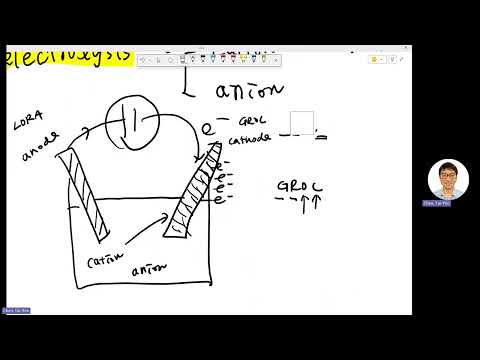
- In an electrolytic cell, reduction always occurs at the cathode and oxidation at the anode; the battery makes the cathode negative and the anode positive.
- Aqueous electrolysis requires comparing water’s electrode potentials with those of dissolved ions; in the RbCl example, water reduction at about −0.83 V is favored over Rb⁺ reduction at about −2.98 V.
- Faraday’s law, m = ItM/(nF), converts current and time into deposited mass, with n determined by the balanced half-reaction and F approximately 9.6485 × 10^4 C/mol e⁻.
- Depositing 10 g of iron from Fe³⁺ requires three electrons per iron atom and about 5.19 × 10^4 C; 5 A for 1.5 hours deposits about 3.84 g of Mn from Mn⁴⁺.
- Research graduate programs may fund students through tuition support and stipends, but Chen emphasizes that a PhD is most appropriate for students whose goals involve research or advanced study.
- Graduate applications are stronger when purpose statements show specific faculty fit and recommendation letters include detailed examples from professors who know the applicant.
Chapters
- Chen previews finishing the electrochemistry material and moving into the next chapter if time permits.
- The remaining schedule includes a Monday content session and a Wednesday review with practice questions.
- The class is encouraged to use study time to prepare for the final.
- Use m = ItM/(nF) to calculate the mass of a substance deposited by electrolysis.
- Current multiplied by time gives charge in coulombs; dividing by Faraday’s constant converts charge to moles of electrons.
- Divide by n, the electrons required per mole of product, then multiply by the product’s molar mass; F is about 9.6485 × 10^4 C/mol e⁻.
- An external battery drives the nonspontaneous reaction in an electrolytic cell.
- The cathode is negative and attracts cations, where reduction occurs; the anode is positive and attracts anions, where oxidation occurs.
- Remember A/O and C/R: oxidation at the anode, reduction at the cathode, as in electrochemical cells.
- Molten NaCl contains Na⁺ and Cl⁻, with no water present as a competing reactant.
- At the cathode, Na⁺ gains an electron to form Na metal.
- At the anode, chloride ions lose electrons and form Cl₂ gas.
- For a mixture of molten salts, identify the cations that could be reduced at the cathode and the anions that could be oxidized at the anode.
- Compare the relevant standard potentials: the cation with the more positive, or less negative, reduction potential is preferentially reduced.
- For oxidation candidates, compare oxidation potentials; the less negative oxidation potential indicates the more favorable oxidation under the stated comparison.
- In an aqueous solution, water must be included among the possible species reacting at either electrode.
- Compare water’s potential with the dissolved ions’ potentials to determine whether water or a solute forms the electrode product.
- This adds water as a competitor to the same potential-comparison method used for molten salts.
- At the cathode, compare Rb⁺ reduction, with E° about −2.98 V, against water reduction, about −0.83 V.
- Water is more readily reduced than Rb⁺, so hydrogen forms at the cathode rather than rubidium metal.
- The example demonstrates why aqueous electrolysis cannot be predicted by considering dissolved ions alone.
- Molten LiBr separates into Li⁺ and Br⁻; Li⁺ is reduced to Li metal at the cathode.
- At the anode, Br⁻ is oxidized, and elemental bromine forms as Br₂ because bromine is diatomic in its elemental state.
- Track oxidation numbers from Br at −1 to Br₂ at 0 to confirm electron loss during oxidation.
- For the mixed molten-salt example, bromide is oxidized to Br₂ in preference to chloride, based on oxidation potentials of about −1.09 V and −1.36 V.
- The cation with the more favorable reduction potential is reduced; the example selects aluminum over lithium to form Al metal.
- The minimum applied voltage is about 2.75 V, found by combining the selected oxidation and reduction potential contributions.
- The target reaction is Fe³⁺ + 3e⁻ → Fe(s), so three moles of electrons are needed per mole of deposited iron.
- Use iron’s molar mass, 55.8 g/mol, and Faraday’s constant, 9.6485 × 10^4 C/mol e⁻, in m = Q M/(nF).
- Depositing 10 g of iron requires approximately 5.19 × 10^4 C of charge.
- A 5 A current applied for 1.5 hours runs for 5,400 seconds, giving the current-time input for Faraday’s law.
- The molten manganese salt supplies Mn⁴⁺, which requires four electrons to form Mn(s); manganese’s molar mass is 54.9 g/mol.
- Substituting the values into m = ItM/(nF) gives about 3.84 g of manganese.
- Chen explains that research-focused graduate programs may provide tuition support, cover fees, and pay a stipend in exchange for research work.
- He presents graduate study as one possible path after a bachelor’s degree, not a requirement for every student.
- He frames his own motivation for a PhD around conducting research, learning more, and pursuing a career as a professor.
- Chen describes research as identifying questions, searching existing knowledge, and designing experiments to test possible explanations.
- A PhD project provides practice in evaluating evidence and reasoning about what may happen next.
- He argues that these methods can build confidence when handling uncertainty in everyday life as well as research.
- Chen lists four core application components: a clear purpose, an academic transcript, a CV, and three strong recommendation letters.
- Applicants should check each program’s minimum academic requirements; GPA matters, but perfection is not the stated standard.
- The application should help reviewers understand the applicant’s character, preparation, and fit, not merely present a list of grades.
- The purpose statement should introduce the applicant, explain academic preparation, and connect relevant experience to graduate study.
- Chen recommends naming specific faculty members, with roughly three potential faculty of interest, and explaining the fit.
- Research, teaching, or service experience can support the case for admission when tied to a clear reason for pursuing the program.
- A strong recommendation should offer concrete examples of a student’s character, thinking, and potential, rather than only report a course grade.
- Chen advises getting to know professors over time through conversations and office hours, even when there is no urgent question to ask.
- Avoid relying on a professor who barely knows you; give potential recommenders enough context and time to write a specific letter.
Transcript excerpt
3:01 Okay. So, >> okay. So, any questions before we get started? So next week and then we have to contact your computer. Okay. So yeah, we're all done. What we're going to do today actually trying to finish chapter 13 the section. Yeah. So we only talk about two nurses and a few example the first one. Okay. So basically you're trying to
3:50 cause some species in your solution for your so that you and the second one is actually so what it does is actually solution if you start with the nucleus solution then the multial solutions okay will undergo a redux reaction Okay. So the question actually you have to like okay to work with a product on your desk. Let's give an update. Okay. So very simple uh two remaining topic we want to go through uh for chapter 17. Okay. So the idea how much time we have we go to 18. Okay.
4:42 Yeah over all the things. Okay. So the the agenda for the remaining two days next week will be finishing everything on next Monday. Okay. I think on Wednesday we're going to have a quick review talking about the contents what are the things that can go through a few questions that actually okay yeah and actually okay and spend your time during your
5:33 sensation I don't know why is you you're going to spend some time do your study okay you want to come back then you want to take the three time finish then uh chapter 18 in content and prepare for the final okay so those are the agenda we're going to have um it's coming up pretty soon okay so um before heading every single points that we want to cover. Okay. So these are the two uh main topic we're going to cover today
This is the start of the transcript. Save this video free for the whole transcript, searchable and time-coded.
In this course
Related notes
Summary, takeaways, and chapters were generated by AI from the video's transcript and may contain errors. The video belongs to its creator, Tai-Yen Chen.