CHEM1312 20261102
Overview
Tai-Yen Chen introduces Chapter 17 electrochemistry by teaching oxidation-number rules and a stepwise half-reaction method for balancing redox equations in acidic and basic solutions. Worked examples include H₂S reacting with Cl₂ in acid and permanganate reacting with oxalate in base, producing a final balanced equation with coefficients 3, 4, 2, 6, 2, and 2.
Key takeaways
- The sum of oxidation numbers in a formula equals its net charge; this rule gives Mn as +7 in neutral KMnO₄ and carbon as +4 in CO₃²⁻.
- A redox reaction can be identified by comparing an element’s oxidation number across the reaction: an increase signals oxidation, while a decrease signals reduction.
- In acidic solution, H⁺ balances hydrogen and H₂O balances oxygen; in basic solution, H₂O balances hydrogen and two OH⁻ are used per missing oxygen.
- Balance redox half-reactions in a reliable order: the atom undergoing redox first, oxygen next, hydrogen last, and charge with electrons afterward.
- Before combining half-reactions, multiply them so the electrons lost and gained match; the acidic H₂S and Cl₂ example has two electrons on each side, while the basic permanganate and oxalate example requires a 3-to-2 multiplier.
- The balanced basic reaction 3C₂O₄²⁻ + 4OH⁻ + 2MnO₄⁻ → 6CO₃²⁻ + 2H₂O + 2MnO₂ has coefficient 4 for OH⁻ and conserves both atoms and charge.
Chapters
- Wednesday will have no in-person lecture; Tai-Yen Chen will upload a prerecorded lecture.
- The Midterm Two partial-credit assignment is due at midnight on the day of this class.
- Chapter 17 is the most calculation-heavy part of Midterm Three and receives the most class time.
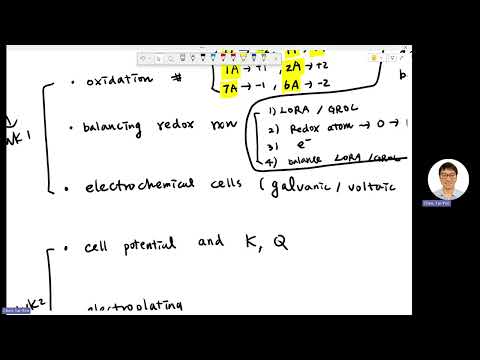
- The week’s priorities are assigning oxidation numbers, identifying redox reactions, balancing them, and calculating electrochemical-cell voltage.
- Later lessons connect cell voltage to equilibrium constant K and reaction quotient Q, echoing Chapter 16’s links between ΔG, K, and Q.
- Students will practice assigning oxidation numbers and using their changes to recognize oxidation and reduction.
- Redox balancing questions commonly ask for the coefficient of a specified species after balancing the equation.
- Electrochemical-cell lessons introduce battery composition and voltage calculations; Chapter 18’s atomic structure material is described as comparatively simple.
- An element in its uncombined elemental form has oxidation number 0, as in N₂ and O₂.
- A monoatomic ion’s oxidation number equals its charge, so Mg²⁺ is +2 and Cl⁻ is -1.
- Tai-Yen Chen recommends using the periodic table to assign common oxidation numbers rather than memorizing every case.
- For the common cases taught here, Group 1A elements are +1, Group 2A elements are +2, Group 6A elements are -2, and Group 7A elements are -1.
- In MgO, Mg is +2 and O is -2, so the oxidation numbers sum to the neutral compound’s total charge of 0.
- The sum of oxidation numbers across a formula equals its overall charge, providing an equation for finding an unknown atom’s value.
- KMnO₄ contains one K, one Mn, and four O atoms; its missing subscripts indicate one atom each.
- K is +1 and each O is -2, contributing -8 in total; because KMnO₄ is neutral, Mn must be +7.
- This calculation demonstrates how known periodic-group values and the formula’s total charge determine a transition metal’s oxidation number.
- Oxygen is usually -2, but each O in hydrogen peroxide, H₂O₂, is -1.
- Hydrogen is usually +1, but it is -1 in metal hydrides such as NaH and LiH.
- For CO₃²⁻, three oxygens contribute -6; the carbon must be +4 so the total equals the ion’s -2 charge.
- Reduction means gaining electrons and decreasing oxidation number; oxidation means losing electrons and increasing oxidation number.
- Oxidation and reduction occur together because electrons lost by one species are gained by another.
- Tai-Yen Chen uses “LEO RA” for losing electrons and oxidation, and “GER” for gaining electrons and reduction.
- Separate the reaction into oxidation and reduction half-reactions after identifying which atoms change oxidation number.
- Balance atoms before charge; in acid, use H⁺ to balance hydrogen and H₂O to balance oxygen.
- In base, use H₂O to balance hydrogen and two OH⁻ for each missing oxygen; then balance charge with electrons.
- Match the electrons released and accepted using a common multiple, add the half-reactions, and cancel identical species.
- The example asks for the H⁺ coefficient when balancing Cl₂ + H₂S → S + Cl⁻ in acidic solution.
- Cl₂ and elemental S each have oxidation number 0; H in H₂S is +1 and its S is -2, while Cl⁻ is -1.
- Sulfur changes from -2 to 0 and is oxidized; chlorine changes from 0 to -1 and is reduced.
- Write H₂S → S for oxidation and Cl₂ → Cl⁻ for reduction.
- Balance the atoms undergoing redox first, then oxygen, then hydrogen; add 2H⁺ to the sulfur half-reaction to balance its two hydrogen atoms.
- Balance chlorine by placing a coefficient of 2 before Cl⁻, then use electrons to balance the charge of each half-reaction.
- Each half-reaction transfers two electrons, so the electron counts match without additional multipliers.
- Add the half-reactions and cancel electrons to obtain H₂S + Cl₂ → S + 2H⁺ + 2Cl⁻.
- The requested coefficient of H⁺ is 2, and the resulting equation balances atoms and total charge.
- The second practice problem balances MnO₄⁻ + C₂O₄²⁻ → MnO₂ + CO₃²⁻ in basic solution and asks for the coefficient of hydrogen peroxide as transcribed, although the displayed equation contains no H₂O₂.
- Mn changes from +7 in MnO₄⁻ to +4 in MnO₂, so manganese is reduced.
- Carbon is +3 per atom in C₂O₄²⁻ and +4 in CO₃²⁻, so oxalate is oxidized; account for both carbon atoms when assigning the oxalate value.
- Balance carbon first: one C₂O₄²⁻ produces two CO₃²⁻, giving six oxygen atoms on the product side versus four on the reactant side.
- In basic solution, add two OH⁻ for each missing oxygen; a two-oxygen difference therefore requires four OH⁻.
- The added hydroxide also introduces hydrogen, so use H₂O to balance hydrogen rather than adding H⁺ in basic solution.
- After atom balancing, the oxalate half-reaction transfers two electrons and the permanganate half-reaction accepts three.
- Multiply the oxalate half-reaction by 3 and the permanganate half-reaction by 2 to match six electrons.
- Cancel shared electrons, water, and hydroxide species to obtain 3C₂O₄²⁻ + 4OH⁻ + 2MnO₄⁻ → 6CO₃²⁻ + 2H₂O + 2MnO₂.
- The final equation’s coefficients reduce to the lowest whole-number ratio, and the coefficient of OH⁻ is 4.
Transcript excerpt
2:02 Mhm. >> Mhm. so any questions before we get
4:07 started? No? So, I'll see you on midterm two. It's okay? I hope it's actually okay. Yeah, so and um a few things, okay, before we get started is first thing is actually on Wednesday we don't have an in-person lecture. Okay, I will upload a pre-recorded lecture for you to watch. Okay? And the second thing is actually for the midterm two partial credit assignment, you will be due midnight today, right? Yeah, so make sure you actually submit it if you feel like you you do have something that you want to actually get some partial credit. For the instruction, all right?
4:54 So, by now we actually already covered two-thirds of the things we want to cover for this semester. Okay, so let's actually only three more chapter to go. Okay, we already finished one, so two more chapter to go. Okay? So, in midterm three, the one that has the most calculation is chapter 17. Okay? And then here I actually summarized the things for the chapter 17. Those are the things that uh we need to memorize. Okay, of course I did not put every single equation yet, okay? So, we're actually heading to the week one. Okay? One of the big things for this week is
5:41 really to learn how to write the oxidation number of a atom within a formula. Okay, so that's actually one thing we're going to practice a lot today. The other thing we want to practice a lot is actually if I give you a chemical reaction, okay? Can you actually identify it is actually redox reaction. Can you actually balance the redox reaction? Okay, let's actually big part of this week. Okay, so probably some most important things that going to be really good at.
This is the start of the transcript. Save this video free for the whole transcript, searchable and time-coded.
In this course
Related notes
Summary, takeaways, and chapters were generated by AI from the video's transcript and may contain errors. The video belongs to its creator, Tai-Yen Chen.