CHEM 334 (F26, BFT, F261030) Ch. 20: Carboxylic Acid Derivatives
Overview
Dr. Eubanks organizes carboxylic acid derivatives by reactivity, from acid chlorides and anhydrides through carboxylic acids, esters, amides, and nitriles, then connects their structures to synthesis and reactions. Key examples include making acid chlorides with thionyl chloride and pyridine, converting salicylic acid to aspirin with acetic anhydride, and explaining why carboxylic acids have higher boiling points through hydrogen-bonded dimers.
Key takeaways
- The reactivity order presented is acid halides, anhydrides, carboxylic acids, esters, amides, then nitriles; more reactive derivatives are useful starting materials for making less reactive ones.
- Thionyl chloride converts carboxylic acids to acid chlorides, while pyridine captures the HCl byproduct as pyridinium chloride and sulfur dioxide is also produced.
- Acid chlorides react with excess Grignard reagent twice, so the resulting tertiary alcohol contains two identical groups from the Grignard reagent.
- Acetic anhydride transfers an acetyl group to the phenolic OH of salicylic acid, forming acetylsalicylic acid, or aspirin, while leaving the carboxylic acid intact.
- Carboxylic acids outrank other functional groups in naming, and their carboxyl carbon is numbered 1.
- Hydrogen-bonded carboxylic acid dimers help explain why acetic acid boils at about 118 °C, compared with ethanol at about 78 °C.
Chapters
- The chapter focuses on carbon centers with three bonds to heteroatoms, an oxidation state shared by carboxylic acid derivatives.
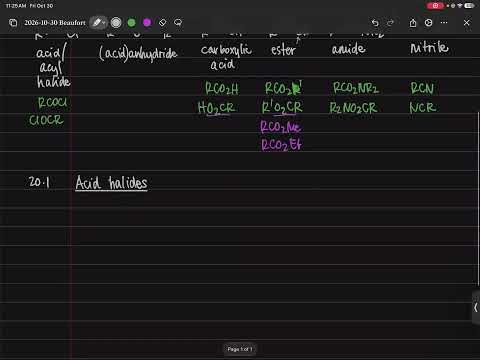
- The six groups are ranked from most to least reactive: acid halides, anhydrides, carboxylic acids, esters, amides, and nitriles.
- Nitriles are the structural outlier because they have a carbon-nitrogen triple bond rather than a carbonyl, but they share the same oxidation-state category.
- Carboxylic acids are commonly written RCO2H, while esters appear as RCO2R′; the order identifies which group is attached to the carbonyl carbon and which to oxygen.
- Examples such as RCO2Me and RCO2Et indicate methyl and ethyl esters.
- The amide shorthand RCONR2 and nitrile shorthand RCN preserve the connectivity needed to identify each functional group.
- Treating a carboxylic acid with thionyl chloride, SOCl2, converts it to an acid chloride.
- Pyridine acts as a base that captures hydrogen chloride, forming pyridinium chloride; sulfur dioxide is another byproduct.
- The resulting acid chloride is water-sensitive and hydrolyzes back to the carboxylic acid, so water can consume the reagent.
- Alcoholysis replaces the acid chloride’s chlorine with an alcohol-derived oxygen, producing an ester; pyridine captures the HCl byproduct.
- Aminolysis with ammonia produces an amide, with two ammonia equivalents: one serves as the nucleophile and one neutralizes HCl to form ammonium chloride.
- Excess Grignard reagent adds twice to an acid chloride, producing a tertiary alcohol with two identical incoming groups; one equivalent cannot stop the reaction after a single addition.
- An acid chloride reacts with a carboxylate salt, commonly the sodium or potassium salt, to form an acid anhydride.
- The carboxylate’s negatively charged oxygen attacks the acid chloride carbonyl carbon and replaces chloride, producing sodium chloride or the corresponding potassium salt.
- Using the deprotonated carboxylate rather than a neutral carboxylic acid provides the nucleophilic oxygen needed for the reaction.
- Anhydrides undergo alcoholysis to form esters and aminolysis to form amides; a tertiary amine cannot provide the N-H product described for this reaction.
- Acetic anhydride, abbreviated Ac2O, is a widely used reagent and can transfer an acetyl group, abbreviated Ac.
- Water hydrolyzes anhydrides into two carboxylic acid molecules; opening a bottle of acetic anhydride exposes it to moisture and creates acetic acid.
- Acetic anhydride acetylates the phenolic OH of salicylic acid while leaving its carboxylic acid group unchanged.
- The product is acetylsalicylic acid, abbreviated ASA and commonly known as aspirin.
- The example distinguishes the phenolic OH from the oxygen atoms in the carboxylic acid, which do not behave as an alcohol group.
- Carboxylic acids use the suffix -oic acid, and the carboxyl carbon is always carbon 1 and has highest functional-group priority.
- A four-carbon carboxylic acid is butanoic acid, also called butyric acid; the lecture relates its name to butter and notes its presence in butter and cheese.
- Formic acid is associated with ant stings, acetic acid is the two-carbon acid in vinegar, and benzoic acid is used in food preservatives such as sodium benzoate.
- Carboxylic acids form hydrogen-bonded dimers, with the carbonyl oxygen of one molecule interacting with the O-H hydrogen of another.
- These strong intermolecular attractions raise melting and boiling points compared with similar-sized molecules such as alcohols.
- Acetic acid boils at about 118 °C, higher than ethanol at about 78 °C, consistent with the greater intermolecular attraction.
Transcript excerpt
0:08 They got that. >> All right. Well, I guess everybody else is going to miss out on the laughy taffy game, but uh >> that's more >> that's what you get for not coming to class on Friday, huh? Okay, so um we're going to move on to chapter 20. Um, this is so it's only I only have three front and back pages of notes, so it's really kind of Yeah, but it's really dense. Um, [snorts] so it's a lot of reactions. Um, so we're going to cover we're going to cover the lecture part kind of fast and then we'll have a lot of practice doing because there's a lot of different reactions. Okay. So the we have the aldahhide and ketone
0:55 oxidation state of carbon where we have two bonds between carbon [snorts] and oxygen. And then the next oxidation state up is the caroxilic acid oxidation state where we've got three bonds between the carbon and oxygen. So this chapter is all about that sort of three bonds to oxygen oxidation state. Um but it's called caroxilic acid derivatives because the caroxyic acid itself is only one of six functional groups sort of in this little category. And so the general form for these derivatives with one exception is
1:48 this where we've got a carbonial with an R group, a carbon atom or potentially a hydrogen, but typically a carbon atom on the left hand side and then we've got Z. [snorts] And Z here has to be a hetereroatom. So something other than C or H because if Z was a carbon then we would have a ketone and if Z was a hydrogen we would have an aldahhide. All right. And [snorts] so another thing to note is that the carbonial in these
This is the start of the transcript. Save this video free for the whole transcript, searchable and time-coded.
In this course
Related notes
Summary, takeaways, and chapters were generated by AI from the video's transcript and may contain errors. The video belongs to its creator, Dr. Eubanks’ Chemistry.