CHEM 334 (F26, BFT, M260928) Lec. 16: Ch. 18: Electrophilic Aromatic Substitution
 Watch on YouTube →
Overview
Electrophilic aromatic substitution (EAS) replaces a hydrogen on benzene through three recurring steps: generate a strong electrophile, add it to the ring to form a resonance-stabilized arenium ion, and eliminate H⁺ to restore aromaticity. The lecture applies this sequence to halogenation and Friedel–Crafts alkylation, surveys sulfonation and nitration conditions, and shows how nitration followed by reduction produces aniline.
Key takeaways
- EAS is an overall substitution despite containing an addition step: electrophile addition temporarily breaks aromaticity, and deprotonation restores the aromatic ring.
- The arenium ion is the key intermediate in EAS: it is nonaromatic but resonance-stabilized, with the positive charge delocalized around the ring.
- Lewis acids such as FeBr₃ and AlCl₃ activate halogens or alkyl halides to generate electrophiles strong enough to attack benzene.
- Sulfonation is reversible: fuming sulfuric acid installs SO₃H, while dilute sulfuric acid can remove it.
- Benzene can be converted to aniline in three reagent stages: HNO₃/H₂SO₄ nitration, Zn/HCl reduction, and NaOH workup.
- In Friedel–Crafts alkylation, the carbocation carbon forms the new bond to the ring, and possible carbocation rearrangements must be considered.
Chapters
0:00
Why Benzene Undergoes Substitution Rather Than Bromine Addition
- Benzene does not generally react with Br₂ alone under ordinary conditions, unlike an alkene.
- With an iron catalyst, benzene replaces a ring hydrogen with bromine; the overall result is substitution, not addition.
- EAS involves electrophile generation, addition that temporarily breaks aromaticity, and elimination that restores it.
6:58
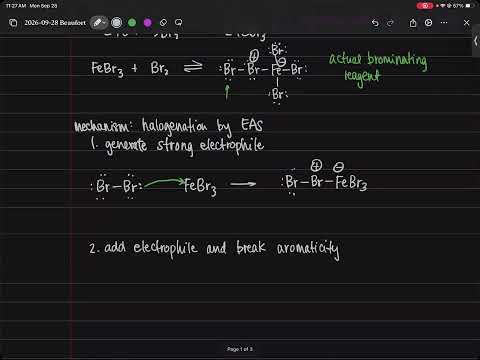
FeBr₃ Activates Br₂ to Create a Strong Brominating Electrophile
- Iron filings can react with bromine to generate FeBr₃; FeBr₃ can also be added directly as the catalyst.
- FeBr₃ coordinates with Br₂, polarizing the bromine and making one bromine strongly electrophilic.
- The catalyst’s role is to make electrophile generation powerful enough to overcome the stability of benzene’s aromatic system.
12:00
Benzene Attack Forms the Nonaromatic Arenium Ion
- A benzene π bond attacks the activated bromine, forming a carbon–bromine bond as the Br–Br bond breaks.
- The attacked ring carbon now bears both hydrogen and bromine, and the ring has a positively charged carbon elsewhere.
- The arenium ion is nonaromatic, but resonance delocalizes its positive charge across the ring.
16:57
Deprotonation Restores Aromaticity and Regenerates FeBr₃
- A base removes the hydrogen from the carbon that acquired bromine; electrons from the C–H bond form a new π bond.
- This elimination restores benzene’s aromaticity and produces bromobenzene.
- The reaction also forms HBr and regenerates FeBr₃, so the catalyst is not consumed overall.
20:21
Chlorination Uses AlCl₃ and the Same Three-Step EAS Mechanism
- For chlorination, Cl₂ reacts with AlCl₃ to generate an activated chlorine electrophile; FeCl₃ can also serve as the matching Lewis acid.
- Benzene attacks chlorine to form a nonaromatic arenium ion, then deprotonation restores aromaticity.
- The products are chlorobenzene and HCl, with AlCl₃ regenerated; the lecture notes that the described halogenation works for chlorine and bromine, not fluorine or iodine.
27:08
Five EAS Reaction Types Install Distinct Groups on Benzene
- Halogenation installs a halogen; sulfonation installs SO₃H; nitration installs NO₂.
- Friedel–Crafts alkylation adds an alkyl group, while Friedel–Crafts acylation installs a carbonyl-containing acyl group.
- All follow the EAS framework, though the lecture emphasizes halogenation and Friedel–Crafts mechanisms.
30:21
Fuming Sulfuric Acid Adds SO₃H; Dilute Acid Removes It
- Sulfonation uses fuming sulfuric acid: SO₃ dissolved in concentrated H₂SO₄.
- The sulfonation is reversible; dilute sulfuric acid can remove the sulfonate group.
- Because fuming sulfuric acid is strongly acidic and aggressive, acid-sensitive functional groups may not survive the reaction.
33:38
Nitration and Reduction Provide a Route from Benzene to Aniline
- Nitration uses concentrated HNO₃ in concentrated H₂SO₄ and proceeds through the nitronium ion electrophile.
- The nitro group can be reduced to an amine using Zn/HCl followed by NaOH; aminobenzene is called aniline.
- A synthesis from benzene to aniline therefore uses nitration first, then Zn/HCl, then NaOH.
39:53
Friedel–Crafts Alkylation Forms a Carbocation Before Ring Addition
- An alkyl halide and AlCl₃ generate a carbocation electrophile, which then bonds to benzene through the familiar arenium-ion pathway.
- The carbon bearing the positive charge is the carbon that attaches to the ring; counting carbons carefully helps avoid drawing the wrong alkyl substituent.
- Carbocations may rearrange if a more stable structure is available; rearrangements are previewed as the next topic.
Summary, takeaways, and chapters were generated by AI from the video's transcript and may contain errors. The video belongs to its creator, Dr. Eubanks’ Chemistry.