CHEM 334 (F26, BFT, W260930) Lec. 17: Ch. 18: Electrophilic Aromatic Substitution
 Watch on YouTube →
Overview
Dr. Eubanks explains how Friedel–Crafts alkylation can produce rearranged products when carbocations shift, and how acylation followed by Clemmensen reduction avoids that problem. The lecture then connects substituent electronics to electrophilic aromatic substitution: activating groups usually direct ortho/para, deactivating groups usually direct meta, and halogens are the key deactivating ortho/para exception.
Key takeaways
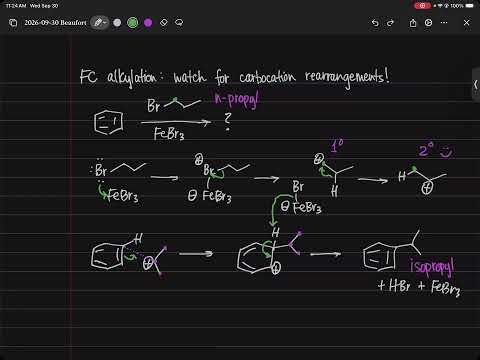
- Friedel–Crafts alkylation can rearrange because its carbocation intermediate seeks greater stability; a primary propyl carbocation can shift to a secondary carbocation and yield isopropylbenzene.
- Friedel–Crafts acylation avoids that rearrangement because the carbonyl-stabilized acylium ion remains intact; Clemmensen reduction then converts the installed acyl group into an alkyl group.
- Toluene nitration yields approximately 63% ortho, 3% meta, and 34% para products, demonstrating that methyl is an activating ortho/para director.
- A nitrile substituent directs nitration predominantly meta: the example gives 93% meta product, compared with 6% ortho and 1% para.
- Halogens deactivate benzene but direct EAS ortho/para, making them a notable exception to the typical meta-directing behavior of deactivating groups.
- For esters and amides, directing behavior depends on which atom is directly attached to the benzene ring: carbonyl attachment favors meta direction, while oxygen or nitrogen attachment favors ortho/para direction.
Chapters
0:00
Friedel–Crafts Alkylation: Carbocation Shifts Change the Product
- In Friedel–Crafts alkylation, AlBr₃ helps generate a carbocation electrophile from an alkyl bromide.
- A primary carbocation rearranges by a hydride shift to a more stable secondary carbocation before it bonds to benzene.
- The rearranged product is isopropylbenzene rather than the expected n-propylbenzene; tracking the carbon skeleton helps avoid drawing the wrong connectivity.
9:00
Friedel–Crafts Acylation Forms a Nonrearranging Acylium Ion
- Acylation uses an acyl chloride, typically with AlCl₃, instead of an alkyl halide.
- Breaking the acyl chloride C–Cl bond forms an acylium ion, whose positive charge is stabilized by the carbonyl group.
- Unlike an unstable carbocation, the acylium ion does not rearrange, so a three-carbon acyl group attaches to benzene without changing its carbon framework.
16:00
Clemmensen Reduction Converts an Acyl Group to an Alkyl Group
- The Clemmensen reduction uses zinc amalgam, Zn(Hg), concentrated HCl, and heat to replace a carbonyl oxygen with two hydrogens.
- This converts an aromatic acyl substituent into an alkyl substituent while preserving the carbon skeleton installed by acylation.
- Do not confuse Clemmensen conditions with the zinc/HCl reduction used for nitro groups in lab: mercury distinguishes the Clemmensen reagent.
19:00
Synthesize an Alkylbenzene Without Carbocation Rearrangement
- Direct Friedel–Crafts alkylation with a four-carbon alkyl halide can rearrange its carbocation and produce tert-butylbenzene instead of the intended straight-chain product.
- The workaround is a two-step sequence: Friedel–Crafts acylation with the carbonyl and chlorine on the same carbon, followed by Clemmensen reduction.
- The lecture presents the sequence in abbreviated form as acyl chloride/AlCl₃, then Zn(Hg)/HCl/heat.
26:00
Activating Groups Direct Nitration Ortho and Para
- An existing substituent—not the incoming group or the particular EAS reaction—determines where a new substituent is directed.
- A methyl group activates the benzene ring and directs nitration toward its ortho and para positions.
- Toluene nitration produces about 63% ortho-, 3% meta-, and 34% para-nitrotoluene; the higher ortho total reflects two ortho positions versus one para position.
35:00
Deactivating Groups Usually Direct Nitration Meta
- Electron-withdrawing substituents deactivate a benzene ring by reducing its reactivity, but do not necessarily prevent EAS.
- With a nitrile substituent, nitration gives about 6% ortho, 93% meta, and 1% para product, illustrating the usual meta-directing effect of deactivators.
- The lecture relates directing effects to arenium-ion resonance: ortho/para attack by activating groups has an especially favorable resonance structure.
40:00
Halogens Are Deactivating but Ortho/Para-Directing
- Halogens withdraw electron density and deactivate the ring, but they direct incoming EAS substituents to ortho and para positions.
- This makes halogens the principal exception to the rule that deactivating groups are meta directors.
- The course’s directing-group chart orders groups from strongly activating at the top to strongly deactivating at the bottom; hydrogen itself has no directing effect.
43:00
Read Ester and Amide Directing Effects by the Ring Attachment
- An ester attached through its carbonyl carbon places the carbonyl next to the benzene ring and acts as a meta director.
- An ester attached through oxygen is an ortho/para director because oxygen, rather than the carbonyl carbon, is directly bonded to the ring.
- Amides follow the same connectivity distinction: identify whether nitrogen or the carbonyl carbon is attached to benzene before predicting direction.
46:00
Preview: Predicting Products with Multiple Directing Groups
- The next topic is how to choose a substitution position when a benzene ring already has multiple directing groups.
- The ester examples establish a key first step: classify each substituent by its actual bond to the ring, not by the functional-group name alone.
Summary, takeaways, and chapters were generated by AI from the video's transcript and may contain errors. The video belongs to its creator, Dr. Eubanks’ Chemistry.