CHEM 334 (F26, BFT, M261026) Ch. 19: Aldehydes and Ketones
 Watch on YouTube →
Overview
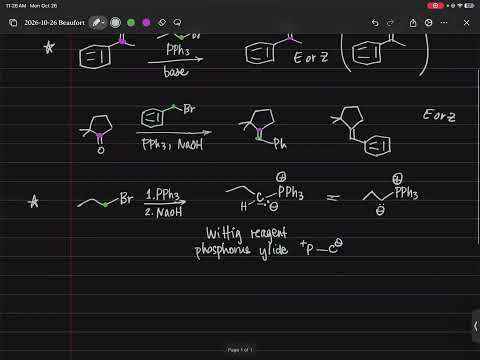
Dr. Eubanks explains how to predict Wittig reaction products and construct their mechanism, from forming a phosphorus ylide to producing an alkene and triphenylphosphine oxide through a four-membered intermediate. The lesson then covers Baeyer-Villiger oxidation: peroxy acids such as mCPBA insert an oxygen into ketones to form esters, expand cyclic ketones into lactones, and preferentially migrate the more substituted adjacent group.
Key takeaways
- A Wittig reaction forms an alkene between the carbonyl carbon and the former alkyl-halide carbon, preserving the total carbon count of the starting materials.
- The Wittig ylide is represented by a negatively charged carbon bonded to positively charged triphenylphosphorus; its reaction with a carbonyl proceeds through a four-membered oxaphosphetane and releases Ph3P=O.
- Wittig reactions may produce both E and Z alkenes for unsymmetrical substrates, so product geometry is not reliably selective in the examples discussed.
- Baeyer-Villiger oxidation uses a peroxy acid such as mCPBA to insert an oxygen into a ketone and produce an ester.
- A cyclic ketone becomes a lactone whose ring has one more member, because the inserted oxygen joins the original ring without removing any carbon atoms.
- Baeyer-Villiger regioselectivity favors migration of the more substituted adjacent group: tert-butyl migrates over methyl in methyl tert-butyl ketone, and phenyl migrates over methyl in the aryl example.
Chapters
- Preserve the total number of carbons from the starting ketone or aldehyde and the alkyl halide in the product.
- Form the new carbon-carbon double bond between the carbonyl carbon and the carbon that was attached to the alkyl halide.
- Remove the carbonyl oxygen and halogen; for an unsymmetrical alkene, the reaction may produce E and Z isomers without strong selectivity.
- For the example using a phenyl-containing alkyl halide, retain the phenyl group on the alkene carbon after replacing bromine.
- Treat the alkyl halide with triphenylphosphine followed by base to generate a phosphorus ylide with PPh3+ and a negatively charged carbon.
- The ylide carbon attacks the ketone carbonyl carbon, while the carbonyl oxygen forms a bond to phosphorus.
- These bond changes create a four-membered oxaphosphetane intermediate containing oxygen, phosphorus, and both alkene carbons.
- Collapse of the ring forms the carbon-carbon double bond and triphenylphosphine oxide, Ph3P=O.
- A peroxy acid has the general formula RCO3H and contains an oxygen-oxygen single bond; examples include peroxyacetic acid and mCPBA.
- Baeyer-Villiger oxidation applies to ketones and inserts an oxygen between the carbonyl carbon and one adjacent carbon group.
- The reaction converts a ketone into an ester, reaching the carboxylic acid oxidation state.
- Dr. Eubanks identifies the inserted oxygen as the peroxy acid oxygen next to the O-O bond.
- Oxidation of acetone with mCPBA inserts oxygen between its carbonyl carbon and one methyl group, producing methyl acetate.
- A cyclic ketone undergoes the same oxygen insertion to form a cyclic ester, known as a lactone.
- The oxygen becomes part of the ring, so a five-membered cyclopentanone-derived ring becomes a six-membered lactone ring.
- Count the original ring carbons plus the inserted oxygen to check that the product ring has expanded by exactly one member.
- In an unsymmetrical ketone, the group more likely to migrate ends up bonded to the newly inserted ester oxygen.
- The stated migratory preference favors more substituted groups, with tertiary groups over secondary groups and methyl groups.
- For methyl tert-butyl ketone, oxygen insertion on the tert-butyl side gives the major ester; insertion on the methyl side is not expected in a meaningful amount.
- When comparing two possible migrations, assess the substitution of the carbons directly adjacent to the carbonyl.
- For the aryl-versus-methyl ketone example, the phenyl group migrates, placing it on the ester oxygen side of the product.
- A four-membered cyclic ketone forms a five-membered ring after Baeyer-Villiger oxidation.
- In the unsymmetrical cyclic example, the oxygen inserts between the carbonyl carbon and the more substituted carbon bearing two methyl groups.
- Count the four original ring carbons plus the inserted oxygen to verify the five-membered lactone product.
Transcript excerpt
0:02 Okay. Um So, last time we kind of briefly introduced the Wittig reaction and we showed that you form a Wittig reagent first and then you do the actual Wittig reaction kind of like you do in the Grignard reaction. Um but let's look at these sort of higher level examples where we're not uh in this case, well, yet. We'll talk about the mechanism of one of them in a second, but um let's pretend we don't care about the mechanism or we're just trying to predict the products of these. Um so, one of the things to keep in mind is that the number of carbons that you start with has to be the same as the number of the car of carbons in the product. And then we're also going to end up forming a carbon-carbon double bond
0:50 between um forget exactly which colors I used for which one. Um between the carbonyl carbon of your aldehyde or ketone and the carbon attached to the alkyl halide of your starting material. Okay, that's all you have to do to predict the products for this. The triphenylphosphine and base don't really do anything except indicate to you that it's a Wittig reaction. So, there's our carbon skeleton for the ketone and we're going to keep the double bond. So, all you really have to do is erase the oxygen. And so, in its place is going to be
1:38 the green carbon which has attached to it two other carbons. Like that. Bromine is gone. And then there's the issue of cis-trans E and Z, right? Because I think the only example that I showed you last time Uh yeah, the example I showed you last time had a symmetrical ketone where it had two methyl groups. And in that case, when we went down to
This is the start of the transcript. Save this video free for the whole transcript, searchable and time-coded.
Related notes
Summary, takeaways, and chapters were generated by AI from the video's transcript and may contain errors. The video belongs to its creator, Dr. Eubanks’ Chemistry.